


The ochre-colored walls rise from the almost dry bed of the Ounila River as if they had grown from the earth itself. Aït Ben Haddou is a ksar — a fortified Berber village — built entirely of pisé, a mixture of clay, straw, and gravel that in this corner of pre-Saharan Morocco has withstood centuries of erosion from wind and rare but violent rains. Walking along the path that ascends to the summit tower means traversing layers of overlapping time, where every corner reveals a construction technique passed down from generation to generation.

The site is located about 30 kilometers northeast of Ouarzazate, along what was once the main caravan route between the Sahara and Marrakech. Spices, gold, salt, and slaves passed through here, and the families living in the ksar controlled the traffic from the shelter of their towers. Today, the village has been UNESCO World Heritage since 1987, a recognition that has helped preserve its structures but has also radically transformed the daily life of the place.
Architecture in rammed earth: how the ksar is built

What immediately strikes you, approaching on foot through the ford or the small bridge over the Ounila river, is the vertical density of the whole. The houses accumulate on top of each other climbing the hill, with the corner towers — called borj — decorated with geometric relief patterns that vary from family to family. These ornaments are not purely decorative: they indicate the social status and tribal identity of the owners.
The building material, rammed earth, has a fundamental characteristic: it requires constant maintenance. Every year, after the rains, the walls must be covered with a new layer of clay plaster. This explains why some sections of the ksar appear more intact than others: the parts still inhabited or recently restored show more saturated colors and smoother surfaces, while the abandoned areas show deep erosions that reveal the internal structure of raw bricks.

The connection with world cinema
Aït Ben Haddou owes part of its international fame to its film career. The ksar has served as a backdrop for productions such as Lawrence of Arabia (1962), Jesus of Nazareth, Gladiator, and more recently, the television series Game of Thrones, where it represented the slave city of Yunkai. Hollywood productions have brought money and infrastructure to the region, but they have also left visible traces: some structures built for film sets are still recognizable at the edges of the site.

This overlap between real history and cinematic fiction creates a disorienting effect during the visit. Tourists often seek out shots seen on screen, while local guides recount anecdotes about the sets and actors with the same ease with which they describe the centuries-old Berber history. It is not necessarily a flaw: it is simply the contemporary reality of a place that has managed to adapt.
What to observe during the visit
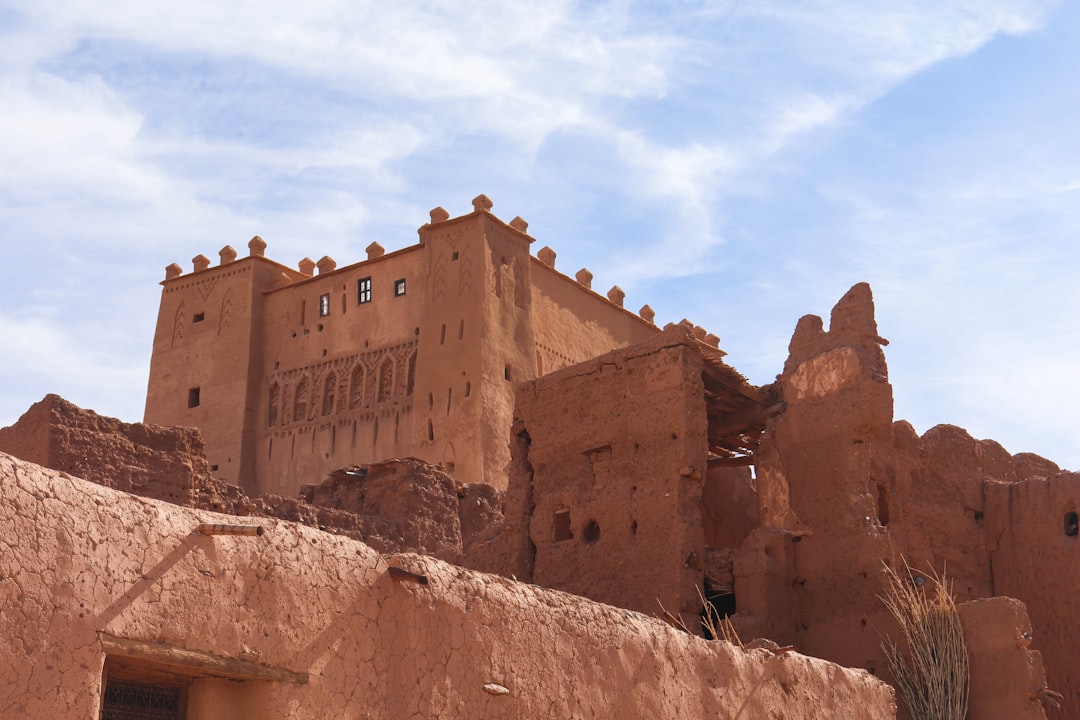
The main path ascends to the summit kasbah, the oldest and most imposing building of the ksar, which offers a panoramic view of the entire Ounila valley and the desert that begins to be glimpsed to the south. Along the ascent, one passes through narrow alleys, some homes open to the public where artisans work with leather or sell fabrics, and a small mosque whose earthen minaret is one of the most photographed architectural elements of the site.
Pay attention to the details of the carved wooden doors — often made of cedar — that contrast with the simplicity of the clay walls. Even the interior ceilings of the visitable homes show remarkably refined stucco work, demonstrating that the external austerity hides well-kept interiors.
Practical tips for the visit
The best time to visit Aït Ben Haddou is early in the morning, before 9:00 AM, when the slanting light enhances the contours of the towers and organized groups have not yet invaded the alleys. The complete visit, including the climb to the summit kasbah, takes about two hours. Entrance to the ksar is free, but some private homes that open as small museums or craft workshops require a voluntary contribution.
From Ouarzazate, the site can be reached in about 30-40 minutes by taxi or with a rental vehicle along the N9 road. Avoid visiting during the peak hours of July and August, when temperatures exceed 40 degrees and the clay surfaces radiate heat. Bring enough water and shoes with a non-slip sole: the path that climbs to the top is uneven and slippery in some sections.


