

At an altitude of 5,058 meters, where the air is so thin that every breath requires conscious effort, lies one of the most extraordinary scientific instruments ever built by humanity. The Atacama Large Millimeter/submillimeter Array, universally known as ALMA, is a collection of 66 parabolic antennas arranged on the Chajnantor plateau in the Atacama Desert, Chile. It is not a single telescope, but an interferometric system that combines the signals from all the antennas to simulate an instrument of enormous size, capable of observing the birth of stars and the formation of planets with a precision unattainable elsewhere.

The ALMA project is the result of an international collaboration between the European Southern Observatory (ESO), the National Radio Astronomy Observatory (NRAO) in North America, and the National Astronomical Observatory of Japan (NAOJ), with the contribution of the Chilean government. Construction began in the early 2000s, and the first scientific observations date back to 2011, while the official inauguration of the complete array took place in March 2013. The total cost of the project exceeded one billion dollars, making it one of the most expensive astronomical observatories ever built.
What to see during the guided tour

Visits to the ALMA site are free but strictly limited: they take place every Saturday and Sunday, departing from the Technical Support Center (AOS) located about 28 kilometers from San Pedro de Atacama. Groups are accompanied to the Operations Support Facility (OSF), at an altitude of about 2,900 meters, where it is possible to closely observe some of the 12-meter diameter antennas and the special vehicles — called ALMA Transporter — that move them across the plain with millimeter precision. These transporters weigh over 130 tons and move on air cushions.
Inside the OSF, visitors access the control room and the interactive museum, where panels and models explain how millimeter radio waves from galaxies billions of light-years away are captured, combined, and transformed into astronomical images. It is also possible to see the cryogenic receivers, cooled to temperatures close to absolute zero, which make the antennas sensitive to very weak signals.

The lunar landscape of Chajnantor
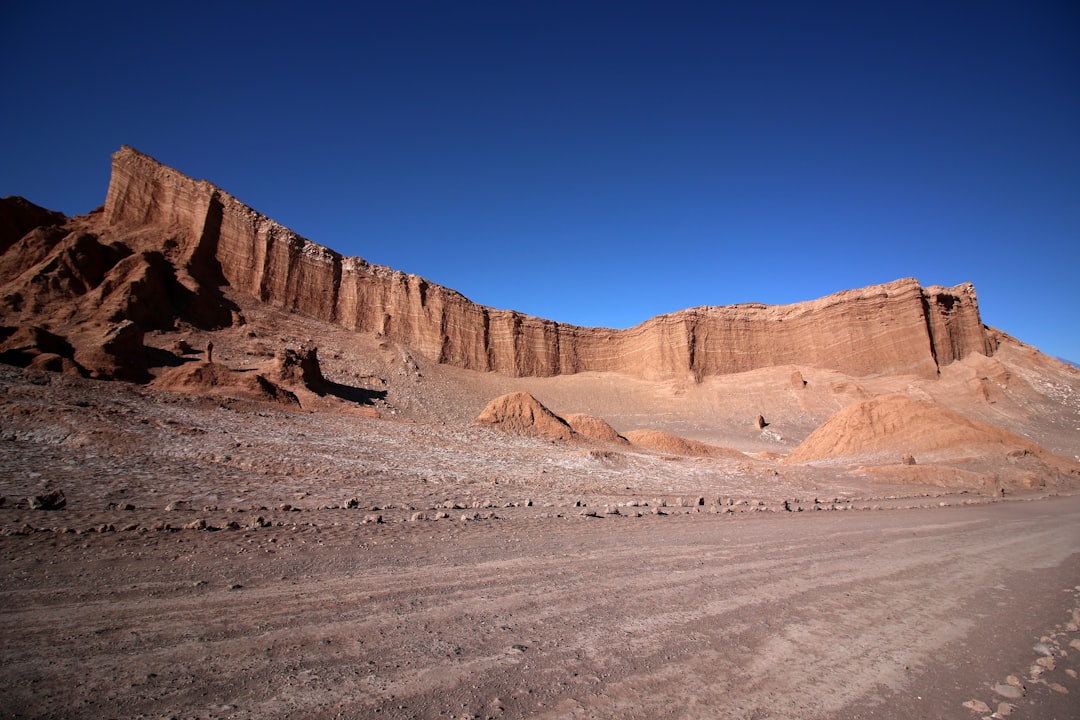
The Atacama Desert is the driest place on Earth outside polar regions, and the Chajnantor plateau — where the operational antennas are located — was chosen precisely for its exceptional atmospheric transparency. Humidity is almost nonexistent for most of the year, a condition essential for observing the millimeter and submillimeter wavelengths that ALMA studies. The landscape surrounding the antennas is barren, reddish, dotted with volcanic formations: in the distance rises the volcano Licancabur, which at 5,916 meters dominates the horizon.

During the visit, even while staying at the OSF at a lower altitude, the sky appears a deep and intense blue that is rarely seen at lower elevations. The clouds, when present, seem to float at eye level. This quality of the sky, combined with the geographical isolation, makes the site visually unique even for those without specific scientific interest.
How to Organize the Visit Practically

Reservations for Sunday and Saturday visits are made exclusively online through the official ALMA website (almaobservatory.org), with weeks or months in advance during the tourist season. Available spots are limited and fill up quickly, so it is essential to book as soon as you know the date of your trip to Chile. The visit is free and lasts about three hours.
It is essential to bring warm clothing even in summer, because at 2,900 meters the temperatures drop quickly in the afternoon. Those who suffer from altitude sickness should spend at least a full day in San Pedro de Atacama — which is located at 2,400 meters — before participating in the visit. The center of San Pedro is about an hour's drive from the site, and transfers are organized directly by the observatory with dedicated buses. Access with private vehicles to the operational antenna area is not allowed.
The meaning of looking back in time
What ALMA observes is not the present of the universe, but its distant past. The radio waves that the antennas collect have traveled for millions or billions of years before reaching the Chajnantor plateau. Some of the most famous images produced by ALMA show protoplanetary disks around young stars, revealing for the first time with extraordinary detail the mechanisms through which planetary systems form, including our solar system billions of years ago.
Standing in front of one of the white antennas, knowing that every day it points towards incredibly distant celestial objects to capture signals invisible to the human eye, produces a feeling that is hard to describe: it is not just aesthetic wonder, but the physical perception of how vast and ancient the universe that surrounds us is.


