
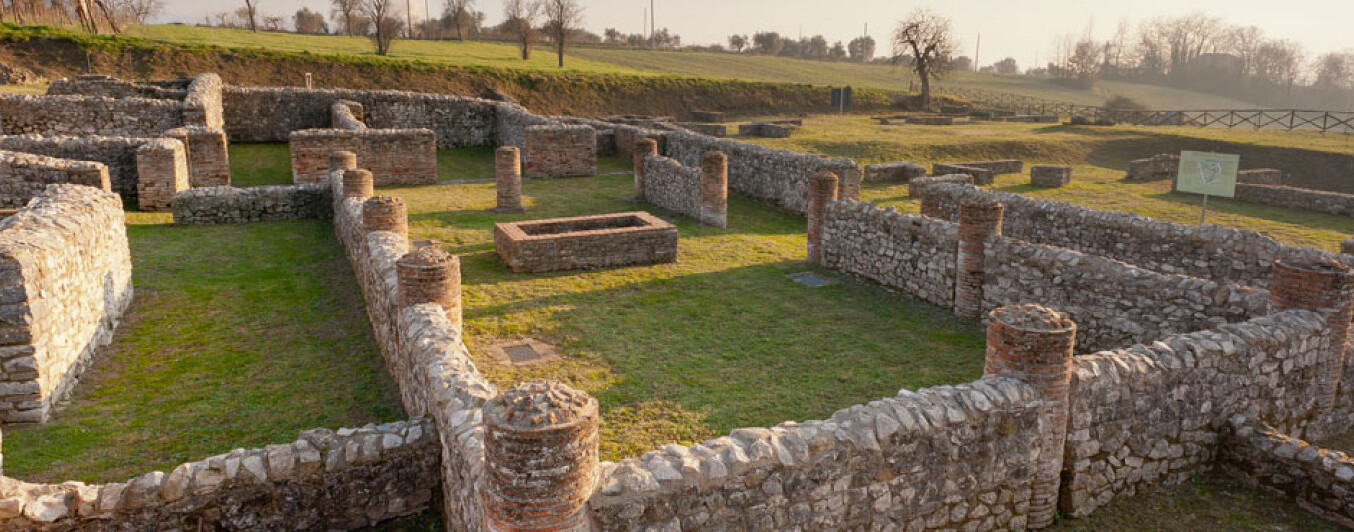

The remains of the ancient Roman colony of Abellinum, deduced in the Graccan age (end II century B.C.), and implanted on a previous Samnite settlement (IV-III century B.C.), the Oppidum Abellinatium, occupy the current plateau of the Civita, north-west of today's inhabited centre of Atripalda, on the left bank of the Sabato river, since ancient times a natural link between the Benevento and the Salerno area.
At the entrance of the Civita, in the northern part of the Civita, a part of the Roman wall circuit is still visible, made of opus reticulatum (latticework), with pyramid-shaped tufelli. At the edge of the moat, which surrounds the entire city walls, three rows of the Samnite fortification of the 3rd century B.C., made of opus quadratum (square work), with large blocks of yellow tuff, have been brought to light.
Inside the city walls, on the east side, there is the public area, with the baths and the forum, from which comes a circular marble altar, currently on display at the Irpino Museum in Avellino.
In the north-eastern area is visible a Hellenistic-Pompeian domus, presumably belonging to a Marcus Vipsanius Primigenius, freedman of Vipsanio Agrippa, son-in-law of Augustus.
The monumental complex has all the character of a rich patrician residence, not only for its size (approx. 2500 square meters of extension), but also for the particular refinement of the decorations of the various rooms and furnishings that have come to light. With the earthquake of 346 A.D. the living conditions of the ancient centre became difficult and with the Greek-Gothic war (535-555 A.D.) there was a gradual abandonment until the Longobard conquest, starting from the end of the VI century A.D..
Of the ancient Abellinum are known some sectors of the necropolis located along the major suburban roads: the most significant testimonies come from the locality Capo la Torre, where burials have been excavated dating from the Roman Imperial Age to the late antique period. In the same locality other burials have been identified along the perimeter walls of the crypt of the Collegiate Church of St. Hippolystus; according to tradition this place can be identified as the Specus Martyrum of the first Christian communities, who kept the remains and relics of the saints. In the crypt the sepulchres of the Levite Romulus and Sabinus bishop (6th century A.D.) are still preserved today.


