



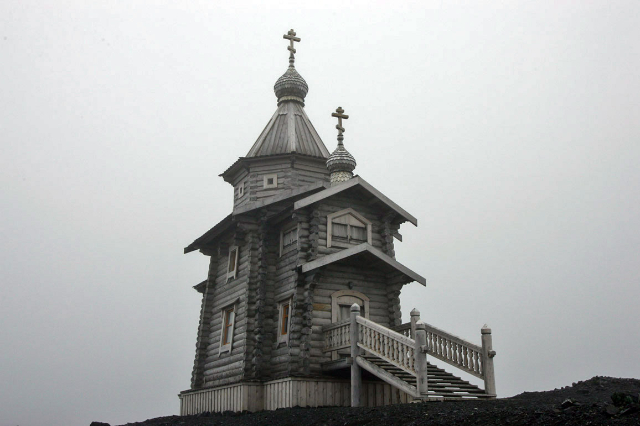
Perched on the stark, icy expanse of King George Island in Antarctica, the Holy Trinity Church stands as a testament to faith and resilience in one of the world's most unforgiving environments. This small yet striking Russian Orthodox church is not only the southernmost Eastern Orthodox church on the planet but also a symbol of spiritual endurance amidst the harsh Antarctic wilderness.
The origins of Holy Trinity Church date back to the late 1990s when the Russian Antarctic Expedition sought to establish a religious site on the continent. Officially consecrated in 2004, the church was built to serve the spiritual needs of the Russian research community stationed at the nearby Bellingshausen Station. Constructed by Siberian carpenters, the church was designed to echo the traditional wooden architecture of Russian Orthodox churches, with its construction materials transported over 15,000 kilometers from Russia.
Reflecting the rich heritage of Russian ecclesiastical architecture, the church's design features a timeless simplicity that pays homage to its roots. Crafted from Siberian pine, the structure is crowned with a single, elegant onion dome topped with a golden cross. Inside, the church houses several beautiful icons, some of which were painted by the renowned Russian artist Vladimir Zayichkin. These icons, depicting saints and scenes from the Bible, are framed by the warm glow of candlelight, creating a serene and contemplative atmosphere amidst the stark, white canvas of the Antarctic landscape.
While Antarctica is devoid of an indigenous culture or traditional gastronomy, the Holy Trinity Church holds a unique cultural significance for those who visit. The church hosts a full-time priest, who spends a year on the icy continent providing spiritual guidance and conducting services. The church becomes particularly poignant during significant religious holidays such as Easter and Christmas, when Russian scientists and international visitors gather to celebrate in this remote corner of the world.
Visitors to Holy Trinity Church might not find local culinary delights typical of more populated regions, but they may partake in traditional Russian foods brought by the expedition teams. These typically include borscht, pelmeni (dumplings), and kvass, a fermented beverage made from rye bread, providing warmth and sustenance in the cold climate.
Beyond its spiritual and architectural allure, Holy Trinity Church harbors a few lesser-known curiosities. For instance, it is one of the few structures in Antarctica equipped with a functioning bell tower, the tolling of which can be heard echoing through the polar silence. The church also serves as a center for ecological awareness and preservation, with its clergy often participating in environmental initiatives aimed at protecting the fragile Antarctic ecosystem.
For those intrigued by the idea of visiting Holy Trinity Church, the best time to plan a trip is during the Antarctic summer, from late November to early March, when temperatures are relatively milder and daylight is abundant. While visiting Antarctica requires careful planning and coordination with a recognized expedition, those who make the journey will find the experience to be profoundly rewarding. It's advisable to dress in layers, as the weather can be unpredictable, and to be prepared for limited amenities.
In a continent largely untouched by human hands, the Holy Trinity Church stands as a beacon of hope, spirituality, and community. Its presence underscores the universal human desire to find meaning and connection, even in the most isolated corners of our planet. For visitors, the church offers not just a glimpse into Russian Orthodox traditions but also a rare opportunity to reflect on the profound beauty and isolation of Antarctica.
