
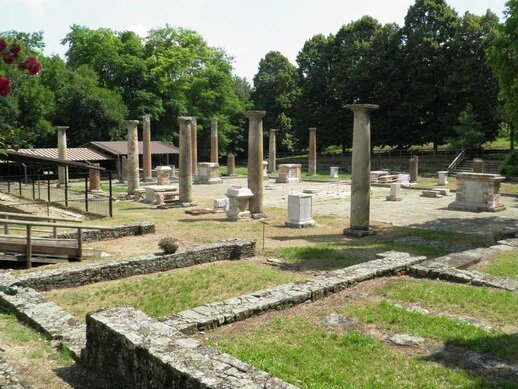

In the verdant hills of Lugagnano Val D'arda, lies the ancient site of the Archaeological excavations of Velleia, a treasure trove of history waiting to be uncovered. Founded in the 2nd century B.C. after the Roman conquest, Velleia emerged as a municipium, built atop the remnants of an indigenous Ligurian settlement. This unique positioning not only reflects the region's historical significance but also its strategic importance during the Roman expansion into northern Italy.
The town of Velleia developed on a series of sloping terraces, ingeniously designed to optimize space in a hilly landscape. The forum, a centerpiece of Roman civic life, was constructed on an artificially created shelf, showcasing the engineering prowess of the era. Under the auspices of Lucio Licinio Prisco, a notable local magistrate, the forum was paved during the time of Augustus, establishing a vibrant hub for trade and social interaction. Its grand portico, which enclosed shops and public spaces, still hints at the bustling life that once filled its streets.
The architectural style of Velleia is a fascinating amalgamation of Roman ingenuity and local aspects. The basilica, which formed the complex's closure on one side, once housed twelve magnificent marble statues from Luni, representing the Julio-Claudian family. Today, these statues are preserved in the National Archaeological Museum of Parma, bearing testimony to the town's cultural and political significance in ancient Roman society.
Local traditions in Lugagnano Val D'arda echo the region's rich history, with numerous festivals celebrating its cultural heritage. One such event is the Festa di San Giovanni, held in late June, where locals partake in vibrant processions and traditional music, reflecting a strong sense of community. This festival not only celebrates the patron saint but also serves as a reminder of the town's enduring ties to its past.
The gastronomy of Lugagnano Val D'arda offers a delightful taste of the region’s agricultural bounty. Visitors can savor local dishes such as tortelli di patate, a type of potato-filled pasta, often served with a rich meat sauce. Pair this with a glass of Gutturnio, a robust red wine that perfectly complements the hearty flavors of the local cuisine. These culinary delights provide a delicious glimpse into the lifestyle of the inhabitants, rooted in the land's rich agricultural traditions.
Among the many fascinating aspects of Velleia, one lesser-known curiosity is the Trajan's Tabula Alimentaria, a bronze inscription discovered in 1747. This remarkable find, which outlines a system of child welfare introduced by Emperor Trajan, highlights the social dynamics of the Roman Empire and its emphasis on community welfare. The inscription marked a significant turning point for Velleia, as it piqued the interest of the Duke of Parma, Don Filippo di Borbone, who began systematic excavations in 1760, further uncovering the town's hidden treasures.
For those planning a visit to the archaeological site, the best time to explore Velleia is during the spring or early autumn months when the weather is mild, and the surrounding countryside is in full bloom. It’s advisable to wear comfortable shoes, as the terrain can be uneven, and to take your time wandering through the site to fully appreciate the intricate details of the ruins. Don’t miss the Antiquarium, a recently rearranged museum that showcases significant artifacts from Velleia, providing context to the discoveries made during the excavations.
As you traverse the ancient pathways of Velleia, take a moment to reflect on the lives of those who walked here centuries ago. The echoes of their stories linger in the stones and the surrounding landscape, inviting you to imagine a time when the town thrived as a center of commerce and culture.
To enhance your visit, consider using the Secret World app, which can help you craft a personalized itinerary to explore the enchanting region of Lugagnano Val D'arda.


