
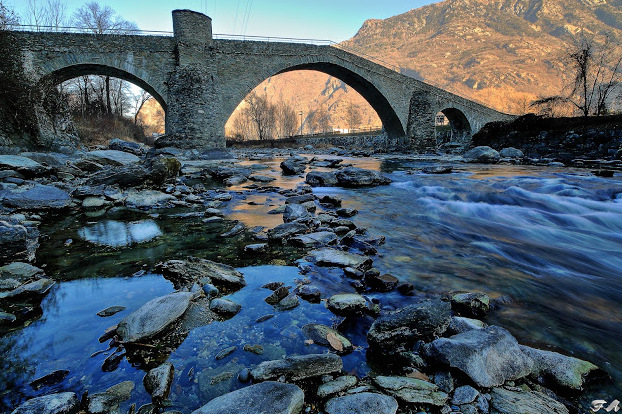

Nestled in the charming hamlet of Echallod in Arnad, the Echallod Bridge stands as a testament to both the engineering prowess and the aesthetic sensibilities of 18th-century Italy. Spanning the rushing waters of the Dora Baltea, this stone bridge is not just a means of crossing but a journey through time, history, and culture.
Constructed between 1770 and 1776, the Echallod Bridge was part of a significant infrastructure project along the Via Francigena, a medieval pilgrimage route linking Canterbury to Rome. This route was a crucial artery of commerce and culture, and the bridge served as a vital connector. The decision to build this bridge was driven by the necessity for safer, more reliable passage over the daunting alpine river, which had long posed a challenge to travelers. Its construction is a remarkable feat of engineering, achieved with the limited resources and technology of the time.
The bridge's architectural style is evocative of Romanesque traditions, characterized by its robust, semi-circular arches and the use of stone and mortar. These three arches elegantly stretch over the river, harmonizing with the rugged landscape of the Aosta Valley. The design reflects a careful balance of form and function, enhancing the bridge's durability while maintaining an aesthetic charm that has endured through centuries. The stone used in its construction was locally sourced, adding a regional authenticity to the structure and subtly blending with the surrounding environment.
Echallod and the wider region of Arnad hold deep cultural significance. The area is steeped in traditions that have been preserved over generations. Local festivals often focus on the Via Francigena, celebrating its historical importance with reenactments and events that bring history to life. These celebrations provide a window into the past, offering visitors a chance to experience the vibrant tapestry of local customs and communal spirit.
No visit to Arnad would be complete without indulging in its renowned gastronomy. The region is famous for its Lard d'Arnad, a Protected Designation of Origin (PDO) product. This unique delicacy is a testament to the area's rich culinary heritage, characterized by its delicate balance of flavors, achieved through a meticulous curing process involving aromatic mountain herbs and chestnut wood. Pairing this with the robust local wines, such as the rustic Donnas, offers a true taste of the valley’s terroir.
Beyond its architectural and cultural allure, the Echallod Bridge harbors intriguing stories that often escape the casual observer. One such tale speaks of the bridge as a refuge for fleeing pilgrims during turbulent times, where its arches provided a safe haven. Another curiosity is the ancient sundial etched into the stone near the bridge's entrance, a guiding tool for travelers in centuries past.
For those planning a visit, the best time to explore the Echallod Bridge is during the late spring or early autumn. The weather is mild, and the landscape is either bursting with flowers or ablaze with autumn colors, creating a picturesque backdrop for exploration. A walk across the bridge offers unparalleled views of the surrounding mountains, and it's worth taking a moment to pause midway to soak in the tranquil beauty of the Dora Baltea below.
To fully appreciate the bridge's history and craftsmanship, consider joining a guided tour offered by local historians, who can provide detailed insights and stories that enrich the experience. As you traverse this ancient structure, remember to look closely at the stonework, where centuries-old marks tell tales of the artisans who toiled to create this enduring monument.
The Echallod Bridge is more than a crossing over a river; it's a bridge to the past, a cultural landmark that invites travelers to pause and reflect on the enduring legacy of human ingenuity and tradition.


