
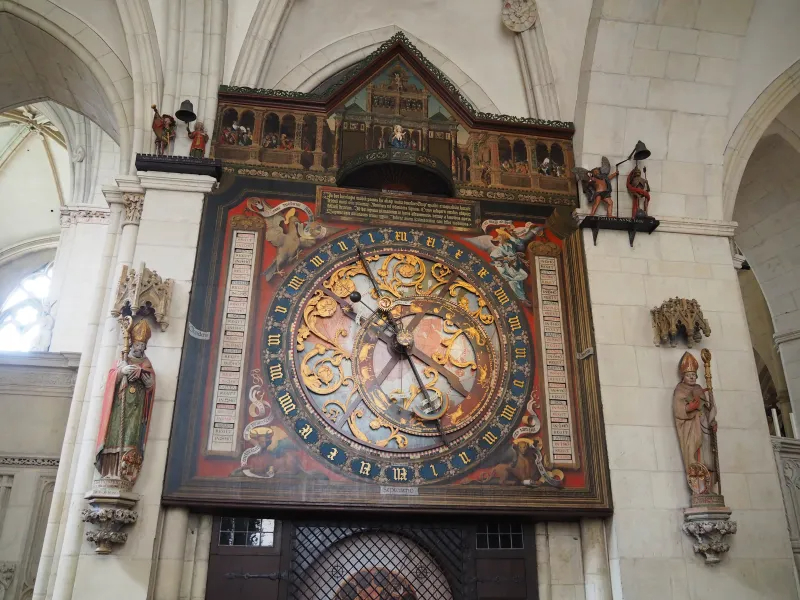

The most famous feature of Münster Cathedral’s interior is the magnificent astronomical clock, made in 1540-43. Not surprisingly for such a complex and beautiful machine, the clock was a team effort: printer Theodor Tzwyvel and Franciscan friar Johannes Aquensis made the astronomical calculations; wrought-iron craftsman Nikolaus Windemaker took care of the metalwork; Ludger tom Ring painted it in exquisite detail; and Johann Brabender probably sculpted the figures.
At the top of the clock are small, animated figures. On the right are Death and Time, who strike the quarters of the hour. Death holds the arrow of death in his left hand and a hammer in his right; Chronos has a sickle of destruction and turns his hour-glass at every stroke of the bell. On the left side are those responsible for striking the full hour. The Tütemännchen (“little blower”) sounds the hours on his horn while the woman at his side matches each note with a ring of the bell.
In the center are the enthroned Virgin and Child, who are adored by a procession of the Three Magi at noon every day, accompanied by a carillion of bells. The Magi are an appropriate choice for an astronomical clock, of course, since they followed a star to Bethlehem. Painted at the top are 16th-century observers, including the painter himself, Ludger tom Ring, wearing a black beret and red coat on the left side. The other figures are probably his sons and assistants.
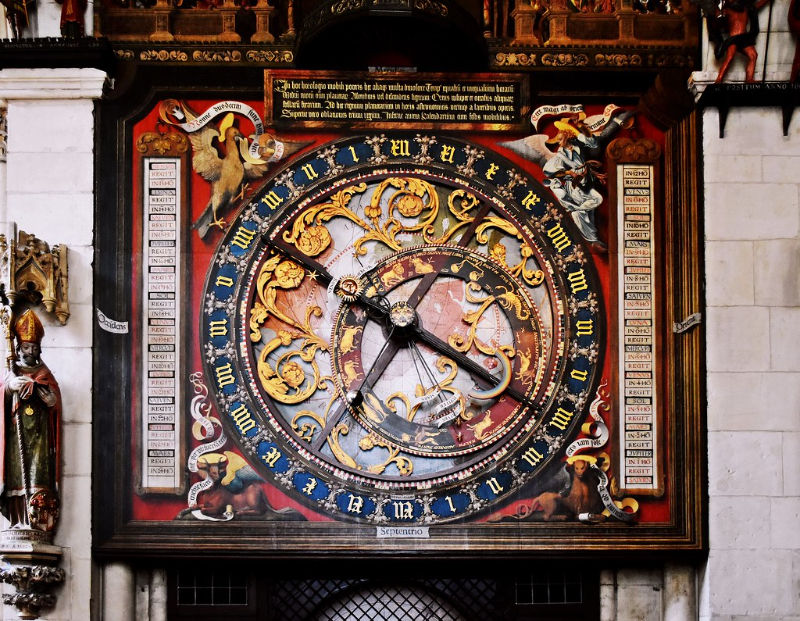
The beautifully painted clock face features the symbols of the Four Evangelists in the corners. Each holds a scroll with a Latin verse that mentions aspects of the clock while also representing four phases in the life of Christ. The scroll of the winged man (Matthew) reads: “Behold there came wise men from the east” (Incarnation); the winged ox (Luke): “There was a darkness over all the earth (Crucifixion); the winged lion (Mark): “They came unto the sepulchre at the rising of the sun (Resurrection); the eagle (John): “Are there not twelve hours in the day?” (Ascension).
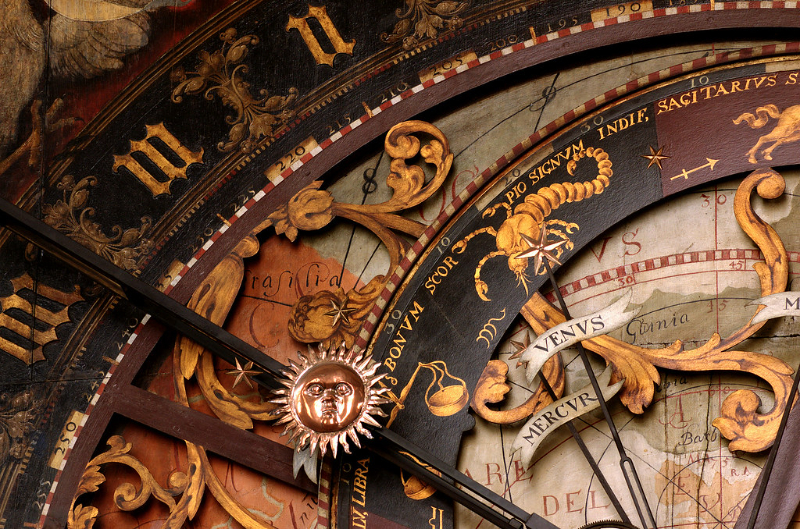
Unlike modern clocks, the Münster clock is divided into 24 hours, runs counterclockwise, and indicates hours and minutes simultaneously. Since the clock faces south, the hands thus follow the actual course of the sun. The main hand, decorated with a silver sun and a rainbow, indicates the time. Each red and white line within the circle of Roman numerals represents four minutes. Five minor hands indicate the position of the planets Jupiter, Mars, Venus, Saturn and Mercury, while a silver ball (half painted black) represents the moon in its phases.
Advertisements
REPORT THIS ADPRIVACY
Running vertically on either side of the clock are boards painted with the gods/planets that rule the day; these change at midnight. They ascend on the right and descend on the left and the ruler of the first hour (labeled IN 1 HO REGIT) is shown on the bottom right. This is the ruler of the day, after which the day is named. To learn what day it is, switch the Latin names and Roman gods for the Germanic ones:
The four points of the compass are written on banners at the edges: Septentrio (north); Oriens (east); Meridies (south); Occidens (west). Behind the clock faces is a map of the world.
Beneath the clock, a bit hard to see behind a wrought-iron fence, is the round calendar and Easter chart. Impressively, the years listed on the calendar are 1540 to 2071. In the center is a figure of St. Paul (c.1540); the current day is pointed out by a soldier with a rod on the lower left. The outer circle lists the days and the saints associated with them. The inner circle has twelve medallions painted with the Labors of the Months.


