
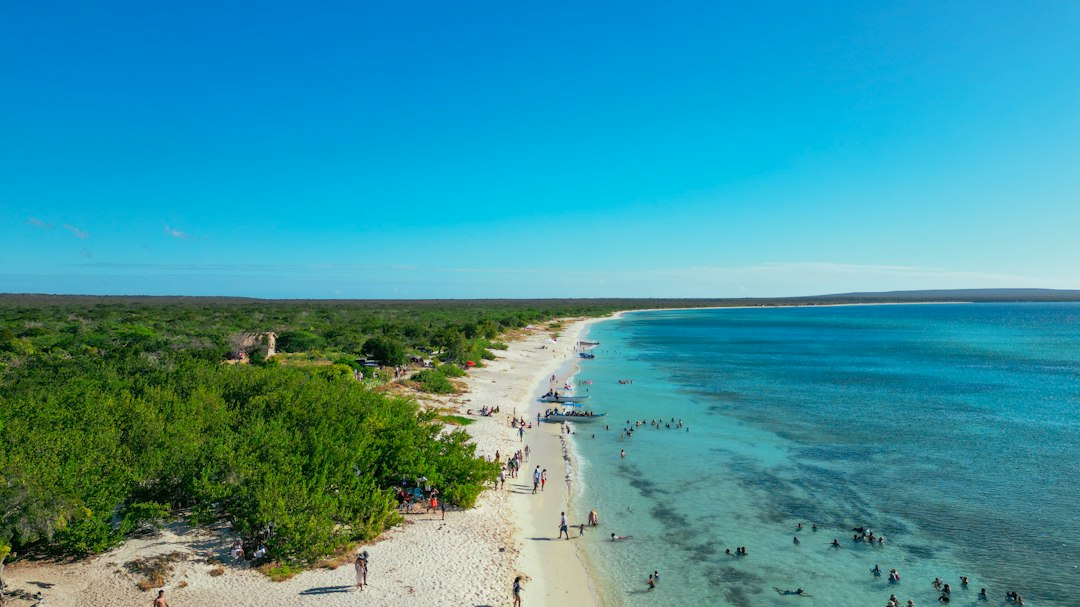

Eight kilometers of fine white sand stretch along the coast of Jaragua National Park, in the most remote part of the Dominican Republic: Bahia de Las Aguilas cannot be reached by car to the shore. To get there, one must board one of the small motorboats that depart from the Las Cuevas harbor, near Pedernales, and navigate for about twenty minutes through waters that change color from emerald green to deep turquoise as the seabed descends towards the coast.
What awaits at the end of the crossing is one of the most pristine beaches in the Caribbean: no hotels, no fixed kiosks, no permanent structures. Jaragua National Park, established in 1983 and covering over 1,600 square kilometers, represents the largest protected terrestrial and marine area in the Dominican Republic, ensuring that this condition remains unchanged. The sand is so fine it resembles flour, of a white that slightly shifts to cream under the afternoon light.
The colors of the water and the landscape
The first visual impact of Bahia de Las Aguilas is dominated by the chromatic contrast between the white of the sand, the green of the coastal tropical scrub vegetation, and the shimmering blue of the sea. In the central hours of the day, when the sun is high, the water near the shore takes on almost unreal turquoise hues, while moving away from the coast, the color gradually becomes darker, passing through shades of cobalt blue.
The seabed is shallow and sandy for the first few meters, which makes swimming safe and accessible. Further out, the presence of coral formations attracts a variety of tropical fish that can be easily observed even without professional diving equipment: just a mask and snorkel are enough to see species like parrotfish and various types of angelfish. The waters of the park are part of a marine reserve that also protects sea turtles, which at certain times of the year come to nest on the beach.
The sand and atmosphere of the beach
Walking eight kilometers along Bahia de Las Aguilas is a physically tangible experience: the beach is so long that both ends disappear from view, closed off by rocky promontories that drop directly into the sea. The sand, free of debris and crushed shells thanks to the absence of mass tourism, is compact enough to walk on without sinking excessively, yet remains soft underfoot.
The absence of permanent structures also means no amplified music, no persistent street vendors, no rows of umbrellas. Visitors bring what they need for the day. This condition creates an atmosphere of tranquility that is now hard to find on the more frequented Caribbean beaches. The trade winds, constant along this coast, mitigate the heat even during the hottest hours and keep the flags — when present on the boats — perpetually taut towards the west.
How to get there and practical advice
The logistical starting point is the city of Pedernales, the capital of the homonymous province, located in the far southwestern part of the Dominican Republic, on the border with Haiti. Pedernales is about a six-hour drive from Santo Domingo via the road that crosses Barahona and runs along Lake Enriquillo. From Pedernales, you can drive to the port of Las Cuevas, where local boatmen organize the crossings: the indicative cost for round-trip transportation ranges from 30 to 50 US dollars per person, depending on the season and the number of passengers.
The best time to visit Bahia de Las Aguilas is early in the morning, when the light is softer and the boats have not yet accumulated. It is essential to bring plenty of water, food, sunscreen, and everything needed for the day, as there are no stable supply points on the beach. Some local vendors reach the beach by boat with drinks and food, but this is not guaranteed. The dry season, from November to April, offers more stable weather conditions and generally calmer seas for the boat crossing.
What to expect and what to respect
Bahia de Las Aguilas is part of a strict environmental protection area. It is forbidden to collect corals, shells, or any natural element, and lighting fires on the beach is not allowed. Waste must be taken away: the integrity of the place directly depends on the behavior of those who visit it, and tourist pressure, although contained compared to other Caribbean destinations, has been increasing in recent years.
Those who arrive expecting services or comforts will be disappointed. Those who arrive knowing they will find sand, water, and silence will find exactly that. The distance to reach this beach — geographically and logistically — is an integral part of the experience: it naturally filters the type of visitor and keeps the place in a state that elsewhere in the Caribbean is now a memory.


