
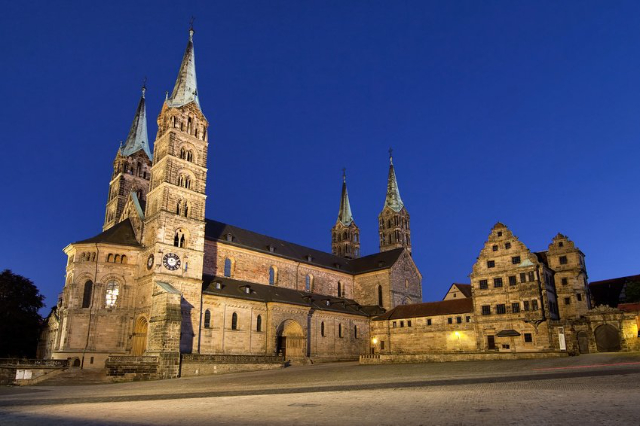

The imperial cathedral of St. Peter and St. George on the Domberg is one of Bamberg's cultural highlights. Located in the old town, the cathedral is one of the most important medieval buildings in Germany. Particularly striking are the four towers that enclose the opposite sanctuaries and tower over the city.
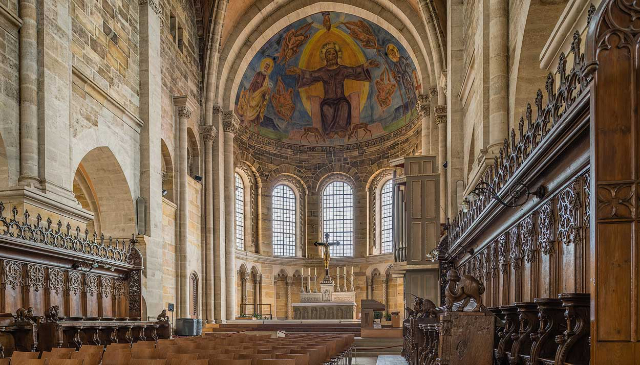
Due to several fires, the church cannot be assigned to any particular stylistic epoch. It was restored and rebuilt several times during the period from the late Romanesque to the early Gothic.
The three patrons of the cathedral are Pope Peter, Knight George and the Mother of God Mary. They are located at the Marian Gate and are said to represent the connection between the Roman and Byzantine churches. This is the main temple of Bamberg - the Cathedral, which is included in the UNESCO World Heritage List "City of Bamberg". The cathedral was founded in 1002 by King (and later Emperor) Heinrich II (Heinrich II). The cathedral was consecrated on Henry's 39th birthday on May 2, 6, 1012.

On April 3, 1081, on Holy Saturday, the cathedral burned down. The holy bishop, Otto I, who ruled Bamberg in 1102-1139, began a new construction of the cathedral, but already in 1185 there was a fire in the cathedral again.
In 1215, under Bishop Eckhart of the dynasty of the Counts of Andex-Meran, construction began on the third and new Romanesque-style cathedral, already with four towers, and not as before, only two in the east. Larger cathedral (current) it was consecrated on May 6, 1237.

Today the cathedral is an outstanding structure of Bamberg, has 4 towers and reflects the situation that existed in the German Empire at the beginning of the 13th century - the transition from the late Romanesque style (eastern part of the cathedral) to the early Gothic (western part of the cathedral). Different styles are especially pronounced in the features of the cathedral towers.
On the north-eastern tower there is a tower clock, which was originally the first mechanical clock and was used to divide the time for prayer and the working day. This watch was the most important chronometer of the city of Bamberg until 1954. Subsequently, the watch was replaced.
The length of the Bamberg Cathedral is approximately 99 meters; the width is 28 meters, 26 meters is the height of the central nave; each of the four towers is about 81 meters in height.
The cathedral will also be distinguished by four portals, two of which are located on the eastern side and two on the northern facade. The interior of Bamberg Cathedral transports the visitor into god's home in Germany. Although not as flamboyant or vertical as cathedrals in France, Bamberg Cathedral has crisp lines, double choirs (double the fun), and interesting interior sculpture that will lead the visitor to reminisce upon times of valor and holy austerity.
The nave of the cathedral is about 85 feet high with a quadripartite vaulting system. The arcade has a blocky feel, since the piers are not carved into many thin columns as with some of the French cathedrals. The minimal clerestory and unadorned triforium is more in a Romanesque style. The interior has such a refined and simple appearance partially because the re-builders wanted to try and preserve what Henry's original cathedral might have looked like, an act of respect towards the founders. On the ceiling of the nave, some highly-stereotyped and offensive paintings of Jews still remain. Once again, these images are reflective of how Jews were viewed in the city during the time. They were included inside the cathedral, but they were depicted in a negative way, perhaps as a reminder to the Christians of what the true religion was, and what would happen if one did not follow it. he eastern choir contains a series of 14 reliefs of prophets and apostles engaged in conversation. These sculptures were done by the earlier sculptural workshop, that was trained from the German Romanesque School, and we can see that they are less active than the portal sculptures, which were done by the masters from Reims, trained in the French Gothic. According to Egon Verheyen, these reliefs are still arranged according to their original positions, since they have the Romanesque style of decoration, which might have been inspired by the original shrine of Kunigunde from when she was canonized in 1201.


