


At dawn, when the fog slowly retreats from the valleys of Ifugao, the terraces of Banaue emerge like an impossible architecture carved into the living rock. The green steps overlap for hundreds of meters of elevation, reflecting the morning's slanting light in shades ranging from emerald green to golden yellow, depending on the rice season. This is not an abandoned monument: these terraces are still cultivated by the Ifugao communities, the very descendants of those who began to shape them over two thousand years ago.
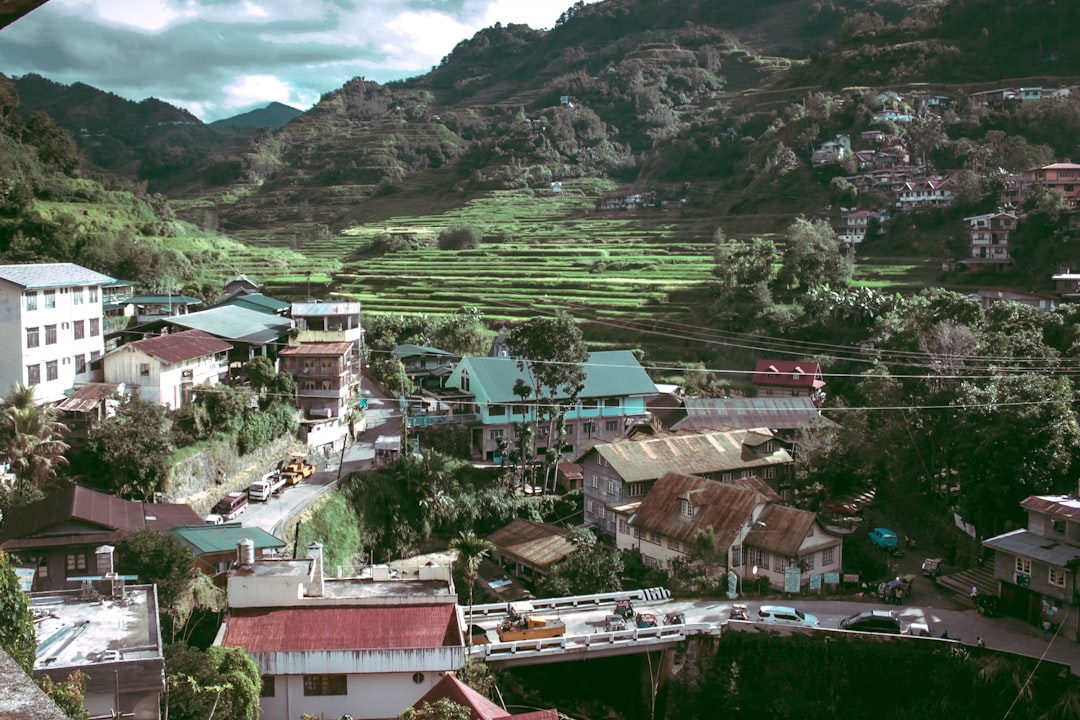
Recognized as a UNESCO World Heritage Site in 1995, the terraces of Banaue are located in the province of Ifugao, on the island of Luzon, about 300 kilometers north of Manila. They extend for thousands of hectares across several municipalities in the region, reaching altitudes that exceed 1,500 meters above sea level. The irrigation system that feeds them, entirely handmade with stone and bamboo channels, is considered by hydraulic engineers an extraordinary example of pre-colonial engineering.
The colors that change with the hours of the day

Observing the terraces of Banaue means witnessing a chromatic spectacle that is constantly transforming. In the early hours of the morning, when the light is still low and the fog occupies the deepest valleys, the landscape takes on cool, almost monochromatic tones: grays, milky whites, and dark greens blend into a composition reminiscent of an ancient engraving. The Ifugao farmers descend along the stone paths that cross the terraces, carrying tools on their shoulders, and their presence adds a human scale to a panorama that is otherwise difficult to measure.
By mid-morning, when the sun rises above the mountain ridges, the flooded fields transform into mirrors of water that multiply the sky. This phenomenon is particularly evident during the planting season, between November and May, when the terraces are flooded before the transplanting of seedlings. In the afternoon, the warm, lateral light brings out the three-dimensionality of the stone walls, built without mortar with locally sourced rock blocks precisely stacked. At sunset, the entire wall of terraces is tinged with orange and red, and the shadows cast by the walls create a geometric lattice that runs throughout the mountain.

The main viewpoint and how to reach it
The most frequented viewpoint is located just a few minutes' walk from the center of Banaue, along the main road that crosses the country. From here, one can embrace with a single glance a significant portion of the terraces on the eastern slope, with the village of Batad visible in the distance. The most useful advice for visitors is to arrive at this viewpoint by seven in the morning: the fog is still present in the valleys, the light is perfect for photography, and the groups of tourists arriving by bus from Manila are not yet present. Throughout the morning, the viewpoint quickly becomes crowded.

To reach Banaue from Manila, the most common solution is the night bus, with several companies operating the route and a journey of about eight to nine hours. Those who prefer a slower approach can stop in Baguio, the mountain city about four hours from the capital, and then continue the next day. There is no train station in the area, and the nearest airport with regular flights is in Manila.
The terraces of Batad: the most intact side

About twelve kilometers from Banaue, reachable by a local jeepney to a stopping point and then on foot for about an hour along a trail, are the terraces of Batad. This natural amphitheater of cultivated steps is considered by many visitors to be the most intact and spectacular view of the entire area, because the village of Batad has remained isolated for decades due to the absence of a drivable road. The terraces of Batad have a particularly recognizable semicircular shape, which visually distinguishes them from those visible from the main viewpoint in Banaue.
The walking path to reach Batad crosses ridges and woods, with side views of the terraces changing perspective at every turn of the trail. It is possible to stay overnight in the village in simple accommodations run by local families, which allows visitors to see the terraces at dawn without having to tackle the walk early in the morning. The Tappiyah waterfall, reachable with an additional half-hour walk from the village, offers a natural resting point during the visit.
What to observe up close: the stone walls and the channels
As you approach the terraces along the paths that cross them, you can observe the construction of the retaining walls with a clarity impossible to grasp from a distance. The stones, of varying sizes, have been selected and positioned without the use of cement or mortar, relying on their mutual weight to ensure stability. Some walls reach heights of several meters. The bamboo irrigation channels, visible at many points along the route, channel rainwater and spring water from top to bottom with a cascading system that feeds each individual terrace before descending to the next.
The Ifugao communities continue to perform rituals related to the agricultural cycle of rice, and at certain times of the year, it is possible to witness traditional ceremonies in the village. Visiting the terraces is free to access the main viewpoints, while some areas require a modest local fee, intended for the maintenance of the paths and support for the families that tend to the irrigation system.


