


The white light of the lighthouse cuts through the humid air at the mouth of the Rio Paraíba do Sul, where the freshwater of the river mixes with the salty waters of the Atlantic. This is the Farol de São João da Barra, one of the oldest lighthouses in Brazil, a colonial tower that stands silently among the wetlands of the Fluminense coastline, in the north of the state of Rio de Janeiro. It is not a place of passage: it is a destination in itself, capable of telling centuries of navigation, trade, and sea dangers with the mere strength of its architectural presence.

The lighthouse stands in a strategic position that the Portuguese navigators immediately understood: the mouth of the Paraíba do Sul was a critical point for the trade routes connecting the interior of the continent to the Atlantic ports. The original tower dates back to the colonial period, with interventions and restorations that have occurred over the centuries to keep this stone sentinel operational. Today, the complex houses the Museu Náutico da Bahia — a name that may cause some confusion among tourists, as the museum is physically located in São João da Barra and not in Bahia — collecting nautical instruments, historical documents, and artifacts related to river and coastal navigation in the region.
The tower and what can be seen up close
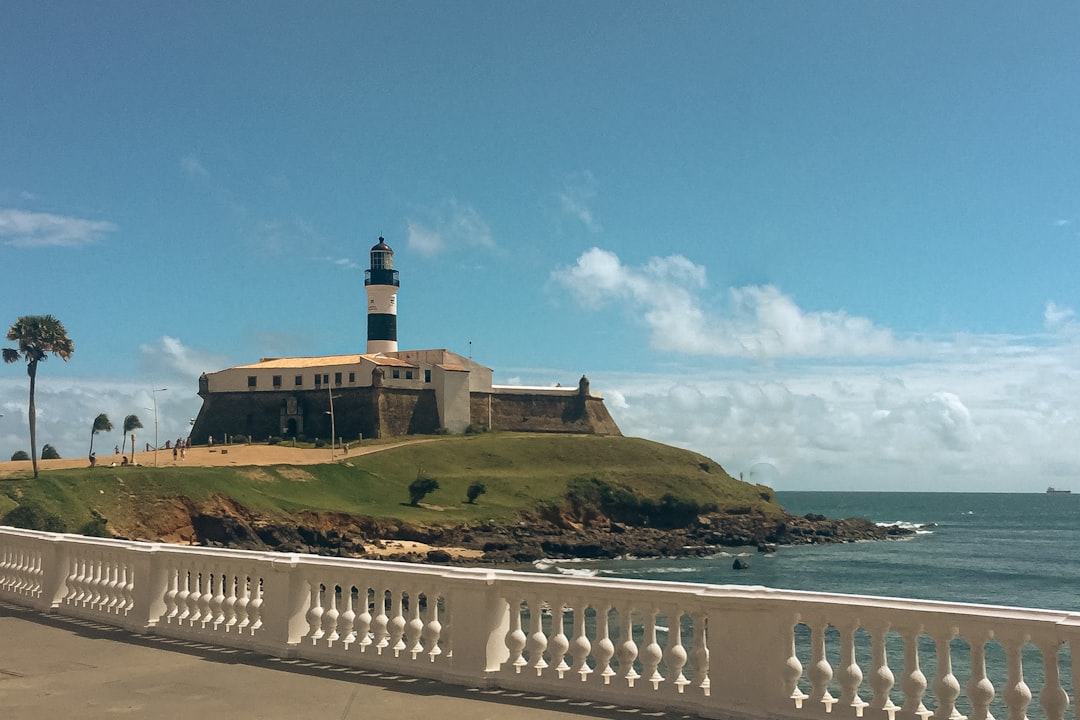
Approaching the lighthouse on foot, the first thing that strikes is the chromatic contrast: the white lime of the tower reflected in the still waters of the surrounding wetlands creates an almost pictorial effect, particularly evident in the early hours of the morning when the light is slanting and soft. The supporting structure is made of solid masonry, with a style that recalls the military and civil architecture of Portugal in the 18th and 19th centuries, characterized by sober proportions and the absence of superfluous ornaments.
Climbing the internal steps of the tower — narrow, made of stone, with the typical spiral of period lighthouses — one reaches the lantern, from which the gaze simultaneously embraces the river delta, the coastal plains, and the line of the marine horizon. It is one of those panoramas that immediately explain why the builders chose exactly that point: no vessel could pass without being seen. Inside the museum, among the exhibited objects, there are sextants, compasses, and original nautical charts that document the navigation techniques used along this coast for centuries.

The natural context: wetlands as a backdrop
What makes the Farol de São João da Barra different from most Brazilian lighthouses is the landscape that surrounds it. The restingas and the wetlands at the mouth of the Paraíba do Sul form a transitional ecosystem inhabited by herons, roseate spoonbills, and numerous species of migratory birds. Walking along the paths that line the lighthouse complex means immersing oneself in a still relatively intact natural environment, where wildlife coexists with human presence without excessive disturbances.

In the evening hours, when the heat of the day subsides, the atmosphere becomes particularly evocative: the reflection of the tower in the still waters of the marshes changes color with the sunset, shifting from orange to purple. Local fishermen return with their traditional boats, and the scene takes on an almost motionless quality, like a vintage photograph. Those who bring a camera — even just a smartphone — will find high-quality visual material here without having to search for particular angles: the place composes itself.
How to organize the visit

São João da Barra is located about 280 kilometers north of Rio de Janeiro, reachable by car via the BR-101 heading north to Campos dos Goytacazes, and then following local directions to the coast. Public transport exists but requires more transfers and significantly longer times, so the car remains the most practical solution for those coming from the state capital.
The best time to visit is early in the morning, preferably between 7:00 and 9:00: the light is ideal for photography, the heat is not yet oppressive, and the wetlands are more lively with local wildlife. Avoid weekends during peak season — December and January in particular — when the influx of Brazilian tourists from the Campos region can make the site more crowded than usual. A complete visit, including climbing the tower and visiting the museum, typically takes two hours. Always check the museum's opening hours directly with the facility before departing, as they may vary seasonally.
Why the trip is worth it
The Farol de São João da Barra is not a museum that one visits out of cultural obligation: it is a physically beautiful place, historically layered, and set in a natural landscape that amplifies the experience instead of reducing it to a simple visit to a building. The combination of colonial architecture, navigation history, and coastal nature is rare even by Brazilian standards, where historic lighthouses are often inaccessible or lack any museum structure.
Anyone traveling along the northern coast of Rio de Janeiro, perhaps heading towards Búzios or Espírito Santo, would do well to consider a detour to São João da Barra. It is not a mandatory stop on standard tourist circuits, and perhaps that is its greatest merit: the opportunity to stand in front of a white tower that has illuminated the sea for centuries without having to share the moment with too many other people.


