


About 110 kilometers west of Sydney, the Blue Mountains National Park extends over more than a million hectares of plateaus, canyons, and dense forests. The name is not poetic by chance: the light that spreads in the air, laden with volatile oils released by the eucalyptus trees, creates a characteristic blue veil visible even from the horizon. It is a real optical effect, produced by the scattering of sunlight on the particles of eucalyptus oil suspended in the atmosphere.

The park was declared World Heritage by UNESCO in 2000, along with other protected areas of the Gondwana Rainforests of Australia. It is not a formal distinction for its own sake: the territory is home to over 400 species of vertebrate animals and a flora of extraordinary variety, with plants that in many cases are not found elsewhere in the world. Those who arrive expecting a tidy and domesticated park are faced with something more raw and authentic.
The Three Sisters and the view from Echo Point

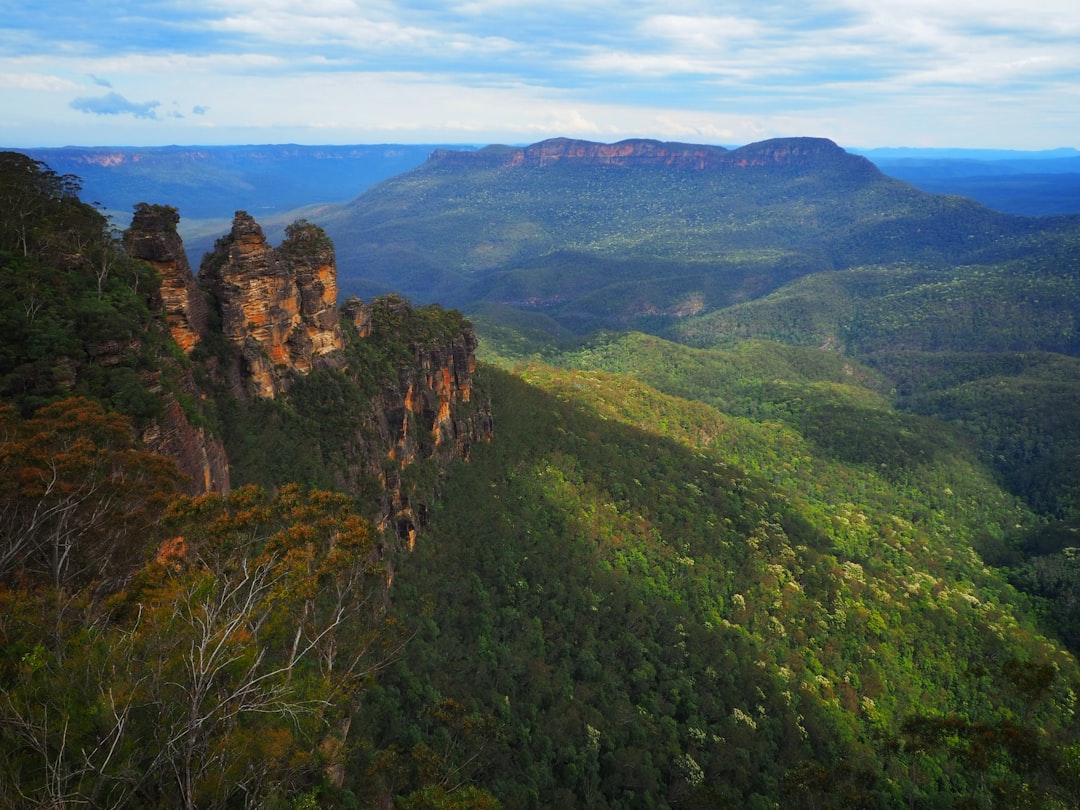
The most recognizable symbol of the park is the Three Sisters, three sandstone pinnacles that rise from the edge of the Jamison Valley, near the town of Katoomba. The formation is the result of millennia of erosion on sedimentary rocks deposited about 200 million years ago. The three spires reach approximately 922, 918, and 906 meters in altitude, and stand out distinctly from the surrounding vegetation.
The main observation point is Echo Point Lookout, accessible on foot from the center of Katoomba in about 15-20 minutes. From here, the view opens up to the valley and the eucalyptus forests that stretch to the horizon. At dawn and dusk, when the slanting light colors the sandstone walls orange and red, the landscape completely changes character. It is worth returning at different times of the day to capture these variations.

Biodiversity and Wildlife
Walking along the park trails means moving through different ecosystems in just a few kilometers. At higher altitudes, heathlands dominate, shrubby grasslands with flowering banksias and grevilleas. Descending towards the canyons, one enters humid forests of tree ferns, some of which exceed 10 meters in height, with trunks covered in mosses and lichens.
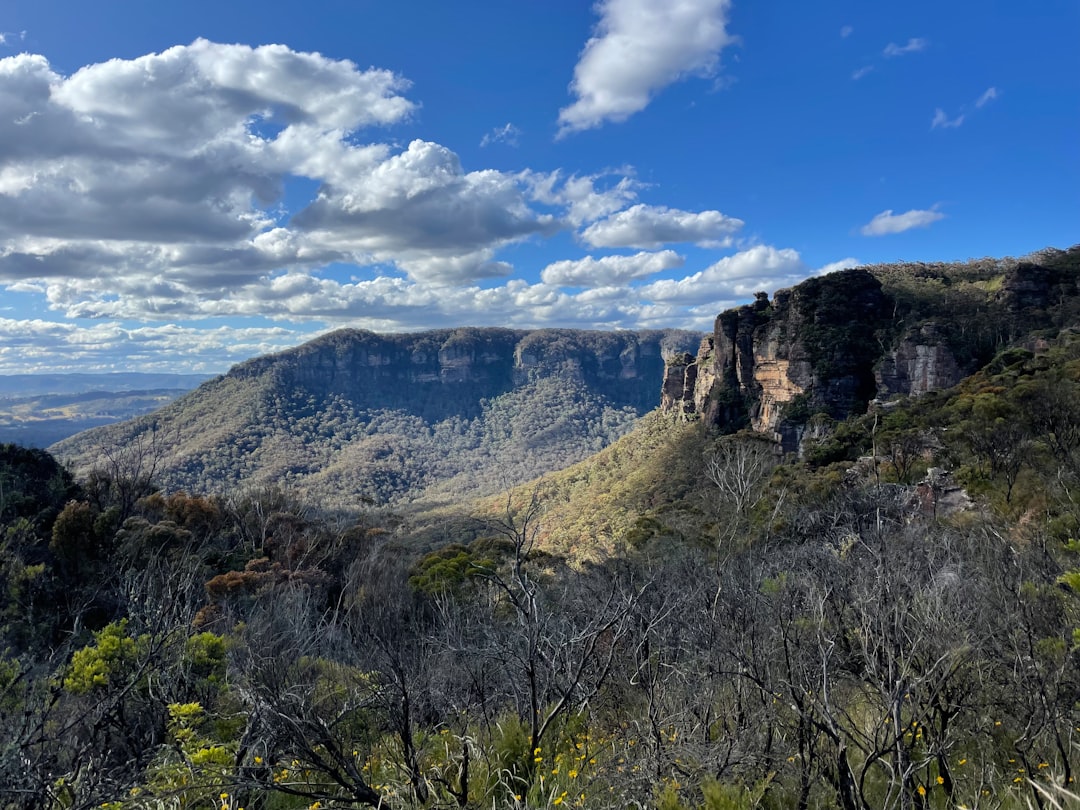
The wildlife is discreet but present. The red-necked wallabies (Macropus rufogriseus) are often spotted along the trails at dusk, while kookaburras emit their characteristic call — similar to laughter — from the early hours of the morning. Those who have patience and silence can observe the superb lyrebird (Menura novaehollandiae), a bird capable of mimicking dozens of different sounds, including those made by other animals and even chainsaws or cameras. It is one of the most surprising sound experiences in the entire park.
The trails: how to move around the park
The network of trails is well marked and varies in difficulty. The Prince Henry Cliff Walk connects Echo Point to Scenic World, running along the edge of the escarpment for about 6 kilometers, with continuous views of the valley below. It is a moderately difficult route, taking about 2-3 hours to complete. For those who want to descend into the valley, the Giant Stairway offers direct access through over 800 steps carved into the rock, with the vegetation gradually changing during the descent.
Scenic World, a private facility adjacent to the park, operates a historic funicular — the Scenic Railway, originally opened in 1945 as a mining transport — which descends with a maximum gradient of 52%, among the steepest in the world for a tourist railway. The ticket for the attractions at Scenic World costs around 40-45 Australian dollars for adults, but the national park itself is accessible for free.
Practical tips for the visit
The most convenient way to reach Katoomba from Sydney is by the Blue Mountains train line, which departs from Central Station and takes about 2 hours. Trains are frequent and the Katoomba station is just a few minutes' walk from Echo Point. Bringing a car is possible, but parking near the main lookouts fills up quickly on weekends.
The best time to visit is the Australian spring (September-November), when the temperature is mild and many plants are in bloom. In summer, the heat can be intense and the risk of bushfires is real — always check the NSW National Parks alerts before you leave. Bringing enough water is essential: the trails that descend into the valley are physically demanding and water fountains are not available everywhere. Hiking shoes with non-slip soles are recommended, especially after rain, when the sandstone rocks become slippery.


