



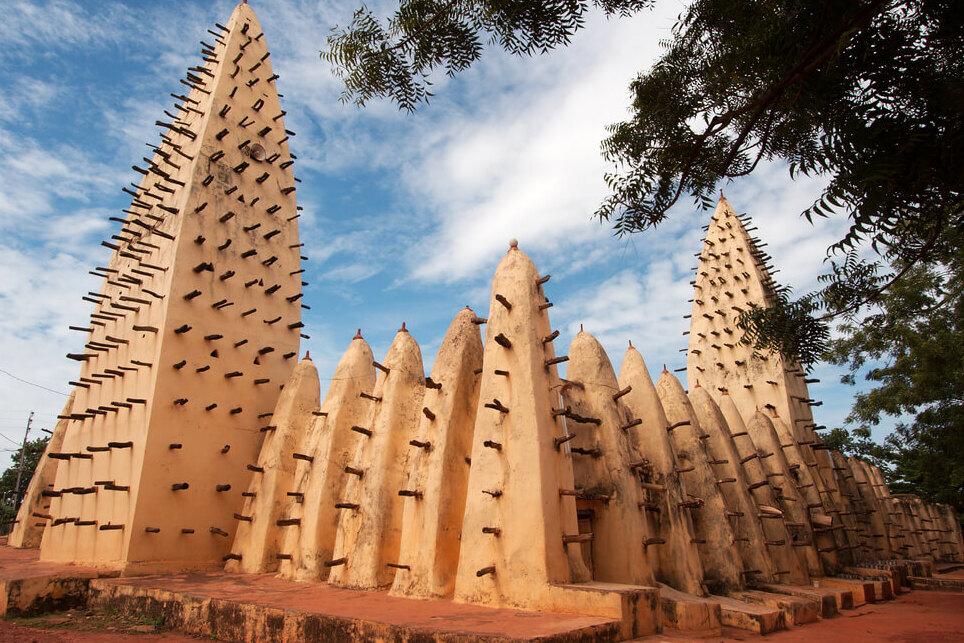
Bobo-Dioulasso was founded in the 15th century, originally under the name of Sya. In 1897 it was occupied by the French. The development of the city received a considerable boost from the construction of the railway linking Abidjan and Ouagadougou. It is the second largest city in Burkina Faso (about 600,000 inhabitants). It is located in the southwestern part of the country, in the province of Houet, about 300 km southwest of the capital Ouaga, on the road to Mali, overlooking the Houët River. The name of the city means "home of the Bobo people of the Dioula language"; the Bobo are in fact the most represented ethnic group in the region. Bobo-Dioulasso is nevertheless a multi-ethnic and multi-cultural city, mainly due to its historical role as a crossroads of the trans-Saharan trade routes. In fact, its real strength lies in its geographical position: close to Mali and Ivory Coast, with which it also shares the Dioula language (a strain of the Bambara language, widely spoken in central-western Africa), Bobo has always been an important crossroads and the meeting point of different ethnic groups that make it a very active and lively town from a cultural point of view. For example, Bobo has long hosted the National Culture Week and the Yeleen Festival, two of the most important and interesting artistic events in all of French-speaking Africa. Bobo's most characteristic building is the Grande Mosquée, an old animist temple converted to Islam. Built in 1880, it is an exquisite example of Sudanese mud architecture. It is said that a few years ago the municipality wanted to demolish it to build a new one, but the bulldozers were unable to scratch the solid bank walls. The interior is very suggestive, very reminiscent of a labyrinth and is characterized by a low ceiling and extreme simplicity in the details with mud walls, many columns and no type of decoration. The old quarters of Kibidwé and Sya are the oldest part of the city: you can admire the first house built in this city, attributed to the time of Sundiata (glorious Mandingo emperor who lived, apparently, at the time of Charlemagne) and the traditional two-storey houses (on the upper floor lives the woman with her children, on the ground floor lives the man). The Grand Marché in Bobo is one of the most beautiful and peculiar in West Africa, thanks to its size and its Sudanese architecture. Inside it is a real feverish hive, where you can find everything. Don't miss the covered butcher's shop: really impressive!
