
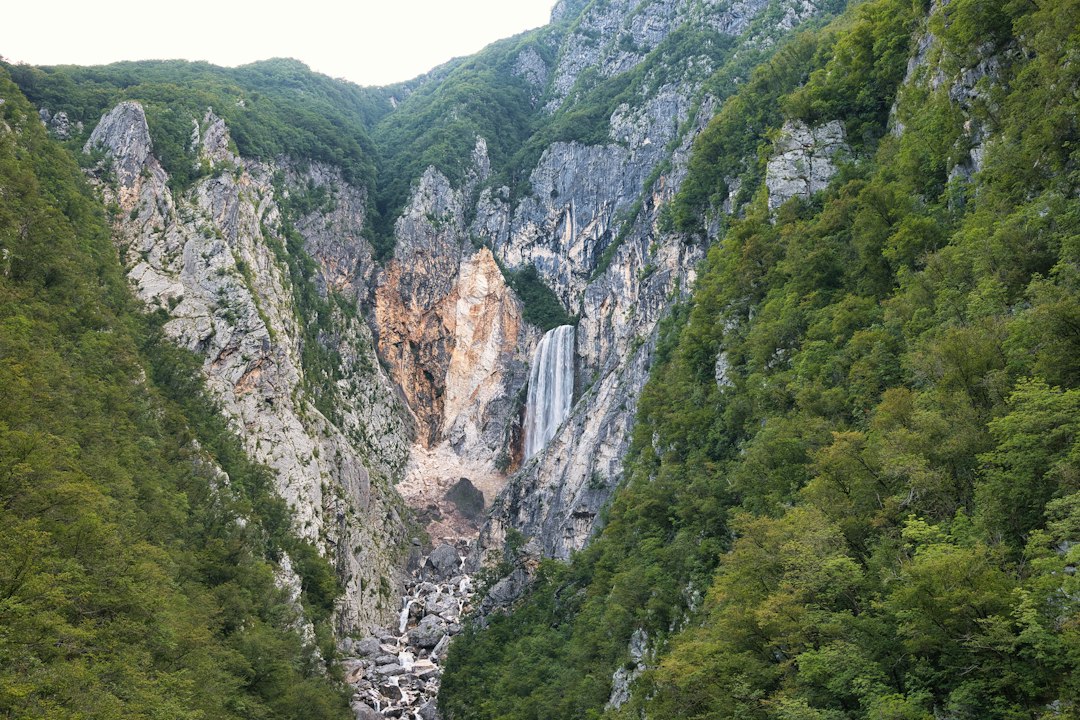

The noise arrives before the sight. Still hidden among the beeches and pines of the valley, the Boka waterfall announces itself with a dull roar that grows with every step along the path. When it finally appears, it is a visual and physical shock at the same time: a column of white water plunges down 106 meters from the rock face, fed by a hidden karst spring in the mountains of Triglav National Park, Slovenia. We are a few kilometers from Bovec, in the heart of the Soča Valley.
The Boka is considered one of the most powerful waterfalls in the Julian Alps, and in spring, when the melting snow feeds the underground spring, the water flow reaches extraordinary values. But even in summer, when many alpine waterfalls reduce to thin strands of water, the Boka maintains an impressive force thanks to the karst system that feeds it, independent of direct precipitation on the surface.
The path to the platform
The route leading to the waterfall starts from the main road connecting Bovec to the Predil Pass. A small marked parking area indicates the beginning of the trail, which climbs quite steeply through the woods for about 20-30 minutes of walking. It is not an easy walk: the ground is uneven, with roots and protruding rocks, and requires suitable shoes. The elevation gain is modest but constant.
The destination is a panoramic platform positioned directly in front of the waterfall, at close range. From here, one can observe not only the main drop of 106 meters but also a second lower drop that completes the water's journey towards the Boka stream, a tributary of the Soča River. The platform is literally enveloped in water mist: in a matter of seconds, clothes become damp, glasses fog up, and skin cools down. It is a total sensory experience, not just a simple observation from afar.
Sound, fog, and visual spectacle
Standing on the platform in front of the Boka means temporarily giving up conversation. The roar of the water hitting the rock is deafening, a continuous white noise that drowns out any other sound. The air is saturated with micro-droplets that form an iridescent halo on sunny days: with the right light, a small rainbow appears steadily in the mist rising from the point of impact.
The rocky wall from which the waterfall flows is vertical and dark, permanently wet. The contrast between the gray rock, the green vegetation growing at the edges, and the white of the water creates a visually striking composition. In autumn, when the surrounding beech trees turn orange and yellow, the landscape around the waterfall adds an additional chromatic level to the spectacle.
When to go and what to bring
The waterfall is accessible all year round, but the best times are spring (April-May) and autumn. In spring, the flow is at its maximum and the waterfall shows all its power; in autumn, the colors of the forest enrich the path. Summer is still valid, with water still abundant thanks to the karst spring. In winter, the trail can be slippery and dangerous due to ice.
Regardless of the season, it is essential to bring waterproof clothing: on the platform, you will inevitably get wet, even on days without rain. A waterproof windbreaker or a rain poncho is sufficient. Also protect your camera or smartphone with a waterproof case, as the water mist penetrates everywhere. Access to the waterfall is free and does not require a reservation.
How to get there and integrate it into the itinerary
Bovec is the logistical reference point for visiting the Boka waterfall. The town can be reached by car from Nova Gorica in about an hour and a half, or from Tolmin by following the scenic road along the Soča River. There is no direct bus connection to the waterfall parking lot, so a car is practically essential.
A visit to Boka easily integrates with other points in the Soča Valley: Lake Bohinj, the Soča Gorges near Bovec, and the picturesque Napoleonic Bridge in Kobarid are all reachable in the same day or over a weekend. Those arriving in Bovec for rafting or kayaking on the Soča can add the waterfall as a hiking excursion in the afternoon, dedicating a total of about two hours for the round trip, visit, and return to the parking lot.


