
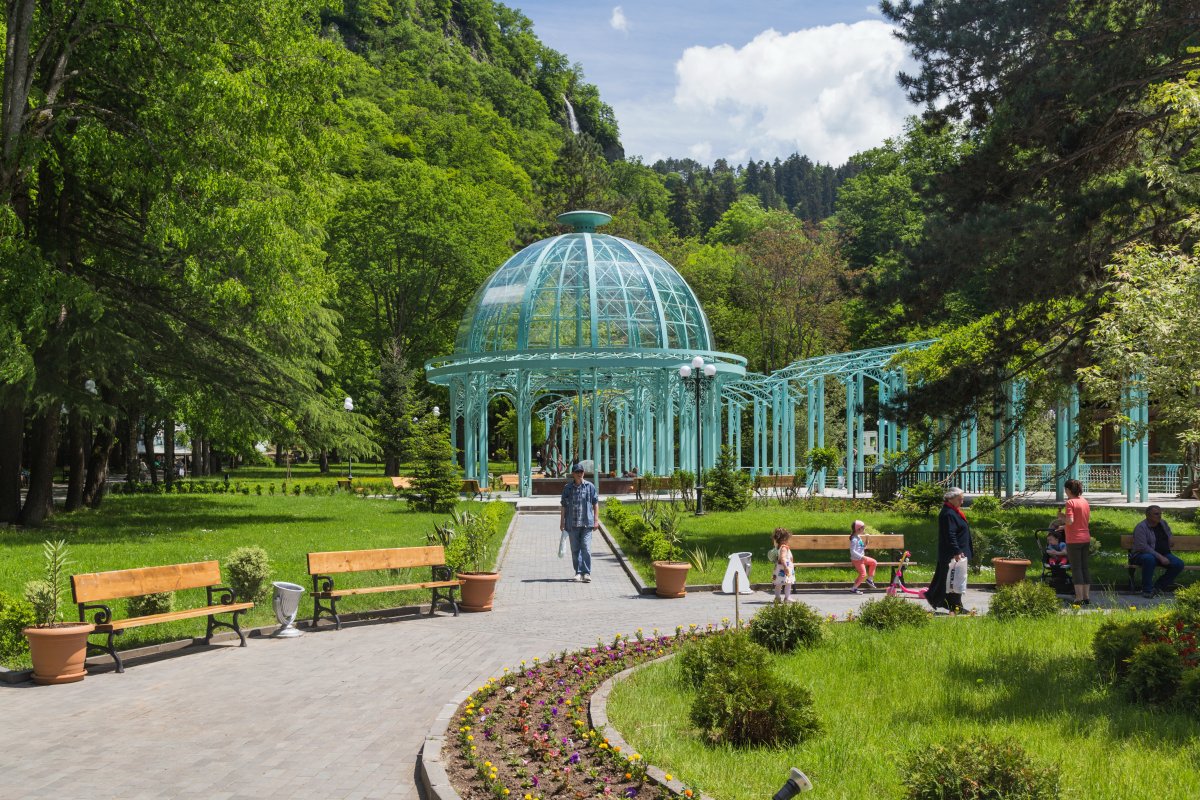

The water flows from the volcanic rock at a temperature of about 38 degrees Celsius and has a distinctive smell of sulfur and minerals. At the public fountain of Borjomi Central Park, anyone can approach with a cup and drink directly from the naturally carbonated mineral water that has made this Georgian city famous throughout the Caucasus. The taste is strong, metallic, with a slight spontaneous effervescence: nothing like bottled water, even though it is from these springs that the famous Borjomi mineral water originates, marketed internationally.

The park is located in the heart of the city of Borjomi, in the Samtskhe-Javakheti region, about 150 kilometers southwest of Tbilisi. The area is nestled in a narrow valley of the Mtkvari River, surrounded by coniferous forests that rise along the slopes of the Lesser Caucasus. The air is cool even in summer, the humidity is noticeable, and the constant sound of water — both from the river and the springs — accompanies every walk. The park was developed in the second half of the 19th century under Russian administration, when the Romanov family chose Borjomi as a summer resort, helping to transform it into a prominent spa destination.
The mineral springs and the outdoor hot tub
The most visited spot in the park is the outdoor hot tub, fed by the hot mineral waters that naturally spring from the ground. The water has a slightly yellowish tint due to the dissolved mineral content, and the temperature remains around 37-38 degrees year-round, making the bath comfortable even on cooler days. Visitors can immerse themselves in the tub by paying a modest entrance fee — generally a few Georgian lari — and stay submerged for as long as they prefer.
Next to the main tub are public fountains where cold mineral water, also naturally carbonated, is available for free. The difference between the two sources is immediately noticeable: the hot one has a more intense flavor and a richer chemical composition of sodium bicarbonate, while the cold one is more sparkling and refreshing. Locals come here regularly with bottles and containers to stock up on water.
The landscape of the park and the Caucasian forest
The Borjomi Central Park extends over several hectares along the banks of the Mtkvari and rises through paths in the woods towards the surrounding hills. The vegetation is dominated by pines, firs, and beeches, with dense underbrush and moss covering the rocks along the secondary waterways. In spring and autumn, the colors are particularly intense, but even in summer, the tree cover provides shade and coolness.
Within the park, there are some structures dating back to the Tsarist era, including a small carved wooden pavilion that recalls the architectural style typical of the spa resorts of the Russian 19th century. A cable car — operating during the tourist season — allows visitors to ascend the hill above the park for a panoramic view of the valley and the forests. The walking path along the river is flat and accessible, while the trails to the heights require a minimum of physical preparation.
The therapeutic experience and the historical context
The therapeutic reputation of the waters of Borjomi has been established for centuries. The properties of the mineral water — rich in bicarbonate, sodium, and natural carbon dioxide — have been studied and documented since the Russian imperial era in the 19th century. Traditionally, they were indicated for gastrointestinal disorders and as support for digestion, and even today many visitors from Georgia and neighboring countries come to Borjomi specifically for a spa treatment.
Dipping into the outdoor pool, surrounded by the forest and with the sound of the river in your ears, is an experience that hardly resembles that of a modern spa. There are no aesthetic treatments or ambient music: there is only the warm water, the steam rising in the cool air, and the tangible feeling of being in a place where the geology is still visible and palpable.
Practical tips for the visit
The best time to visit the park is early in the morning, when the tour groups have not yet arrived and the atmosphere is more intimate. Bringing a swimsuit is essential to access the hot spring. Entrance to the park is generally free, while the hot spring has a small separate fee. To reach Borjomi from Tbilisi, there are both buses and trains, with a journey of about two and a half hours; the train station is located a few minutes' walk from the park entrance.
It is recommended to dedicate at least half a day to the visit, including a walk in the woods and a stop at the public fountains. In the summer months, the park can be crowded on weekends, especially with Georgian families and tourists from the former Soviet countries. Bringing an empty bottle to fill at the free mineral fountain is one of the most sensible habits to adopt during the visit.


