
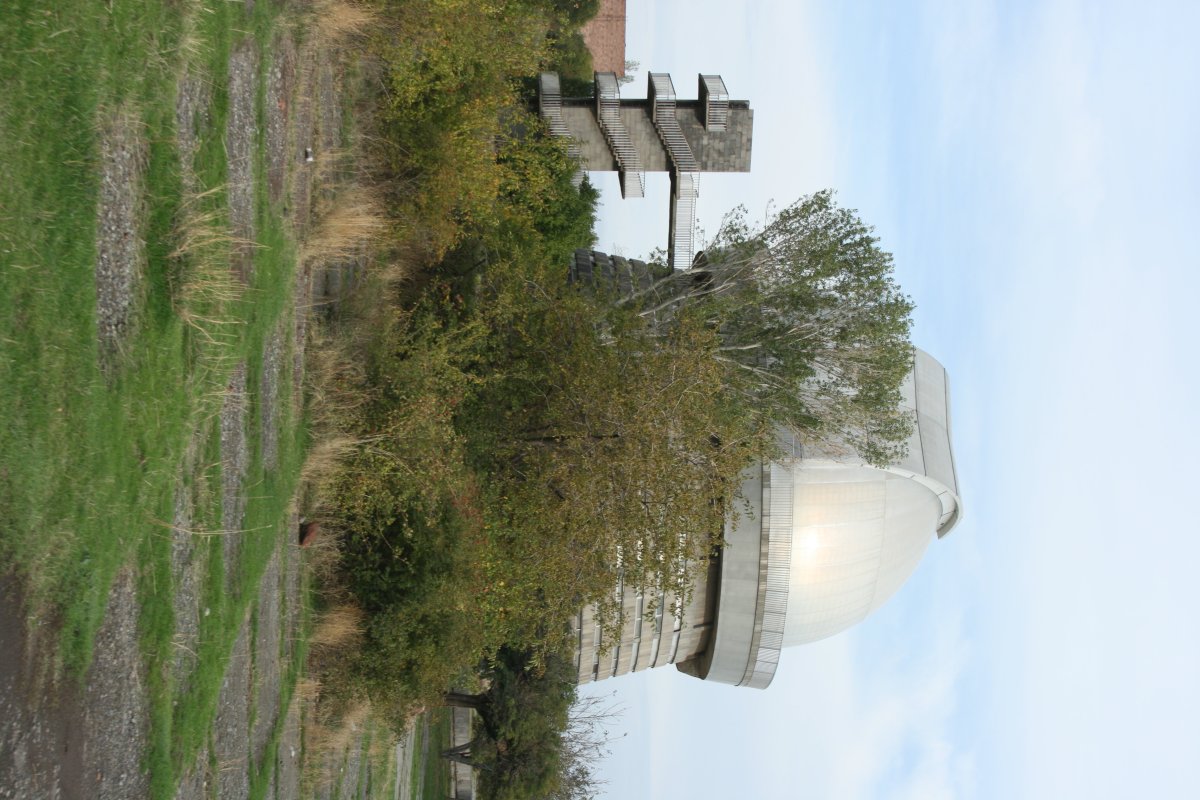

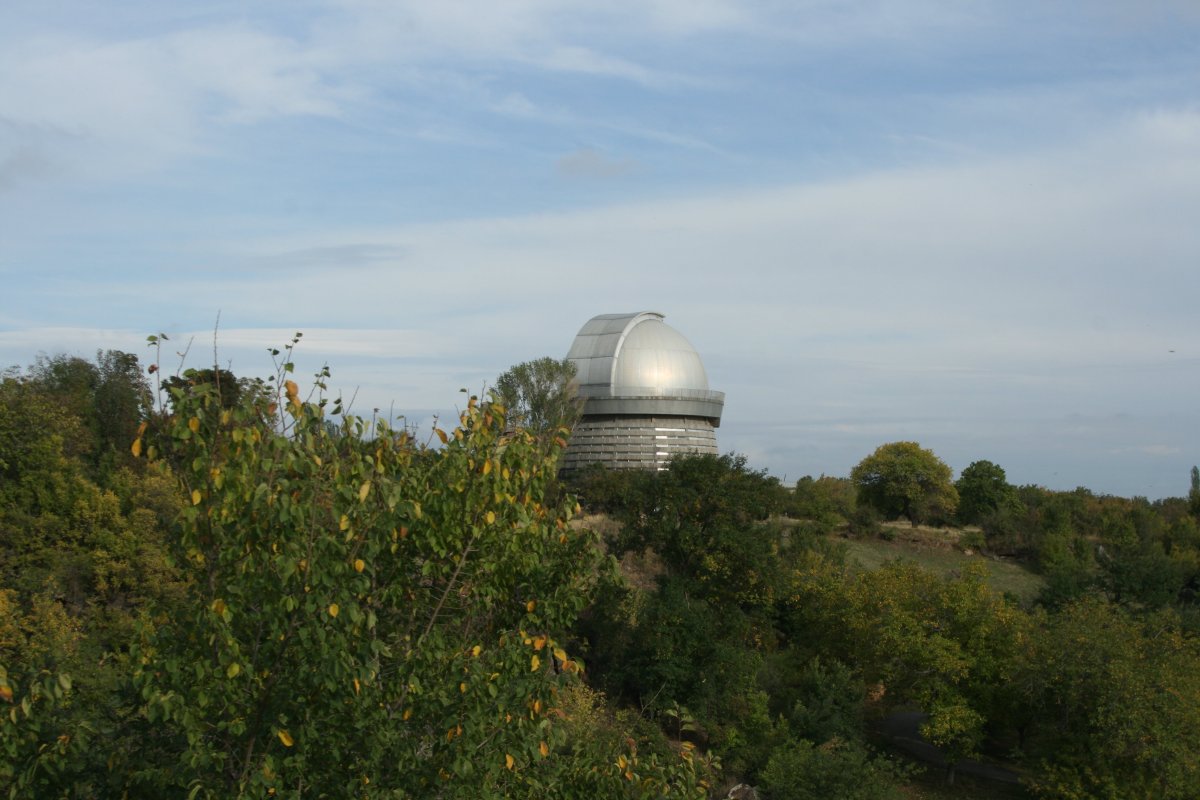
On the southern side of Mount Aragats, at about 1500 meters above sea level, a series of white domes emerges among the meadows and wild apple trees of the Armenian plateau. The Byurakan Astrophysical Observatory does not announce itself with tourist signs or crowded parking lots: it is reached by secondary roads that pass through villages of volcanic stone, and when it finally appears, it has something suspended in time, as if the Soviet Union had never completely faded from these hills.
Founded in 1946 by the Armenian astrophysicist Viktor Ambartsumian, one of the brightest scientists of the 20th century, the observatory soon became one of the most active centers of astronomical research in the Soviet bloc. Ambartsumian — who was also president of the Academy of Sciences of Armenia and received the Stalin Prize twice — chose this plateau for the exceptional quality of the night sky, far from light pollution and benefiting from hundreds of clear nights a year. His vision transformed a windy plateau into an open-air laboratory that would change the understanding of the universe.
The Schmidt Telescope and the Markarian Catalog
The scientific heart of the observatory is the 1-meter Schmidt telescope, the main instrument in one of the most ambitious astronomical endeavors of the twentieth century. Between 1965 and 1980, astrophysicist Benjamin Markarian used this telescope to conduct the first major systematic survey of galaxies with active nuclei and intense ultraviolet emission. The result was the Markarian Catalog, which listed over 1500 objects — now known as Markarian galaxies — opening a new window into the study of active galactic nuclei and quasars.
By visiting the observatory, it is possible to physically see the dome that houses this historic instrument. The external structure, with its functional architecture typical of the Soviet era, contrasts with the mechanical precision of the interior: the telescope is still there, with its metal rods and pointing mechanisms that seem to have come straight out of an engineering manual from the Sixties. It is not a museum piece: some researchers continue to use the facilities of the observatory, which also hosts a scientific library with archival publications.
The landscape and architecture of the complex
The complex extends over a wide area, with residential buildings where astronomers lived during observation sessions, laboratories, a cafeteria, and even a small school — a true miniature city of science. Walking among the tree-lined paths, one notices the details of Soviet urban planning applied to a scientific context: austere proportions, local materials, an aesthetic that prioritizes function without sacrificing a certain formal dignity.
In the background, Mount Aragats — the highest volcanic massif in Armenia at 4090 meters — dominates the horizon with an almost oppressive presence. In spring and autumn, when the snow covers the upper peaks and the sky is a deep cobalt blue, the visual contrast between the white domes and the dark profile of the mountain is unexpectedly beautiful. It is one of those places where science and landscape naturally overlap.
How to organize the visit
The observatory is open to visitors, but it is necessary to contact the management in advance to arrange a guided tour: there is no structured tourist service with fixed hours, and showing up without notice risks finding the gates closed. The official website of the Byurakan Astrophysical Observatory (bao.am) provides the necessary contacts. Some travel agencies in Yerevan organize group excursions that include transportation and a guide, a convenient solution for those who do not want to manage logistics independently.
From Yerevan, the drive takes about an hour and a half, crossing the Ararat plain and gradually ascending to the plateau. There is no direct public bus connection to the observatory, so it is advisable to rent a car or arrange a taxi for the day. The best time to visit is in the morning, when the light is soft and the chances of having a clear sky are higher. Plan for at least two or three hours to visit the complex at a leisurely pace, including time to stroll between the buildings and enjoy the view of Aragats.
Why the trip is worth it
Byurakan is not a destination for those seeking comfort or immediate entertainment. It is a place that requires a certain type of attention: the ability to stop in front of a telescope from the 1950s and imagine the nights spent by Markarian cataloging distant galaxies billions of light-years away, or to look at the sky during the day knowing that at night it becomes one of the most starry in the Caucasus.
What you take away from Byurakan is not a postcard photograph, but something more subtle: the concrete feeling that science, at certain historical moments, has been an act of collective imagination capable of transforming a windy plateau into an observation point of the universe.


