


Looking down from the Đurđevića Tara Bridge, built between 1937 and 1940, the river appears like an emerald-green ribbon flowing 1,300 meters below, nestled between limestone rock walls that time has patiently sculpted over millennia. The Tara Canyon is the deepest canyon in Europe and the second in the world after the Grand Canyon in Colorado: numbers that are truly understood only when standing on the edge and realizing that the tops of the black fir trees below you look like tufts of grass.

The canyon stretches for about 82 kilometers within the Durmitor National Park, a UNESCO World Heritage site since 1980, traversing one of the last primordial black pine forests in Europe. The area around the village of Tepca, in northern Montenegro, is the most frequented access point, and from here it is clear why this region remains surprisingly distant from mass tourism to this day.
The light that changes the canyon

At dawn, when the fog rises from the river and gets caught between the rocky walls, the canyon takes on pearl gray and purple hues that make it difficult to distinguish where the rock ends and where the sky begins. The early hours of the morning are the time when the colors are cooler and the depth of the canyon seems even more dizzying: the shadowed walls contrast with the peaks illuminated by the rising sun in a play of light that lasts just thirty minutes before the light becomes uniform.
In the afternoon, between two and four o'clock, the sunlight penetrates directly into the bottom of the canyon and the Tara River transforms: the water, naturally clear due to filtration through the limestone, becomes an intense turquoise that contrasts with the dark green of the black pine forests on the walls. At sunset, the limestone rocks are tinged with orange and ochre, while the valley floor sinks into shadow creating an effect of depth that is almost three-dimensional. It is the favorite moment for photographers visiting the bridge.

The Đurđevića Tara Bridge: the main observation point
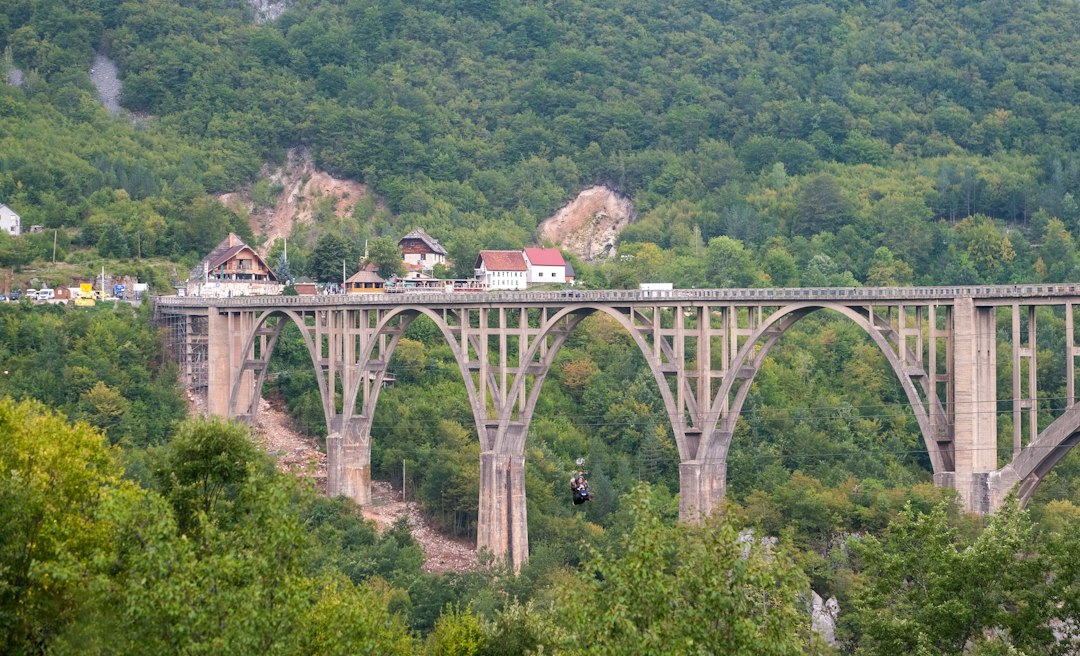
The Đurđevića Tara Bridge is the most iconic structure for observing the canyon. Measuring 365 meters long and with a maximum height of about 172 meters above the river, it was built between 1937 and 1940 and consists of five arches made of reinforced concrete. During World War II, in 1942, one of its arches was blown up by Yugoslav partisans to slow down the advance of the Axis, and it was rebuilt only after the war. The signs of this history are still visible in the irregularity of one of the central arches.

From the bridge, there is the most complete view of the canyon: looking east, you can see the river curving between the walls and disappearing into the forest, while to the west, the rocks open up into a wider panorama where you can distinguish the different bands of vegetation — the low scrub near the water, the broadleaf zone halfway up the slope, and the black pine forest at altitude. For the more daring, it is possible to practice bungee jumping from the bridge: some local agencies offer the service during the summer season.
Rafting to see the canyon from below
The perspective from below is completely different and equally impressive. Rafting on the Tara River is one of the most renowned in the Balkans: the classic route covers about 82 kilometers in two days with overnight camping along the river, or there are shorter stretches for a single day. The water of the Tara is classified as class two and three difficulty for most of the route, with some class four rapids in the narrowest section.
From below, the rocky walls appear even taller and more vertical. The black pine forest, which from above looks like a dark green carpet, reveals itself to be a succession of centenary trees with trunks reaching remarkable sizes. The silence is broken only by the sound of the water and, occasionally, by the call of some raptor nesting on the rocky walls.
Practical tips for visiting the Tara Canyon
The best time to visit the canyon is from May to September. In spring, the river is fuller and the rapids are more intense, ideal for rafting; in summer, the colors are more vibrant and the longer days allow you to enjoy the sunset over the canyon. Winter is not recommended because many secondary roads become impassable with snow. The village of Tepca can be reached by car from Žabljak in about an hour on mountain roads: it is advisable to have a vehicle with good ground clearance, especially outside the summer season.
To visit the bridge without paying for parking and without the crowd of tourist buses, arrive before eight in the morning or after five in the evening. Rafting agencies are mainly located in Žabljak and in the villages along the canyon: booking a few days in advance in July and August is almost essential. Always bring a warm layer even in summer: the temperature at the bottom of the canyon can be significantly lower than that of the surrounding plateau.


