
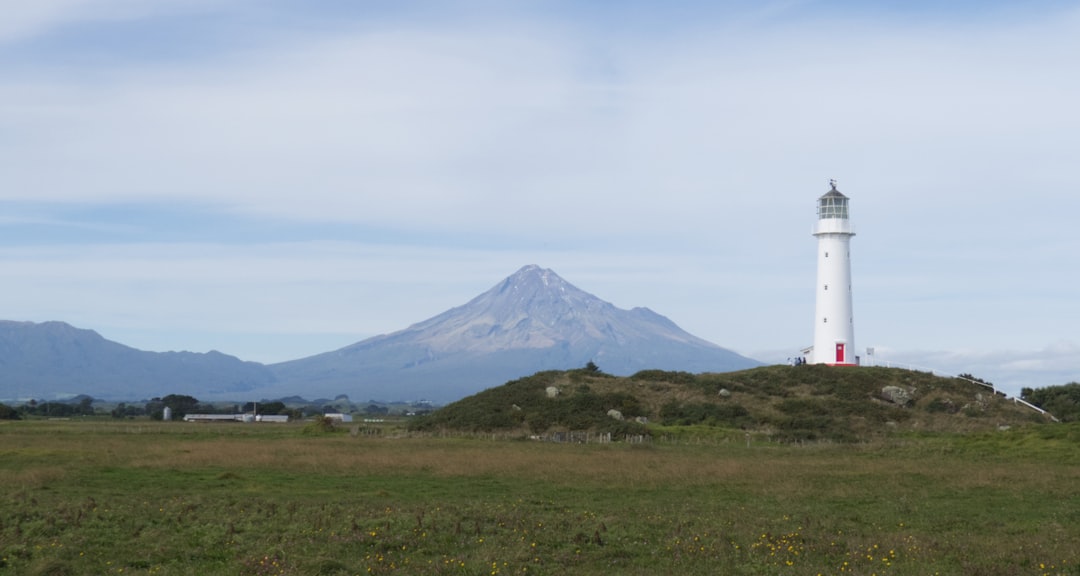

White and red, in alternating stripes, the Cape Egmont Lighthouse stands out against a sky often traversed by fast-moving clouds, with the perfect cone of Mount Taranaki behind it and the gray-green of the Tasman Sea in front. It has not always been here: this lighthouse has a history of relocations and adaptations that makes it even more fascinating than its silhouette already suggests. Arriving in Pungarehu, a small locality on the west coast of New Zealand's North Island, means finding oneself in a corner of Taranaki where the light changes every quarter of an hour and the wind carries the scent of the open ocean.
The lighthouse was moved to its current location in 1877, after being originally built on Mana Island, in the Wellington area. The decision to relocate it responded to specific nautical needs: the Taranaki coast, exposed to the currents of the Tasman, required a reliable light signal for vessels navigating these treacherous waters. Since then, the cast iron structure — a construction feature that allowed for its disassembly and reassembly — has remained steadfast on the promontory, becoming one of the most photographed symbols of the entire region.
The structure: cast iron, stripes, and light
Observing the lighthouse up close, one immediately notices the quality of the construction: the cast iron panels that make up the shaft are assembled with a precision that betrays Victorian engineering at its best. The red and white stripes are not merely decorative — they historically served to make the lighthouse recognizable during the day, visually distinguishing it from the coastal background. The height of the tower is about 14 meters, a modest measure compared to other oceanic lighthouses, but sufficient to project light a considerable distance over the sea thanks to the elevated position of the promontory.
The original lantern has been replaced over the decades with modern lighting systems, but the outer shell retains its nineteenth-century appearance intact. Walking around the base, one can observe the details of the metal joints and the small iron entrance door, elements that silently tell the modular construction logic of these artifacts designed to travel.
The natural context: Taranaki and the Tasman
What makes Cape Egmont truly memorable is not just the lighthouse itself, but the visual combination that its surroundings offer. The Mount Taranaki, a dormant volcano standing 2,518 meters tall, appears on clear days as an almost unreal presence behind the structure — a perfect pyramid that seems drawn rather than geologically formed. On cloudy days, the summit disappears into the mist and the landscape takes on darker tones, equally photogenic but in a different way.
The coast here is rocky and battered, with dark sandy beaches of volcanic origin stretching north and south. It is not a coast suitable for swimming due to the currents, but it is perfect for long walks during which one can spot seabirds and, in the right seasons, cetaceans offshore. The area surrounding the lighthouse is accessible and unfenced, allowing for free movement without time constraints.
How to organize the visit
The Cape Egmont Lighthouse can be reached by car from New Plymouth, the main city of Taranaki, traveling about 35 kilometers south along State Highway 45, locally known as the Surf Highway. The journey takes less than forty minutes and passes through an agricultural landscape dotted with farms and small towns. There are no regular public transport services that reach Pungarehu, so a car is practically essential.
The best time to visit is early in the morning, when the light is lower and Mount Taranaki — if the sky is clear — reflects with great clarity. Bringing a waterproof layer is almost always advisable: the weather in Taranaki changes rapidly and even on initially sunny days, the wind can bring rain within minutes. It is not necessary to purchase tickets to access the outdoor area of the lighthouse, which is freely accessible. The interior of the tower is generally not open to the public.
Why the trip is worth it
Cape Egmont is not a stop to include in a rushed itinerary: it deserves to be reached slowly, perhaps as part of a complete tour of the Surf Highway that runs along the entire west side of Taranaki. Those who love photography will find here one of the most immediate and rewarding compositions in New Zealand: a lighthouse in the foreground, the ocean in the background, a volcano in the distance. A natural and constructed geometry that is rarely found aligned with such simplicity.
For those traveling with children or looking for a relaxing stop during a road trip, the area around the lighthouse offers open space, clean air, and the tangible satisfaction of seeing up close a structure that has guided sailors for almost one hundred and fifty years. No great expectations or special preparation are needed: just arrive, look, and let the landscape do the rest.


