



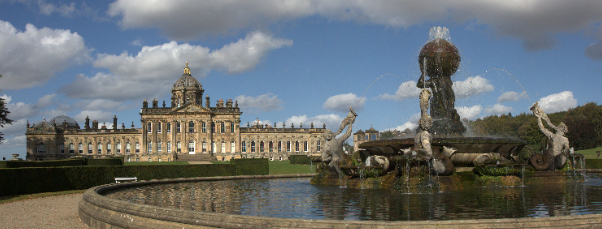
In the rolling Howardian Hills of North Yorkshire, Castle Howard stands as a testament to the grandeur and opulence of the 18th century. This magnificent estate is not just a home but a sprawling narrative of English aristocratic history, art, and culture, woven into the very fabric of its stone walls and lush landscapes.

The origins of Castle Howard trace back to the late 17th century when Charles Howard, the 3rd Earl of Carlisle, commissioned the visionary architect Sir John Vanbrugh to create a residence that would reflect the family's status and influence. Construction began in 1699, and despite its completion spanning over a century, the castle emerged as one of the most splendid examples of Baroque architecture in Britain. Vanbrugh, alongside Nicholas Hawksmoor, infused the castle with classical elegance and dramatic visual flair, setting a new standard for English country houses.
The art and architecture of Castle Howard are nothing short of breathtaking. Its design features a central dome, a hallmark of Baroque style, inspired by the grand palaces of Europe. Inside, the castle boasts richly decorated rooms filled with an impressive collection of artwork, including pieces by Titian, Gainsborough, and Joshua Reynolds. The Great Hall and the Long Gallery are particularly notable for their intricate frescoes and ornate plasterwork, serving as a living gallery of historical and artistic significance.

Beyond the stone and mortar, Castle Howard is steeped in local culture and traditions. The estate plays host to a variety of events throughout the year, from classical music concerts to the annual Castle Howard Proms, attracting visitors from across the globe. These events are a celebration of both local and national culture, offering a glimpse into the vibrant community life that thrives around the estate.
Gastronomy in the region around Castle Howard is as rich as its history. North Yorkshire is renowned for its hearty fare, and visitors can indulge in traditional dishes such as Yorkshire pudding, parkin (a gingerbread cake), and the region's famous cheeses. The estate itself offers delightful culinary experiences, with its farm shop and cafes providing locally sourced produce and seasonal delicacies that capture the essence of Yorkshire's culinary heritage.
For those seeking lesser-known curiosities, Castle Howard does not disappoint. Among its treasures is the Atlas Fountain, an iconic feature of the estate's gardens, designed by William Andrews Nesfield in the 19th century. Another hidden gem is the Temple of the Four Winds, a stunning pavilion offering panoramic views of the surrounding countryside. The estate also harbors stories of intrigue and romance, including the tale of Lady Cecilia Howard, whose ghost is said to wander the halls, a reminder of the castle's storied past.
When planning a visit to Castle Howard, timing is key. The estate is open year-round, but the gardens are particularly enchanting in spring and summer when the flowers are in full bloom. Autumn offers a spectacle of colors, while winter transforms the estate into a serene, frosted wonderland. To fully appreciate the vastness and beauty of the grounds, allow at least a full day for exploration.
Visitors should consider joining a guided tour to uncover the rich tapestry of history and anecdotes that bring the castle to life. Be sure to explore the Walled Garden and the Ray Wood, both havens of biodiversity and tranquility. For a truly immersive experience, the estate's adventure playground and boat trips on the Great Lake offer additional layers of enjoyment for families.
Castle Howard is more than just a stately home; it is a living testament to the artistry and ambition of its creators, a sanctuary for culture and nature, and a timeless destination that continues to inspire and enchant all who walk its storied paths.
