
← Back

Cathedral of Santa Maria Assunta

Via Don Luigi Minotti, 18-8, 03100 Frosinone FR, Italia ★★★★☆ 152 views
Ranita Mell
Frosinone
🏆 AI Trip Planner 2026

Get the free app

Discover the best of Frosinone with Secret World — the AI trip planner with 1M+ destinations. Get personalized itineraries, hidden gems and local tips. Free on iOS & Android.

🧠 AI Itineraries 🎒 Trip Toolkit 🎮 KnowWhere Game 🎧 Audio Guides 📹 Videos
Download on the App Store Get it on Google Play
Scan to download Scan to download

Religious places · Frosinone

Cathedral of Santa Maria Assunta - Frosinone | Secret World Trip Planner

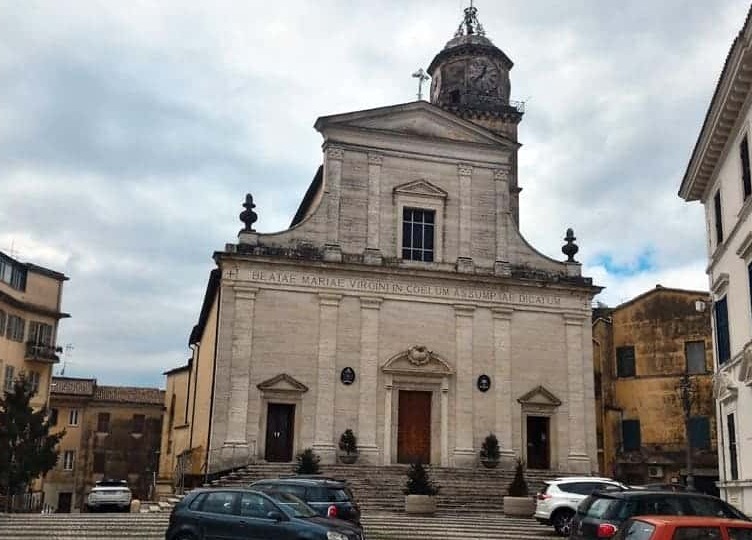
The church of S. Maria in Frosinone, cathedral of the Diocese since 1987, was built on the top of the hill where the acropolis of the city stood in Roman times. The building, completely restored after the Second World War, is now in an elegant eighteenth-century style. The church, located on the site of an ancient pagan temple dedicated to Mars, is of early Christian origin and would have been the seat of a diocese, which merged in the early eighth century with the nearby Veroli. In the Middle Ages, the primitive church construction was substituted by another one in Romanesque style, of which the historical bell tower remains a testimony. The first official document mentioning the cathedral dates back to 1147.The façade, anticipated by a wide staircase, is marked by three portals. The elegant Romanesque bell tower stands out on the left. The interior, with a Latin cross plan and three naves, is divided by a series of rounded pillars. Visitors are ideally "welcomed" by the two bronze statues of the two Popes from Frosinone, Saint Ormisda and Saint Silverio, placed at the sides of the central altar. The two popes, father and son, lived in the 6th century, the first successfully worked for the reunification of the Eastern and Western Churches. The statue of St. Ormisda is reproduced with his hands clasped to his chest: with his right hand he holds an iron cross while with his left hand he holds the book Epistole Hormisde. The apse is decorated by the elegant episcopal chair in white Carrara marble, which has two full-length sculptural reliefs of the two patron saints, by the choir of canons and by the large mosaic depicting the Assumption of the Virgin. The work of Carlo Mariani, placed in the apse in 1967, is inspired by the medieval miniatures of the Benevento-Cassino school, and constitutes the apex of an iconographic itinerary dedicated to the life of the Virgin and Christ. The latter is developed in ten paintings that have adorned the walls of the church since 1963 and are the work of the artists Purificato, Fantuzzi, Montanarini, Ceracchini and Colacicchi. To complete this excursus on the works of art of the church we can add the paintings of Sarra, placed in the chapel of the Blessed Sacrament, the panels of the Via Crucis and the polychrome stained glass window of the facade.

🗺 AI Trip Planner

Plan your visit to Frosinone

Suggested itinerary near Cathedral of Santa Maria Assunta

MAJ+
500.000+ travelers worldwide
  1. 🌅
    Morning
    Cathedral of Santa Maria Assunta
    📍 Frosinone
  2. ☀️
    Afternoon
    Schioppo waterfall
    📍 0.8 km · Frosinone
  3. 🌆
    Evening
    Soup with bread underneath
    📍 0.8 km · Frosinone

Buy Unique Travel Experiences

Powered by Viator

See more on Viator.com

Explore nearby · Frosinone

Frequently Asked Questions

The Church of S. Maria became the official cathedral of the Diocese in 1987. The building was completely restored after the Second World War and now features an elegant eighteenth-century style, though its origins date back to early Christian times.
The two bronze statues depict Saint Ormisda and Saint Silverio, two Popes from Frosinone who were father and son living in the 6th century. They are positioned at the sides of the central altar, with Saint Ormisda's statue showing him holding an iron cross and the Epistole Hormisde book.
The apse features a large mosaic depicting the Assumption of the Virgin, created by Carlo Mariani and placed in the cathedral in 1967. This mosaic is inspired by medieval miniatures from the Benevento-Cassino school and serves as the centerpiece of an iconographic journey depicting the life of the Virgin and Christ.
The cathedral was originally built in Romanesque style during the Middle Ages, as evidenced by the historical bell tower that remains on the left side of the façade. After post-World War II restoration, the building now displays an elegant eighteenth-century style with a Latin cross interior plan divided by rounded pillars and three naves.
The cathedral was constructed on top of a hill where the ancient Roman acropolis once stood, on the site of a pagan temple dedicated to Mars. The building's prominent location is emphasized by a wide staircase leading to the façade, which features three portals and the distinctive Romanesque bell tower.
