
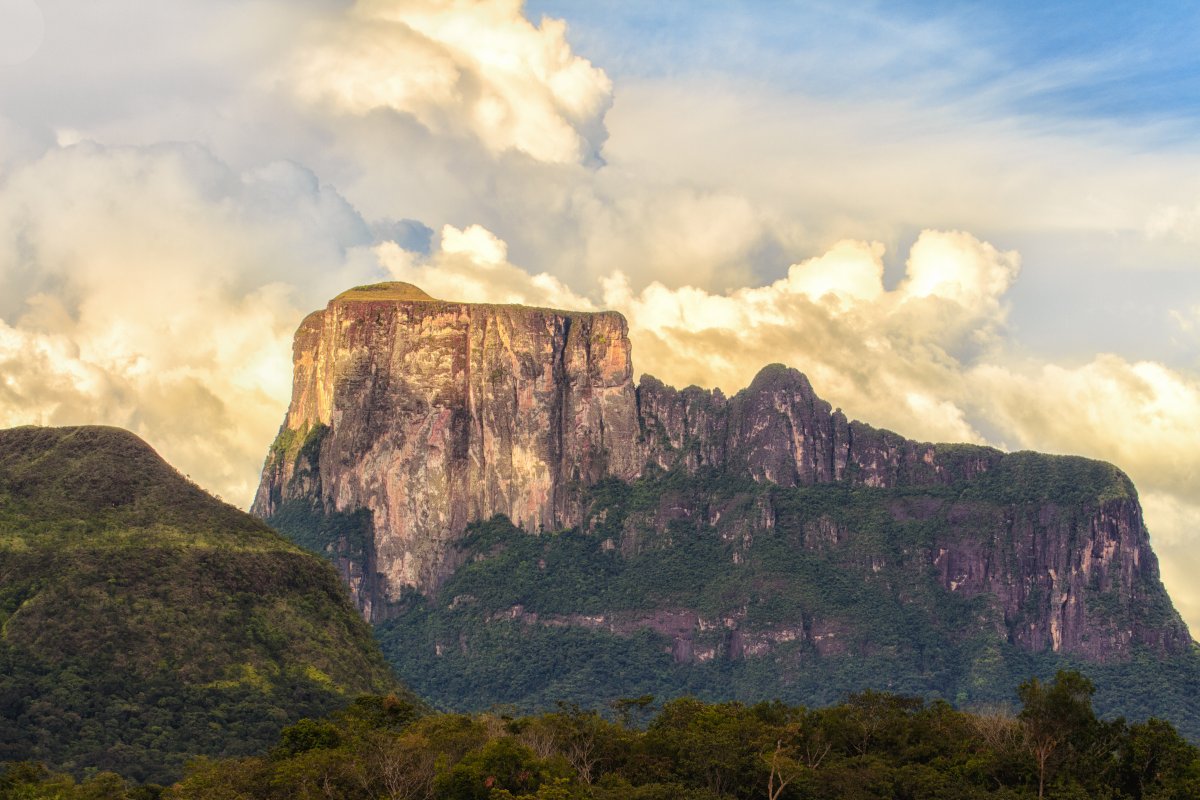

From the heart of the Amazonas State of Venezuela rises one of the most extraordinary rock formations on the South American continent: the Cerro Autana, a tepui that reaches a height of 1,300 meters and stands out from the Amazon plain like a solitary monolith, its vertical walls of Precambrian quartzite dropping steeply for hundreds of meters. It is not a volcano in the classical sense of the term — there is no lava flowing, there are no active craters — but its origin belongs to an even older and more fascinating geological story: these rocks are over a billion years old, and tell of a primordial world that predates even the dinosaurs.

For the Piaroa people, who inhabit the forests at the foot of the mountain, the Cerro Autana is not simply a mountain. It is the trunk of the original cosmic tree, the axis of the world from which the fruits that gave life to humanity were born. This sacred dimension is not a marginal folkloric legend: it is the center of Piaroa cosmogony, and anyone who approaches this place should do so with the awareness of walking on land that belongs, first and foremost, to a living and present indigenous community.
The cave that crosses the mountain
What makes Cerro Autana unique among the Venezuelan tepuis — and there are dozens of them, including the famous Roraima and Kukenán — is the presence of a cave that almost entirely crosses the summit of the mountain. This natural gallery, about 400 meters long and up to 30 meters high in some places, was formed through karst processes that eroded the quartzite over millions of years. It is a very rare geological phenomenon: quartz is one of the most resistant minerals to chemical erosion, yet here water has found a way to carve a tunnel into one of the hardest rocks on the planet.
Inside the cave live colonies of guácharo birds (Steatornis caripensis), nocturnal and capable of orienting themselves with echolocation, whose screech fills the darkness of the cave with an unforgettable sound. The walls are covered with mineral formations and mosses adapted to the humid and dark environment, while beams of light filter through the openings in the vault, creating highly intense visual effects. Those who manage to cross the cave emerge on the other side of the mountain with a completely different perspective on the underlying Amazon rainforest.
How to get there and what to expect
Reaching Cerro Autana is not an ordinary hike. The logistical starting point is Puerto Ayacucho, the capital of the Amazonas State, accessible by plane from Caracas. From there, it is necessary to organize a boat transfer along the Rio Orinoco and its tributaries — a journey that can take one or more days depending on the boarding point — to the Piaroa communities living at the foot of the tepui. There are no roads that reach close to the mountain.
It is essential to organize the visit through local Piaroa guides or agencies specialized in indigenous ecotourism based in Puerto Ayacucho. Access to the mountain requires permission from the indigenous community, and attempting to reach it independently is both ethically wrong and practically impossible without knowledge of the territory. The best time to visit the region is the dry season, between November and March, when river levels are more manageable and rainfall is less intense, although Venezuelan Amazon maintains high humidity year-round.
Geology as a Visual Spectacle
Observing Cerro Autana from the plain, the first thing that strikes is the color contrast: the quartzite walls take on shades ranging from pale gray to burnt ochre, speckled with black due to the colonies of algae and cyanobacteria that colonize the damp surfaces. The flat summit — a defining characteristic of the tepuis — is covered by endemic vegetation adapted to the extreme conditions of nutrient-poor substrate and strong solar radiation.
This geology is the direct result of the Guiana Shield, one of the oldest rock formations on Earth, which emerges in Venezuela, Guyana, Suriname, and Brazil. The tepuis are the eroded remnants of an ancient continental plateau, and Cerro Autana represents one of the most isolated and spectacular examples of this morphology. To look at it means to look into geological time with a clarity that few places in the world can offer.
Respect and Responsibility in the Visit
Any visit to Cerro Autana implies a precise cultural responsibility. The territory is indigenous Piaroa land recognized by the Venezuelan State, and the tourism that takes place there must necessarily involve and benefit the local community. Photographing people without consent, collecting plants or minerals, and behaving lightly regarding the spiritual norms of the place are unacceptable behaviors.
Bringing only the bare essentials, relying completely on local guides, and maintaining an attitude of listening are the foundations for an experience that leaves something real — not just images to share, but a concrete understanding of how ancient and fragile the natural world that hosts us is.


