


The smell of burnt copal hits you before you even see the stalls. It is a dense, resinous fragrance that rises from the braziers held by the curanderos on the steps of the church of Santo Tomás, built by the Dominicans around 1545 on top of a pre-existing Maya ceremonial platform. Every Thursday and Sunday, the central square of Chichicastenango — a municipality in the Guatemalan highlands located about 2,070 meters above sea level — transforms into one of the most vibrant indigenous markets in all of Latin America.

The market is not a recent tourist creation. The K'iche' Maya gathered in this place to trade goods and practice their rituals long before the arrival of the Spaniards. Even today, the purification ceremony on the steps of the church — where local shamans burn offerings of copal, colored candles, and flower petals — is not a spectacle organized for visitors, but an authentic religious act that takes place every week.
A labyrinth of fabrics and colors
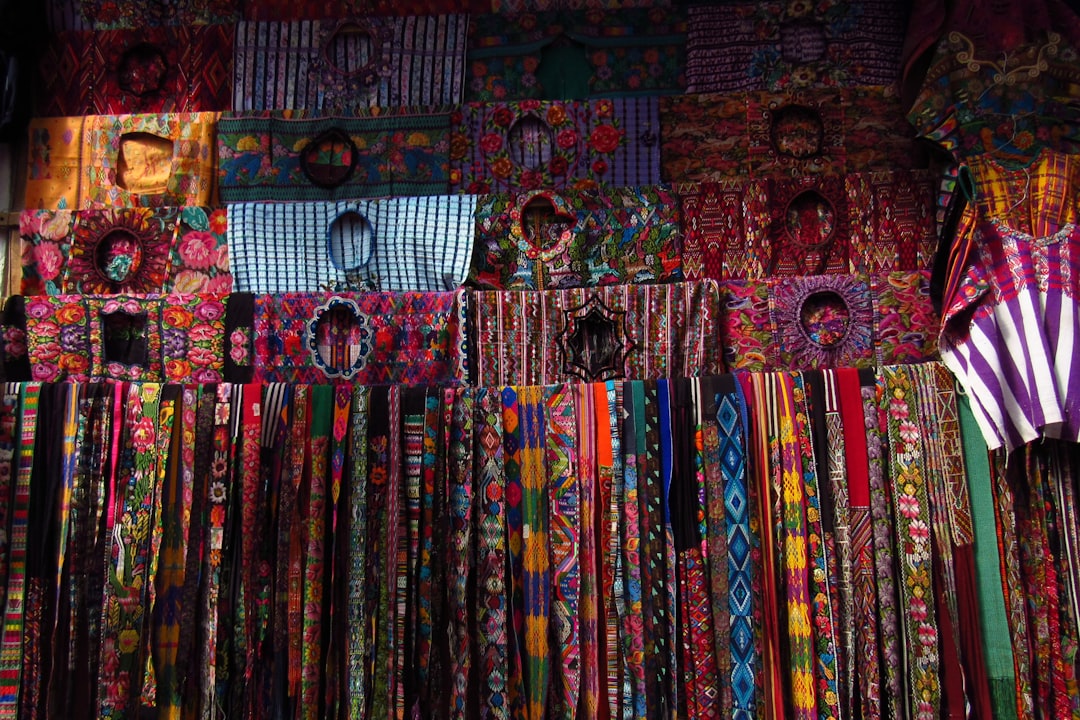
Entering the market means getting lost in a maze of improvised corridors where every available inch is occupied. The indigenous K'iche' women wear the huipil, the traditional blouse hand-embroidered with geometric patterns that vary from village to village: the dominant colors in Chichicastenango tend to be bright red and gold yellow, combined with cotton threads woven on a backstrap loom, a technique passed down through generations. The fabrics for sale — tablecloths, blankets, bags, dresses — are genuine handcrafted products, not industrial imitations, and the bargaining process is an integral part of the experience.
Next to the fabrics are carved wooden masks used in ceremonial dances, statuettes of syncretic saints, green jade necklaces — a stone considered sacred by the Maya — and hand-painted ceramic objects. Prices are not fixed: an authentic huipil can cost between 150 and 400 quetzals (about 18-50 euros), while cheaper reproductions can be found at much lower prices. Distinguishing the two requires attention to the density of the fabric and the quality of the embroidery.

Sounds and Voices of the Market
The noise is constant and layered. The vendors call out to passersby with a firm but not aggressive voice, children run between the legs of adults, and someone prays softly in front of an improvised altar. From the food market — separate from the craft market but adjacent — come the scents of corn tortillas cooking on a clay comal, dried chilies, and local herbs like epazote. Here, tropical fruits, black beans, chiles of every variety, and pepián, a paste made of pumpkin seeds and chili that is the basis of one of the oldest traditional Guatemalan dishes, are also sold.

By around eleven in the morning, the crowd reaches its maximum density. The aisles narrow, voices overlap, and it takes a few minutes to get oriented. Those who arrive before nine have the advantage of finding the stalls just set up, the vendors more open to conversation, and the morning light — often golden and filtered through the highland mist — making the fabrics even more vivid.
The Church of Santo Tomás and Religious Syncretism

The Church of Santo Tomás deserves a visit separate from the market, if only to observe from a respectful distance what takes place on its 18 steps — one for each month of the Maya Tzolkin calendar. The Maya priests, called ajq'ij (literally "guardians of time"), conduct rituals with incense and colored candles, each with a specific meaning: yellow for corn, red for blood and life, black for death. The interior of the church holds an equally unique atmosphere: the floor is often covered with flowers, pine needles, and candles lit by the faithful.
A few steps from the church is the Rossbach Museum, which houses a small but significant collection of pre-Columbian Maya objects found in the region, including worked jade, ceramics, and ceremonial incense burners. It is not a large museum, but it offers a useful historical context for understanding what is seen in the market.
Practical tips for the visit
Chichicastenango can be reached from Antigua Guatemala in about three hours by bus, or from Ciudad de Guatemala in about two and a half hours with direct service. Market days are Thursday and Sunday: arriving by 8:30 in the morning allows for a more leisurely exploration before the crowd becomes intense. In the afternoon, after 2 PM, many vendors start to take down their stalls.
It is advisable to bring cash in quetzals, as most vendors do not accept credit cards. Keeping your bag in front of your body during peak hours is a reasonable precaution. Photographing people always requires their explicit consent — many vendors prefer not to be photographed, and respecting this preference is the most direct way to establish an authentic relationship with those who have been animating this market every week for centuries.


