

At dawn, when the mist slowly rises from the Rapti River, a dugout canoe glides silently over the water. On the sandy bank, a few meters from the boat, a one-horned Indian rhinoceros lowers its head to drink. A little further away, motionless like a fallen branch, a gharial — the crocodile with a thin and elongated snout — basks in the sun on the gravel bars. This scene is not exceptional at the Chitwan National Park: it is simply the morning.
Founded in 1973 as the first national park in Nepal, Chitwan covers about 952 square kilometers in the Terai plains, in the Ratnanagar area, Chitwan district. In 1984 it was declared a UNESCO World Heritage Site, recognition linked to its extraordinary density of wildlife in an ecosystem of subtropical forests, elephant grass savannas, and riverine wetlands. The village of Sauraha, on the north bank of the Rapti, is the main access point for visitors.
The fauna: rhinoceroses, tigers, and gharials
Chitwan hosts one of the most significant populations of Indian one-horned rhinoceros (Rhinoceros unicornis) in the world, with recent censuses estimating over 700 individuals within the park. Spotting a rhinoceros does not require extraordinary luck: in the morning hours, the banks of the Rapti and the edges of the grasslands offer close encounters with regularity. More rare, but documented, is the presence of the Bengal tiger: the park is part of the Nepal Tiger Conservation program, and estimates speak of over 100 individuals in the territory.
The gharials (Gavialis gangeticus), with their characteristic narrow snouts and visible teeth even when their mouths are closed, are easily observed on river beaches during the hottest hours. Chitwan is one of the few places in the world where this species, classified as critically endangered, survives in appreciable numbers thanks to repopulation programs active since the 1970s. During a canoe descent, dozens of individuals can be counted in just a few kilometers of river.
The dugout canoes at dawn and the walks in the prairies
The dugout canoe trip — the descent in a traditional canoe — typically departs at dawn from the shore of Sauraha and lasts between 60 and 90 minutes, covering several kilometers along the Rapti River to the entrance of the park. The silence of the absent engine allows for impossible approaches with other means: gray herons, cobalt-winged kingfishers, and fishing eagles alternate along the banks, while rhinos come down to the water unaware of human presence.
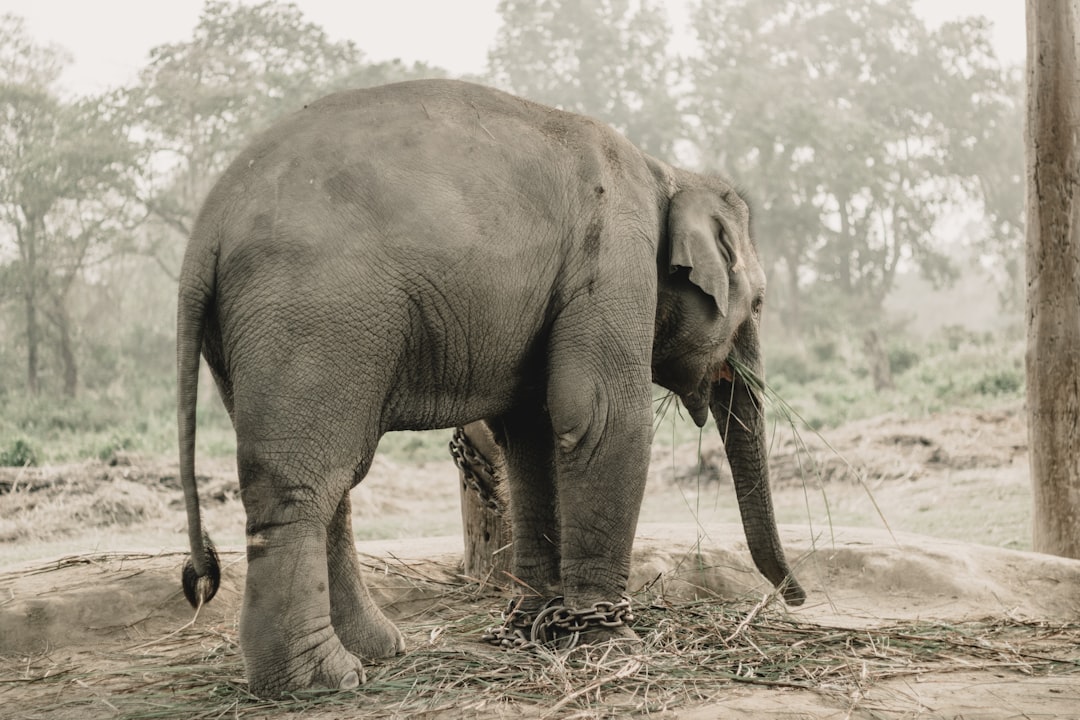
The walks in the buffer forests of the buffer zone, guided by naturalists from the Tharu community — the indigenous people of the Terai — offer a different experience. Tharu guides read the footprints in the mud with precision: the three toes of the rhino, the wide paw of the tiger, the heavy step of the wild elephant. Elephant grass (Saccharum spontaneum) reaches 5-7 meters in height during the wet season, transforming the prairies into green mazes where sound replaces sight.
Biodiversity: birds, reptiles, and sal forests
Chitwan is a reference site for birdwatching in South Asia: the park hosts over 500 species of birds recorded, including the rare dalmatian pelican, the wild peacock, and numerous species of kingfishers. The dry season, between October and March, is the best time for observation: the sparse vegetation facilitates sightings and the temperatures are bearable.
The sal (Shorea robusta) forests, which cover most of the park, have a relatively open understory that allows for distant sightings. Next to the sal grow Terminalia and Lagerstroemia trees, and in spring, the blooming of the silk cotton tree (Bombax ceiba) colors the treetops with bright orange-red, visible even from the canoe on the river.
Practical Information for Visiting Chitwan
The entrance ticket to the park for foreign visitors costs about 1,500 Nepalese rupees per day (about 10-11 euros), plus the costs of specific activities such as canoeing or jeep safaris. Access is mainly from Sauraha, which can be reached by bus from Kathmandu in about 5-6 hours or by flight to Bharatpur airport, about twenty minutes by car. The best time to visit is between November and February: the monsoon rains from June to August make many roads impassable and some areas of the park are closed.
It is advisable to book canoes and guided walks in advance through the lodges or certified agencies in Sauraha, preferring guides with official training issued by the park. Avoid wearing bright colors during walking excursions: gray, green, and beige blend better with the environment and increase the chances of spotting wildlife without disturbing the animals.


