

Thousands of transparent calcite needles hang from the ceiling like strands of blown glass, motionless in the still air of a cave where artificial light transforms them into a frozen waterfall. They are the fistuleuses, the ultra-thin tubular stalactites that make the Grotte de Choranche unique: hollow structures, sometimes several centimeters long, with a diameter that does not exceed that of a cocktail straw. They grow slowly by the deposition of calcium carbonate around a drop of water, and their extreme fragility makes them almost impossible to find intact in other karst systems open to the public.
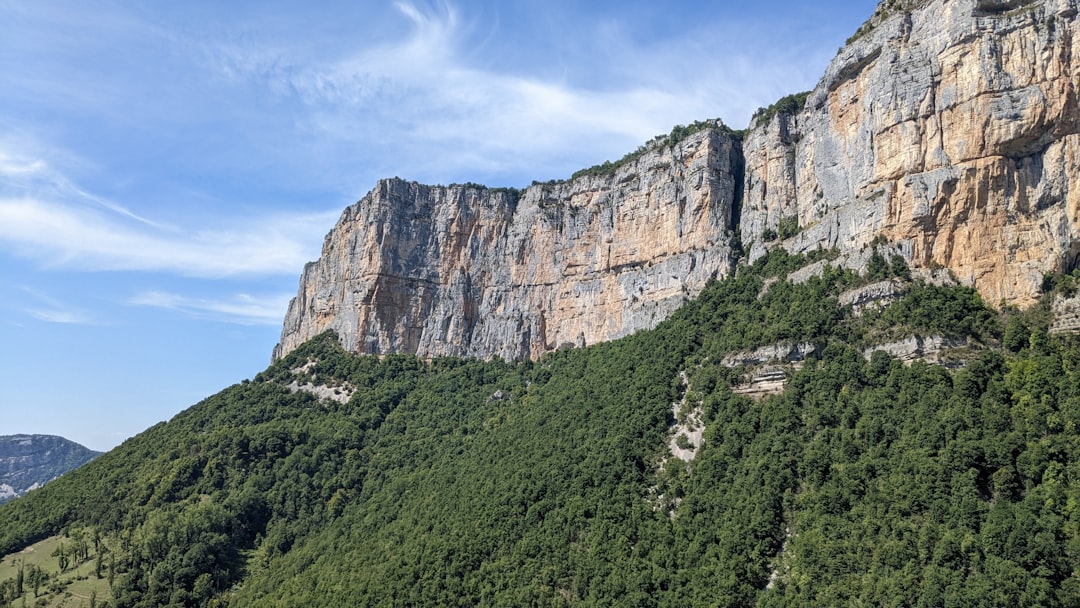
The caves open in the rocky wall of the Vercors massif, in the Auvergne-Rhône-Alpes region, above the village of Choranche, in an area where the vertical limestone cliffs dominate the Bourne valley. The external landscape is already spectacular even before entering: the rocky facade that overlooks the parking lot gives an idea of how much one is about to descend beneath the surface of a world that has remained untouched for millennia.
What to see inside: lakes, stalactites, and underground fauna
The main tourist route crosses several rooms connected by natural galleries, with a manageable elevation even for those without caving experience. Visitors walk on equipped walkways overlooking underground lakes of crystal-clear waters, where the proteus (Proteus anguinus), a blind and depigmented amphibian adapted to life in karst waters, lives. Spotting it requires patience and a bit of luck, but guides often point out its presence in the illuminated pools along the route.
The most scenic room is the one where the fistulous formations are concentrated in greater numbers: the ceiling appears literally covered with these pale filaments, some of which reach remarkable lengths without breaking. The internal temperature remains constant around 9-10 degrees Celsius all year round, regardless of the external season, and the humidity is very high. Bringing an extra layer is essential, even in summer.
The history of explorations and the discovery of the system
The caves have been known locally for centuries, but their systematic exploration and subsequent opening to the public date back to the 20th century. The karst system of Choranche is part of a larger complex that includes the Coufin cave, explored and documented by speleologists throughout the 1900s. Research has revealed that the galleries extend for several kilometers, but only a portion is accessible to tourists under safe conditions. Geological studies have confirmed that the formation of fistulous structures at this site is favored by particular conditions of humidity and chemical composition of the water, which are difficult to replicate elsewhere.
Over the years, the site has been equipped with lighting systems designed to enhance the formations without damaging them, and the path has been adapted to modern accessibility standards. The current management aims to balance tourist hospitality with the preservation of an extremely delicate underground ecosystem.
Practical information for organizing the visit
The Choranche Caves are located about 50 kilometers southeast of Grenoble, accessible by car via the road that follows the Bourne valley from Pont-en-Royans. There is no direct bus connection from the city, so a car is practically essential. Parking near the entrance is paid. The guided tour lasts on average 45-60 minutes and departs at scheduled times; during the summer months, it is advisable to book online or arrive early for the desired time, as groups have a maximum number of participants to avoid overcrowding in the galleries.
The full ticket is approximately 10-12 euros for adults, with reductions for children and families, but it is always advisable to check the updated rates on the official website before departure. The best season to avoid queues is spring or early autumn; in August, the site is very busy. Wearing closed shoes with non-slip soles is strongly recommended, as the walkways can be damp.
The natural context of Vercors
Visiting Choranche offers the opportunity to immerse oneself in one of the most intact regional natural parks in France. The Vercors Regional Natural Park, established in 1970, protects a limestone plateau of great ecological value, with fir forests, vertical cliffs, and a network of well-marked hiking trails. Pont-en-Royans, a few kilometers from the caves, is a characteristic village with houses clinging to the rock above the Bourne River, ideal for a lunch stop before or after the underground visit.
Combining the caves with a walk in the surroundings transforms the excursion into a full day, with the disorienting contrast between the intense light of the limestone canyons outside and the absolute darkness — interrupted only by artificial lighting — that greets visitors as soon as they cross the threshold of the mountain.


