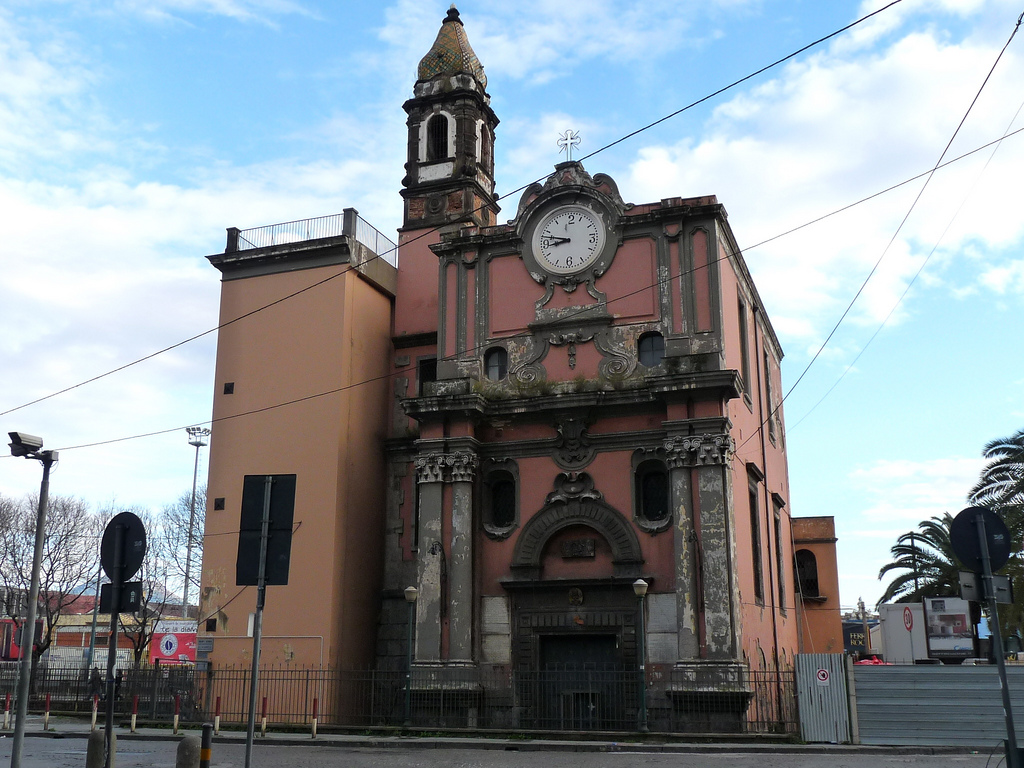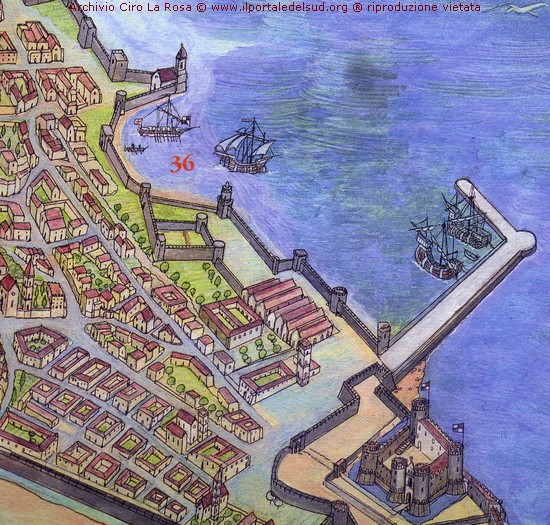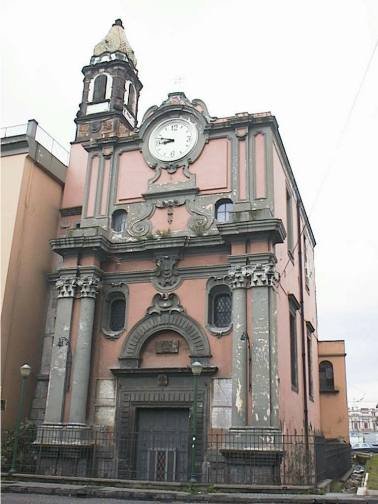

The church of Santa Maria di Portosalvo originally stood in the largo del Mandracchio and had the apse overlooking a stretch of water, the so-called Mare Morto or Molo Piccolo, a fishing port connected to the sea through two entrances crossed by bridges on which ran the Strada Nuova, today's Via Marina. Starting from the late thirties the port was buried, then began the modernization of the area, concluded after the war, eliminating the urban fabric of medieval origin. Therefore, the church appears alienated from its context, reduced to a traffic island, the only qualifying element of the environment. It was built in 1554 by the will of Bernardino Belladonna, escaped the pirates and a shipwreck thanks to the intervention of the Virgin. It was the seat of a brotherhood of sailors who provided the dowry of poor girls. A series of tombstones on the facade and in the sacristy retrace the history of the church, from its origins to the various restorations of the eighteenth and nineteenth centuries, to the consecration of 1770. The beautiful façade should date back to that time, decorated with stuccoes, marked by columns and pillars and with a clock in the second order, where the forms of the last rococo already turn towards classicism. Curious the portal, with flat ashlars, with in the tympanum a seventeenth-century relief of the Madonna of Portosalvo. To the left the seventeenth-century bell tower, with the small dome covered with polychrome majolica embrici.Da note, finally, the chromatic note of the dome, covered with yellow and green embrici. The interior, with a nave with two chapels on each side, is covered with polychrome marbles that a plaque in the sacristy would date, like the side altars, to 1744. Therefore it shows a rococo aspect, strengthened by the stuccoes of the second order, in which seventeenth-century paintings and carvings are inserted without serious contrast. The gilded wooden ceiling is the ancient one, in the middle there is the Glory of the Virgin, a canvas by Battistello Caracciolo, datable to 1634, therefore of a late moment, when the art of the master moved away from Caravaggio's art leaning towards plastic and drawing cadences. Other furniture of great prestige is the seventeenth-century carved cantoría, placed on the entrance. The balustrade of the high altar, designed by Dionisio Lazzari in 1647, shows the typical Neapolitan plant decoration in commesso, with mother-of-pearl and semiprecious stones inserts, but next to it there is a motif linked to the church and to the sailors, a small ship, placed in two small pillars, to remind us of the continuous protection invoked by the sailors devoted to the Virgin. The marble high altar, made around 1778, is concluded at the top by an Eternal Father and two little angels, sculpted by Giacomo and Angelo Viva. Later, in 1806, the only Angelo sculpted the San Pietro and San Paolo, placed in the cone, at the sides of the sixteenth-century painting of the Madonna di Portosalvo. To the right of the church, isolated on a flowerbed, detached from a context now destroyed and reduced to the role of traffic divider, stands the spire erected in 1799 by pro-Bourbon to commemorate their victory over the French army, in the first order, medallions are the Symbols of the Passion (one is missing), in the second, in rectangular panels, the Madonna of Portosalvo, San Gennaro and St. Anthony of Padua.