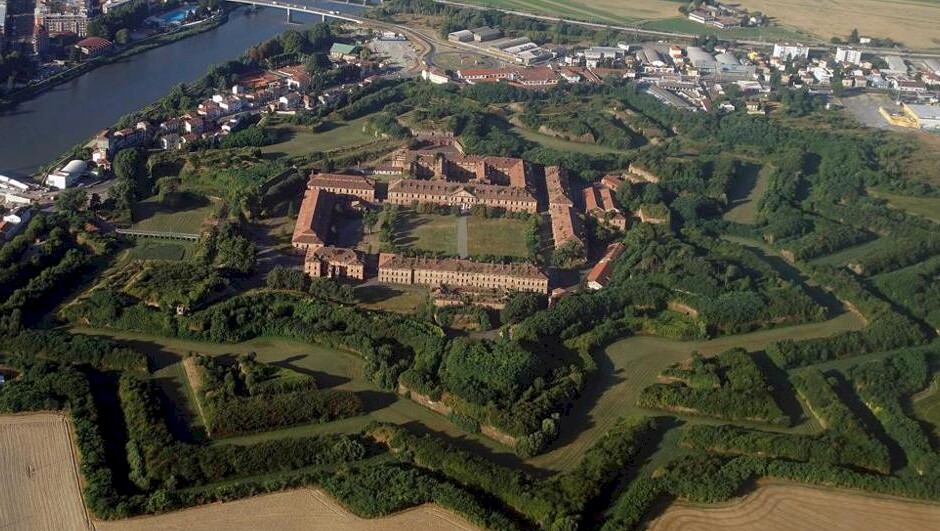

In the 18th century the Citadel of Alessandria was built: the most important military fortress in Europe, still intact. Built by the Savoys on the banks of the Tanaro, it still looks as it did when it was built: a star surrounded only by the countryside and the plain. It was built following the Treaty of the Alliance League, stipulated in 1703, during the War of the Spanish Succession, between the Emperor of Austria and the Duke of Savoy Vittorio Amedeo II: the Duke was given the provinces of Alessandria and Valenza and the lands located between the Po and the Tanaro, as a reward for having sided with the Hapsburg Empire. In 1707 the city of Alessandria was officially annexed to the territories of the Savoy state, and it was immediately clear that it was necessary to increase its security with the construction of a fortified citadel, whose project was entrusted to the military engineer Ignazio Bertola. The construction of the Citadel of Alessandria was part of a vast defence programme of the Savoy State, which included a system of forts blocking the alpine accesses to the plain: the fort of Bard to control the passes of Piccolo and Gran San Bernardo, that of Brunetta near Susa and that of Fenestrelle in Val Chisone. Already existing were the fortresses of Cuneo and Saorgio and the fortress of Ceva in the Tanaro valley. The Citadel thus became the central element of the Piedmontese defence system. After the defeat of the Piedmontese troops in Napoleon Bonaparte's first Italian Campaign (1796), the Citadel and the City of Alessandria came under French rule. Three years later Austro-Russian forces forced the French to lay down their arms. But already on 14 June 1800, following the battle of Marengo, the French took possession of the fortress and the City once again. At this point Napoleon decreed the demolition of all the fortresses which constituted the defensive apparatus of Piedmont, apart from the Fort of Fenestrelle, the Citadel of Turin and the Citadel of Alessandria. On the contrary, the latter, in the intentions of the leader, was destined to become the major French defensive work in the Po Valley and an essential logistic centre for military operations in Italy. Alessandria therefore took on the role of a large entrenched camp, supported by the existing Citadel and another fortress that was intended to be built on the banks of the Bormida, but whose original project was never realized. With the collapse of the French Empire, Alessandria was reintegrated into the Savoy state. The Citadel was once again the scene of history during the uprisings of 1821: the soldiers of the Piedmontese garrison rose up and took possession of the fortress, declaring their loyalty to King Victor Emmanuel I, but demanding the proclamation of the Spanish Constitution. Carlo Alberto, heir to the throne, at first offered his support but later withdrew it. It was then that the constitutionalists raised the Carbonaro tricolour on the Citadel, proclaiming the Spanish Constitution and declaring war on Austria. Subsequently, the troops of Carlo Felice, who succeeded Vittorio Emanuele I to the throne, defeated the constitutionalists and suppressed the insurrectionary movements, regaining possession of the Alexandrian stronghold. In 1833 the Cittadella was the prison of Andrea Vochieri, a member of Giuseppe Mazzini's Giovine Italia. Between 1855 and 1857 new defensive works were erected: the Bormida, Acqui and Ferrovia forts. Alessandria became an entrenched camp for the control of the Tanaro-Bormida river system. During the course of the Second War of Independence against Austria, the Citadel and the entrenched camp of Alessandria once again represented the fulcrum of the defensive system and the logistic centre of Napoleon III's French army, which rushed to the aid of Piedmont attacked by Austria. With the proclamation of the Kingdom of Italy, as the City became the seat of an Army Command, the Citadel's functions were reduced to those of barracks for various regiments, including the 37th Infantry Regiment of the Ravenna Division, which was stationed there on several occasions until the Second World War. From 1943 to 1945 the Citadel was occupied by the Germans. In the 1950s it was the headquarters of the 52nd Field Heavy Artillery Regiment. In 2007 the Ministry of Defence officially closed down the Citadel.