
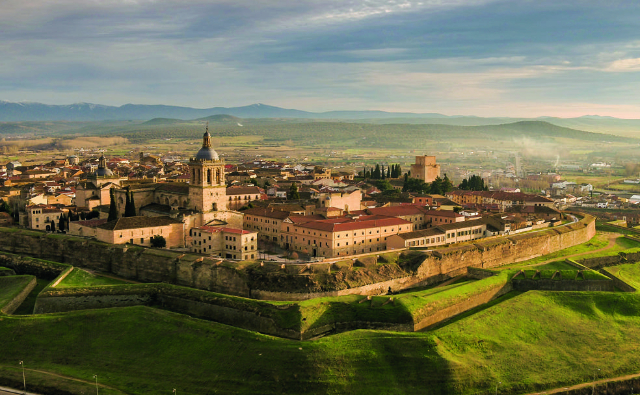

The charm of fortified cities is undeniable, their walls preserve the urban layout and architecture of other times; but there are few whose walls explain the evolution of history as well as Ciudad Rodrigo , in the southwest of Salamanca.Ciudad Rodrigo is a city near Spain's border with Portugal. It’s known for its Old Town and 12th-century city walls. It is a small city of less than 15,000 people. The site on which Ciudad Rodrigo stands, a rocky hill on the banks of the river Águeda, has been populated since the Neolithic period. Around the 6th century BC, the vetones, a tribe of Celtic origin, founded the city of Miróbriga and settled there. Four centuries later, the Romans conquered the city and re-named it Augustóbriga in honour of the emperor Octavian Caesar Augustus.

Dating to this period are the Three Columns, an enigmatic monument that still stands at the foot of the city's entrance. The object of centuries of dispute between the Arabs and Christians, this fortified town was repopulated in 1100 by Count Rodrigo González Girón, from whom it took its definitive name. King Ferdinand II of León completed the repopulation of the area and undertook several ambitious projects, including the fortification of the city and the restoration of the old Roman port. It was also during his reign that the city regained its status as an Episcopal See and that works on the Cathedral commenced. The main buildings of the historic quarter, which is an Historic-Artistic Site, date back to the 15th and 16th centuries, a period during which the city enjoyed its golden age. The main defining feature of the city is the imposing medieval wall that surrounds it.
This was constructed in the 12th century during the reign of Ferdinand II, although alterations were subsequently carried out during the 18th century. The walled enclosure has a perimeter in excess of 2 kilometers and seven gates, the oldest of which are the Puerta del Sol and the Puerta de Santiago.

The Puerta de la Colada leads to the promontory on which the Castle of Henry II was erected by order of the king in 1372. A square-plan keep presides over the fortress. The complex currently houses the city's parador.
Situated in the Plaza Mayor, or main square, are several stately buildings, such as the House of the First Marquis of Cerrablo, the 16th-century Casa de los Cueto, and the City Hall. The latter was constructed during the mid-16th century in the Renaissance style but also contains elements added at the beginning of the 20th century. Its main façade has two emblazoned towers and a gallery supported by columns with plateresque capitals. The boom enjoyed by the city during the Renaissance period gave rise to the emergence of numerous palaces and mansions. One of the most outstanding of these is the so-called Palacio de los Castro with its beautiful plateresque portal flanked by spiral columns crowned by figures of lions. Particularly noteworthy in this context is the Palacio de los Águila (16th-17th centuries), an austere mansion adorned with the coats of arms of its former owners. A tour of the city could also include the Neo-Gothic Palacio de la Marquesa de Cartago constructed during the 19th and 20th centuries, the Moctezuma palace, which now houses the municipal cultural centre, the so-called Casa de los Vázquez, now the main post office, and the Palace of the Count of Alba de Yeltes.


