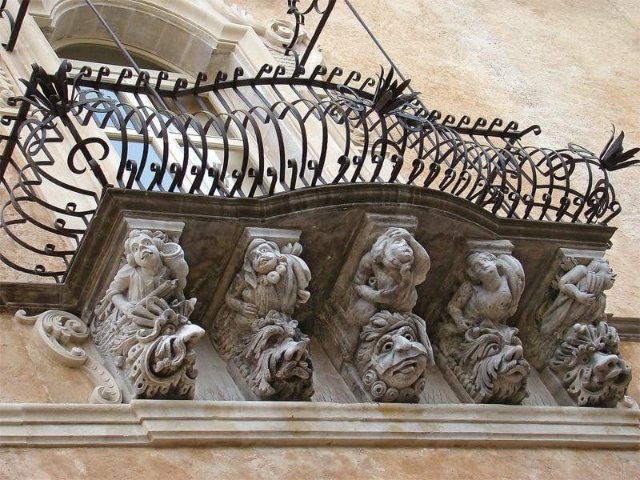
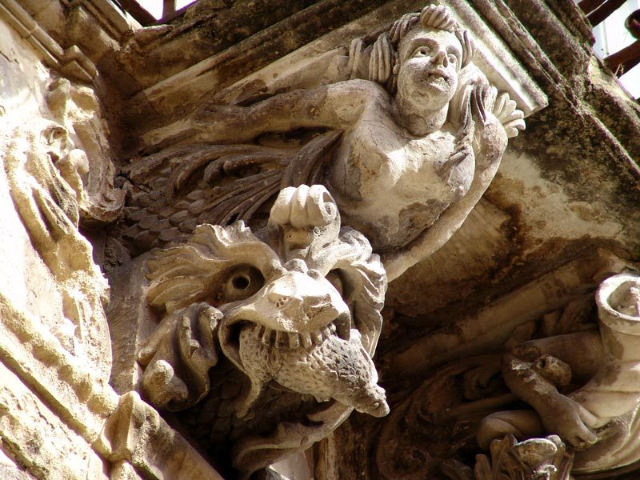
Palazzo Cosentini, one of Ragusa's most charming Baroque mansions, is distinguished by its colorful and richly detailed balconies, which are among the most characteristic in the city. This residence is one of Ragusa's monuments that is part of the UNESCO serial site of the Late Baroque Towns of the Val di Noto.The history of Palazzo Cosentini begins in the late 18th century, when Baron Raffaele Cosentini and his son Giuseppe decided to have it built. The building is located at a strategic point, where two important communication routes of the ancient city intersected. The first is the Salita Commendatore, a flight of steps that was once the only link between the upper and lower parts of Ragusa. The second was the San Rocco road, which passed in front of the church of the same name and connected to the country roads leading to Comiso and Chiaramonte Gulfi. For this reason, in the two corners of the main elevation of the building, there were statues of the protectors of wayfarers. One was dedicated to St. Francis of Paola and is still visible, while the other, unfortunately lost in the course of time, represented St. Christopher or St. Roch.Architecturally, Palazzo Cosentini has an irregular rectangular plan and is spread over three distinct floors. Its elevations are characterized by pilasters ending in elegant composite capitals, windows richly decorated with friezes and fine details, and splendid balconies. The large front door, which faces Commendatore Street, is preceded by four steps and is decorated with two tall pillars that emerge slightly from the wall. Above the main door is the first of four artistic balconies of this magnificent Baroque mansion. In the past, the Palace was connected by stairs and internal passages to the nearby Church of Santa Maria dell'Itria, where the Cosentini family had the Chapel of the Crucifix built.The balconies of Palazzo Cosentini represent the distinctive element of this residence. As in other splendid Baroque residences of the Sicilian East, such as Palazzo Bertini in Ragusa, Palazzo Nicolaci in Noto, Palazzo Beneventano in Scicli or Palazzo Napolino in Modica, the typical grotesque masks can also be admired here. The balcony located in the Salita Commendatore is known as the "balcony of backbiting." Five human-like masks hold symbolic animals such as snakes and scorpions in their mouths. Their ghastly appearance contrasts with the five sweet-looking female figures above them. Continuing along Mazzini Street, three more balconies can be seen. In the first, also known as the "balcony of the storyteller," a figure with a scroll in his hand, perhaps a script to be recited accompanied by figures playing various musical instruments, is depicted in the center. The second is the "balcony of abundance," where female figures are depicted with symbols of prosperity such as fruit and cornucopias. The last is the so-called "gentleman's balcony," where an innkeeper with a barrel, a flute player, and a female figure paying her respects to the noble lord can be recognized. The latter is depicted in a common manner and could possibly portray a member of the Cosentini family.Palazzo Cosentini, with its charming balconies and rich history, is an important testament to Ragusa's Baroque architecture and continues to enchant visitors with its timeless beauty.