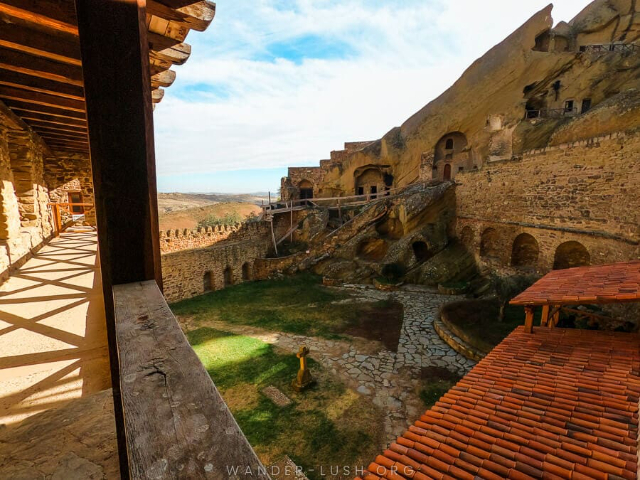
High in the cliffs of eastern Georgia, along its rugged and remote border with Azerbaijan, lies the Davit Gareja monastery complex, a remarkable and historic site consisting of 19 medieval cave monasteries. Carved into the rocky slopes, these monasteries are not only a testament to religious devotion and ascetic life but also to the endurance of spiritual and artistic traditions throughout the centuries.

Davit Gareja is renowned for its cultural and historical significance. Established in the 6th century by Saint David Garejeli, one of the thirteen Assyrian monks who came to Georgia to spread Christianity, the complex soon became a center of monastic life and Georgian Orthodox scholarship. Over the centuries, it expanded to house nearly 5,000 monk cells and numerous chapels, each adorned with unique frescoes, which are considered masterpieces of Georgian art.
The landscape surrounding Davit Gareja is as breathtaking as it is harsh, characterized by semi-desert and steppe, with the complex itself perched high on the cliffs, offering panoramic views of the expansive surroundings. This isolation adds to the spiritual gravitas of the site, where the sounds of monk chants occasionally pierce the silence, resonating through the deserted steppe.
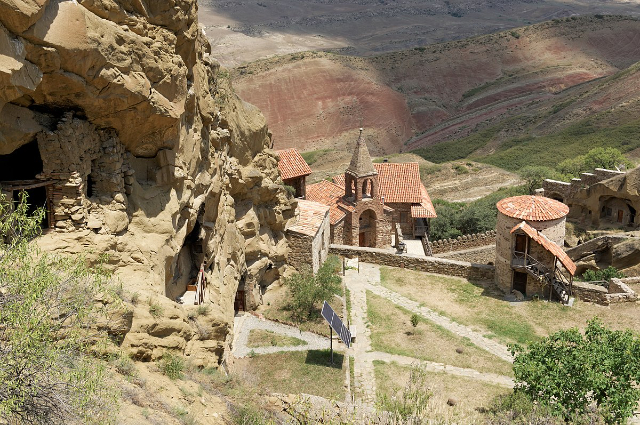
Today, while much of the complex remains in ruins, one cave still functions as an active monastery. This continuity of monastic life amidst ruins speaks volumes about the enduring spiritual legacy of Davit Gareja. Visitors to the site can explore the caves and chapels, each offering a glimpse into medieval Georgian monastic life and the region’s rich history.
Davit Gareja remains a pilgrimage site and a significant cultural landmark, attracting both the faithful and tourists who are drawn to its historical significance, spiritual ambiance, and stunning natural environment. It is a place where history, art, and spirituality intertwine against a backdrop of dramatic landscapes, making it one of Georgia’s most revered and mesmerizing sites.