



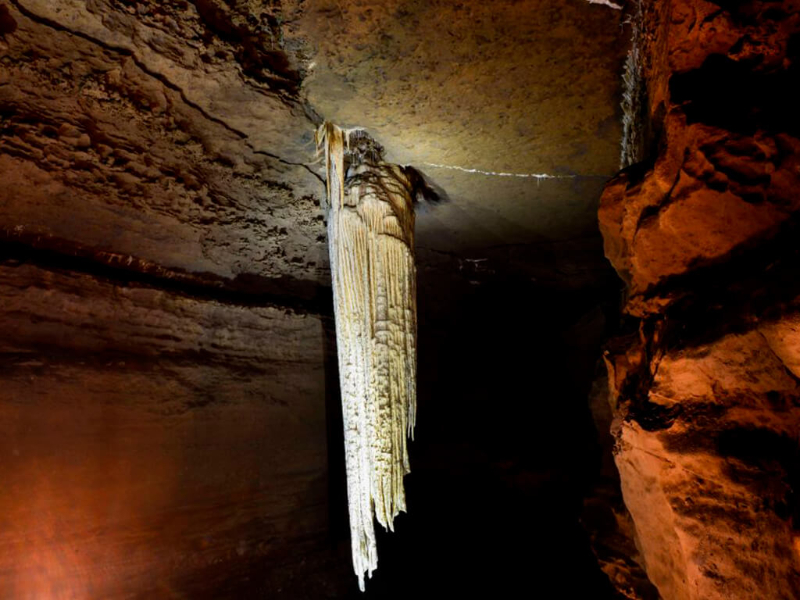
Doolin Cave was opened in 2006 and boasts a Great Stalactite that distinguishes these recent caves.
Also called Pol an Ionain (or Poll-an-Ionain), the limestone cave is located near the town of Doolin in County Clare, Ireland, at the western end of the Burren. At Doolin Cave you can discover striking environments and, of course, the just-mentioned Great Stalactite, the longest stalactite in the northern hemisphere. The birth of this landscape began with the death of another. Under the sea some 360 million years ago, marine animals, plants, shells and corals accumulated over many thousands of years, forming thick beds of limestone.
This compaction of marine life and subsequent limestone formation were unevenly distributed due to the movement of ocean currents. Areas of shale rock, less resistant to erosion, formed between these beds, and the resulting topography of the Burren is characterized by terraces and cliffs.
Climate change is not a new phenomenon, and the history of our world has been marked by several periods of extreme weather changes. These periods have commonly been called "ice ages," the most recent of which began about two million years ago. Since then, the Burren has been covered by ice several times, the last known period of glacial cover ending 12,000 years ago. Limestone pavements, a distinctive feature of the Burren landscape, are the result of ice scraping away surface debris of soil, stones, and the upper layer of rock. Thus, when the ice melted, a massive uneroded rock surface was exposed.
The term "karst" is used to describe soils with characteristic shapes and drainage due to the combination of high rock solubility and well-developed subsurface drainage through solution channels. The Burren is a superb example of glacial karst, where the unusual karst shapes are even more special because of recent glaciation. The Burren is internationally famous, not only for its beautiful limestone landscapes, but also for the region's remarkable flora and rich archaeological heritage. The term "Burren" is synonymous with "karst" because both terms are derived from words meaning "stony place," but Burren comes from Gaelic and Karst from Old Slavic.
Ice and water have sculpted the Burren's current landscape. The Burren's typical paved surface has been shaped and sculpted into features such as pits, depressions, streams and channels known collectively as "karren." The erratics are the result of glacial deposition. Rocks and boulders were carried by the ice as it slowly moved southward and were then deposited as the ice receded. All of these processes created the strange but beautiful landscape of today, from the cracked pavements to the intricate network of caves.
Buried deep beneath the Burren's surface, another world exists. Uninterested in convention or human concerns, it has flourished with unbridled creativity in its mission to carve out a niche for itself. This is the realm of nature.
In addition to the rain falling directly on the limestone, streams that originate on other impervious rocks usually sink soon after passing over the limestone, just like the stream that sinks at the entrance to Doolin Cave. After passing through caves, water emerges from springs, although these may be on the coast or even under the sea.
The discovery of Doolin Cave Doolin Cave, home of the giant stalactite. In his poem The Forge. Seamus Heaney wrote, "All I know is a door in the dark," and this is the fate of cavers and cavers everywhere.
In 1952, a group of explorers arrived in Lisdoonvarna, a small town in northern County Clare located 5.4 kilometers from the present entrance to Doolin Cave. These men were uncertain of what they might find, but they were excited by the prospect of traveling beneath the undocumented underworld of the Burren.
Called the Whitsuntide Expedition because they arrived on the weekend of the Feast of Pentecost or June, these intrepid adventurers had no idea that their team members would stumble upon Doolin Cave.
The group of 12 men, most of whom were students, was part of an expedition sent by the Craven Hill Potholing Club from the Yorkshire Dales in Britain. Nine of the 12 stayed at the Irish Arms Hotel in Lisdoonvarana and three camped on a nearby hill. That Pentecost Sunday two men who had been camping, Brian Varley and J.M. Dickenson, broke away from the group and decided to go exploring near a rock face they had seen the previous day. As they made their way through the limestone floors, they noticed a small stream that seemed to disappear under the large cliff. Following the water, they retrieved some boulders and made their way through a narrow passage and then crawled about 500 meters, finally reaching the main chamber of the cave. This crawl was described by other cavers who visited the cave as a "miserable and knee-destroying crawl." Arriving at the cave's main chamber, the men described what they had seen:
"Climbing over the boulders, we found ourselves speechless in a large chamber, of wide width, impressive length and height. As our lamps went around this large chamber, we spotted a giant stalactite, certainly more than 30 feet long, the only formation in the chamber and proudly placed right in the center. It is truly majestic and poised like a veritable sword of Damocles. With our headlights not adequately illuminating this huge formation, we headed-believe it or not-to the back of the chamber, not daring to speak lest the vibration of the first voices heard in this chamber since the beginning of time shatter it."
Upon leaving the site, the men decided to pretend to the others in the group that they had found nothing as a joke, but they could not contain their excitement. Instead, when they met them, they jumped into the air shaking their fists recounting their discovery.
