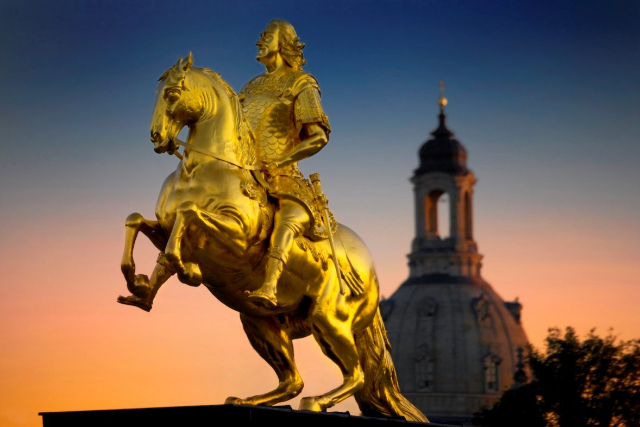

Standing majestically at the heart of Dresden's Neustadt district, the Goldener Reiter (Golden Rider) is more than just a statue—it's a symbol of the city's resilience and rich history. This gilded equestrian statue captures the grandeur of Augustus the Strong, the Elector of Saxony and King of Poland, depicted in the regal guise of a Roman Emperor. Perched proudly along Hauptstrasse, Dresden's bustling main pedestrian boulevard, the statue gleams with historical significance and artistic splendor.
### History and Origins The story of the Goldener Reiter begins in the early 18th century, a time when Augustus the Strong's ambition to transform Dresden into a cultural capital of Europe was in full force. Commissioned in 1733, shortly after Augustus’s death, the statue was crafted by sculptor Ludwig Wiedemann. It was intended to immortalize Augustus's vision of Dresden as the 'Florence on the Elbe'. Over the centuries, the statue has borne witness to Dresden's tumultuous history—from the ravages of World War II to the peaceful reunification of Germany.
### Art and Architecture The Goldener Reiter is a masterpiece of Baroque art, a style characterized by its grandeur and detail. Crafted from bronze, the statue is coated with gold leaf, giving it an eternal luster that catches the eye from afar. Augustus's figure is shown on horseback, exuding power and confidence, mirroring the aesthetic of Roman emperors. This artistic choice highlights his desire for political legitimacy and cultural sophistication.
### Local Culture and Traditions Dresden's Neustadt, home to the Goldener Reiter, is a vibrant district known for its artistic spirit and cultural dynamism. The area frequently hosts festivals, such as the Bunte Republik Neustadt, a lively street festival celebrating diversity and creativity. Visitors can immerse themselves in local traditions, including the Striezelmarkt, one of Germany's oldest Christmas markets, where the air fills with the scent of gingerbread and mulled wine.
### Gastronomy While exploring the area around the Goldener Reiter, indulge in Saxon culinary delights. Try Sauerbraten, a marinated pot roast, or Dresdner Stollen, a rich fruit bread traditionally enjoyed during Christmas. Pair these with a glass of Radeberger Pilsner, a local beer brewed just a short distance from the city, to taste the essence of Dresden.
### Lesser-Known Curiosities Beyond its historical and artistic significance, the Goldener Reiter hides intriguing secrets. During World War II, the statue was dismantled and stored safely to protect it from bombing raids, showcasing the city’s dedication to preserving its heritage. Few know that the statue faced the threat of being melted down for metal, yet it survived, a testament to Dresden's enduring spirit.
### Practical Visitor Information The best time to visit the Goldener Reiter is during spring or early autumn when the weather is pleasant for strolling along Hauptstrasse. As you approach the statue, notice the intricate details of Augustus’s attire and the horse’s posture, each a testament to Wiedemann's craftsmanship. Nearby, explore the eclectic shops and cafes of Neustadt, offering unique souvenirs and local flavors.
For a personalized itinerary to fully experience Dresden, try using the Secret World app to uncover the city's hidden gems and cultural treasures.
