
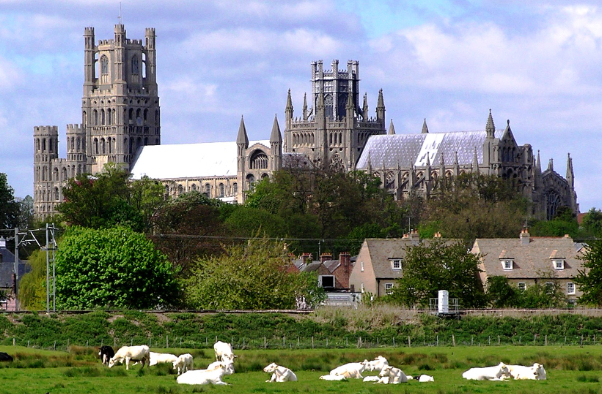

Rising majestically from the flat Fens of Cambridgeshire, Ely Cathedral stands as a beacon of history, art, and spiritual significance. Often referred to as "The Ship of the Fens" due to its towering presence amid the low-lying landscape, this awe-inspiring structure offers a journey through time with every step along its stone floors.
The origins of Ely Cathedral date back to 673 AD when St. Etheldreda, a Saxon queen, founded a monastery on the site. A woman of remarkable piety and strength, Etheldreda's legacy continued long after her death, as the monastery became a significant religious center. After being destroyed by Danish invaders in 870, it was refounded in 970 by King Edgar. The current cathedral, however, began to take shape in 1083 under the direction of Abbot Simeon and was consecrated in 1109, marking the establishment of the Diocese of Ely. Throughout its history, the cathedral has witnessed pivotal events, including the English Reformation and the Civil War, each leaving its indelible mark on the structure and its community.
Architecturally, Ely Cathedral is a treasure trove. It showcases the transition from Norman Romanesque to Gothic styles, with its most striking feature being the Octagon Tower. Completed in 1342 after the original Norman central tower collapsed, this octagonal marvel is a masterpiece of medieval engineering. Its lantern, a delicate structure of wood and glass, floods the nave with celestial light, creating a sense of divine presence. The cathedral is also home to the Lady Chapel, renowned for its intricate carvings depicting the life of the Virgin Mary, and the Prior's Door, a stunning example of Romanesque art with its elaborate carvings.
Ely's connection to its cathedral runs deep into the cultural fabric of the city. Each year, the Feast of St. Etheldreda is celebrated with fervor, drawing visitors and locals alike to honor the city's patron saint. The Ely Cathedral Christmas Gift & Food Fair is another highlight, transforming the nave into a festive marketplace that embodies the community spirit. The cathedral's choral tradition, dating back centuries, remains a vital part of local culture, with its choir performing regularly at services and special events.
No visit to Ely is complete without sampling the local gastronomy, tightly interwoven with its history. The Fens, rich in agriculture, provide a bounty of fresh produce. Look for Ely Gin, infused with local botanicals, and Fenland celery, a regional specialty with a distinct flavor celebrated at the annual Fenland Celery Festival. Local eateries often feature dishes with freshly caught river fish and locally sourced lamb, offering a taste of the land's richness.
Beyond its well-known features, Ely Cathedral holds lesser-known curiosities that intrigue the discerning visitor. The cathedral's stained glass museum, tucked away in the South Triforium, is a hidden gem, displaying a vibrant collection from the medieval period to contemporary works. The cathedral also houses the Ely Porta, a 14th-century gateway that once protected the monastic precincts and now stands as a testament to the cathedral's enduring past. Legend has it that Oliver Cromwell, once a resident of Ely, is said to have stabled his horses inside the cathedral during the English Civil War, a story that adds a touch of rebellious charm to this sacred space.
For those planning a visit, the best time to experience Ely Cathedral is during the spring and early summer months when the Fens are in full bloom, and the cathedral's gardens are at their most vibrant. Arriving early in the day allows for a more intimate exploration before the crowds gather. Be sure to climb the Octagon Tower for an unparalleled view of the surrounding landscape, and don’t miss a guided tour, which offers deeper insights into the cathedral’s rich history and architecture.
Whether drawn by its historical significance, architectural grandeur, or cultural richness, Ely Cathedral offers an unforgettable experience. It is a place where history and spirituality coexist, inviting visitors to reflect on the passage of time and the enduring power of faith and community.


