


The smell arrives before everything else. A resinous and sweetish fragrance, almost medicinal, that weaves through the narrow streets of the medina even before your eyes adjust to the light filtered through the alleys. It is the scent of thuya wood, a conifer endemic to the Moroccan forests of the Atlas, whose gnarled root has been worked by the artisans of Essaouira for generations. The shops are open from early morning, and the rhythmic sound of chisels on wood blends with the Atlantic wind that blows steadily over the city, earning it the local nickname of “City of Wind”.

Essaouira is located on the Atlantic coast of Morocco, about 175 kilometers north of Agadir. Its medina was inscribed on the UNESCO World Heritage List in 2001, a recognition that solidified the value of an urban center built in the 18th century by the cartographer and engineer Théodore Cornut, called by the Alawite sultan Mohammed ben Abdallah around 1765. The city still bears the marks of that rational planning: the streets intersect almost orthogonally, unusual for a North African medina, and the honey-colored limestone walls delineate a compact urban space that can be walked in less than an hour.
The thuya wood souk: a centuries-old craftsmanship
The commercial heart of the medina is concentrated along the Avenue de l'Istiqlal and in the adjacent streets, where dozens of shops display objects carved from thuya wood: inlaid boxes with threads of lemon and cedar, chessboards, frames, trays decorated with geometric patterns. Thuya wood has a distinctive visual characteristic: the root, once polished, reveals circular grains and knots that almost look hand-painted. Artisans often work sitting at the shop's doorstep, and it is not uncommon to stop and watch a master transform a raw block into a finished object in just a few minutes.
Prices vary greatly depending on the size and complexity of the piece: a small box can cost between 50 and 150 Moroccan dirhams, while more elaborate objects reach much higher figures. Bargaining is an integral part of the experience, but it should be practiced with respect and without haste. Artisans appreciate those who stop to observe the work before asking for the price.

Colors and atmosphere: white, blue, and the salt of the Atlantic
The walls of the medina are painted white and blue — not the vibrant turquoise of Chefchaouen, but a more subdued blue, almost faded by the sun and the sea wind. This color palette, along with the dark wooden doors and wrought iron lanterns, creates a coherent and recognizable visual atmosphere. The clothes hung between the balconies, the crates of fresh fish carried on the shoulders of men coming up from the port, the cats sleeping on the thresholds: these are details that repeat every day and constitute the visual rhythm of daily life.

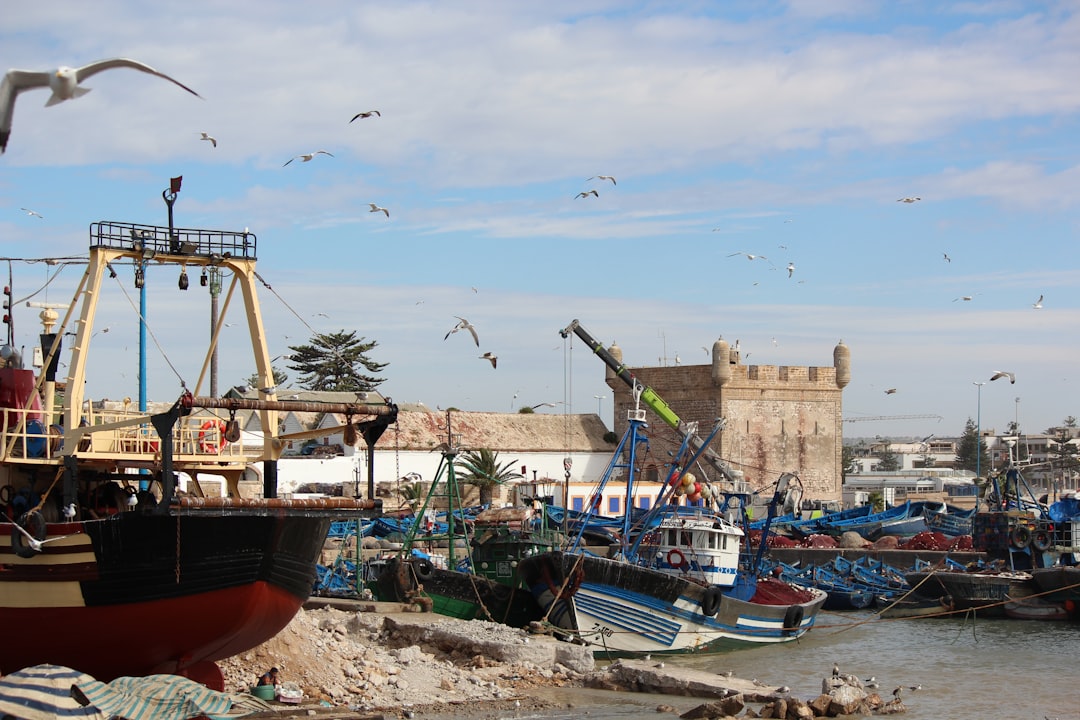
The fishing port, just outside the southern walls, deserves a separate visit. Early in the morning, when the boats return, the dock transforms into an improvised market where sea bream, scorpion fish, octopus, and squid are sold. The grilled fish stalls along the quay are frequented by both locals and visitors, and the price of a simple meal — fresh fish with bread and olives — is around 50-80 dirhams.
The spice and food souk
Less touristy than the wooden shops, the food market inside the medina takes place in a series of covered alleys near the Place Moulay Hassan, the main square. Here you can find piles of loose spices — turmeric, smoked paprika, ras el hanout in its infinite variations — alongside vendors of marinated olives, local cheeses, and argan oil, the oil extracted from the fruits of the argan tree, typical of the Souss-Massa region. Argan oil is sold in both food and cosmetic versions, and the price difference between authentic products and lower quality ones can be significant.
This corner of the medina is frequented mainly by locals and retains an authenticity that the more touristy alleys have partly lost. Vendors rarely speak European languages, but communication happens nonetheless, through gestures and smiles.
Practical tips for visiting the medina
The best time to visit the souks is in the morning, between 9 and 12, when the light is softer, the wind has not yet reached its afternoon intensity, and the shops have just opened. On Friday mornings, many shops remain closed or open late for prayer. The medina is entirely pedestrian and can be comfortably walked: wearing comfortable shoes is essential, as the alleys are paved with uneven stones. Essaouira can be reached by bus from Marrakech in about three and a half hours, or by private transfer. A guide is not necessary to find your way: the medina is small and the risk of getting lost is minimal; in fact, spontaneous detours are often the most interesting.


