


The free ferry that connects Fårö to nearby Gotland takes just a few minutes, but the feeling of crossing a border is immediate. On the island, the landscape changes register: the vegetation becomes sparser, the Baltic wind arrives unobstructed, and the roads almost completely empty, especially in spring, when summer tourists have not yet invaded the coast. Fårö is also known for being the private residence of Swedish director Ingmar Bergman, who settled there in the 1960s and remained until his death in 2007, drawn precisely by this natural austerity.

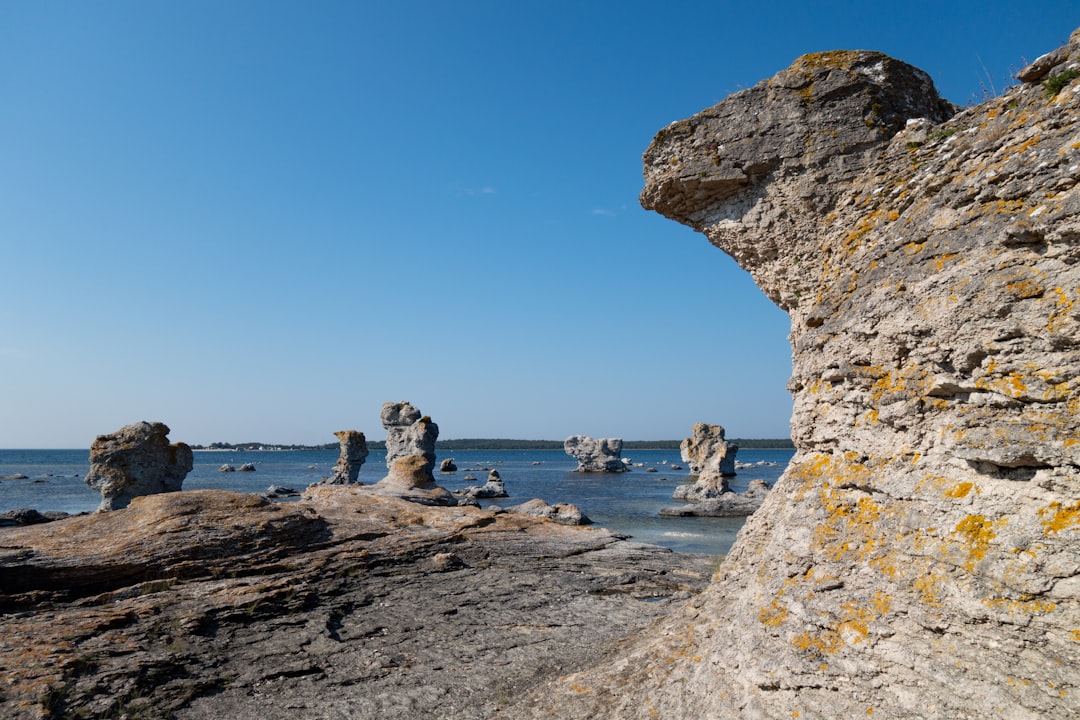
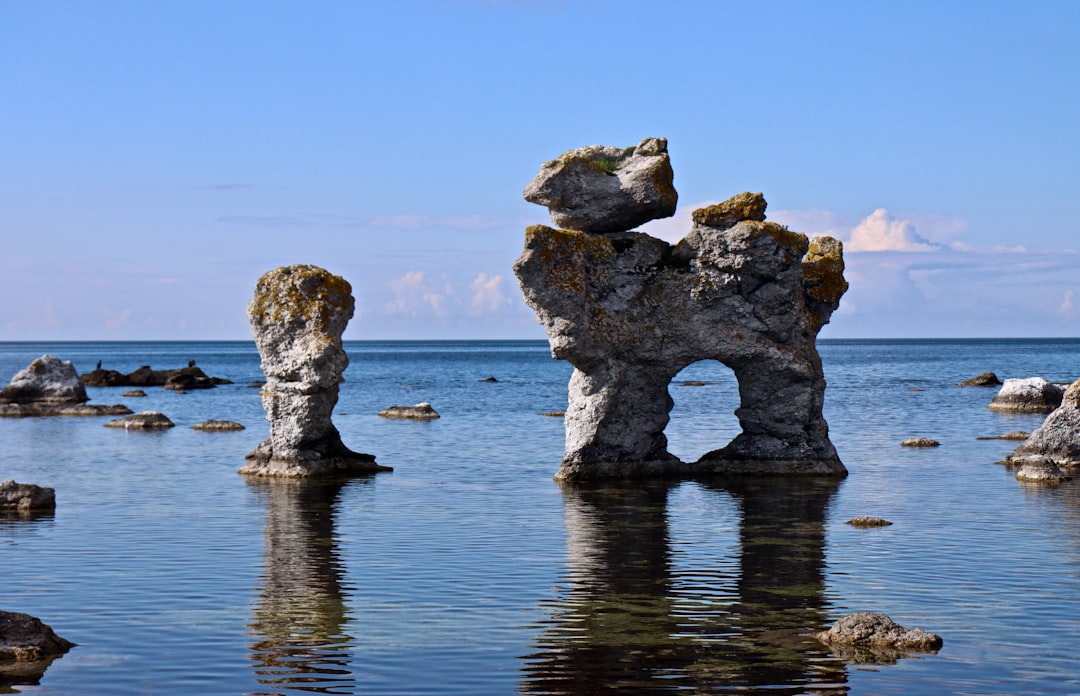
But before Bergman, and independently of him, the island already had its own geological and biological identity that was quite particular. The western and northern coasts are dotted with limestone formations called raukar, columns and pillars of limestone eroded by the sea over millennia, which emerge from the shore like natural sculptures. Some exceed three meters in height. Walking among them means traversing a landscape that seems to belong to another geological era, silent and almost extraterrestrial.
The raukar: limestone sculptures on the Baltic

The raukar of Fårö are mainly found along the coast of Langhammars and Digerhuvud, two protected natural areas in the far north of the island. These formations are the result of the selective erosion of Silurian limestone, a sedimentary rock formed about 400 million years ago when this area was covered by a shallow tropical sea. Fossils of corals, crinoids, and mollusks can still be found in the limestone, visible to the naked eye on the smooth surfaces of the raukar.
At Langhammars, the columns are particularly dense and tall, some with shapes resembling mushrooms or crenellated towers. The ground around is covered by a carpet of gray and yellow lichens that grow slowly on the stone, giving the landscape an almost monochromatic color palette. In spring, among the crevices of the rocks and in the surrounding sandy meadows, wild orchids typical of the limestone areas of Gotland bloom, including the Dactylorhiza sambucina, the elderflower orchid, recognizable by its yellow or red-purple flowers.
Fauna and biodiversity: a surprisingly rich island
Despite its small size — Fårö measures about 113 square kilometers — the island hosts a variety of environments that translates into remarkable biodiversity. The internal wetlands, pine forests, and heather moors create distinct microhabitats. In spring, the migration of birds transforms the coasts into prime observation points: ducks, terns, sandpipers, and various species of waders stop on the island during their movements northward.

Along the Baltic shore, it is possible to observe the common tern (Sterna hirundo) that nests on the gravel beaches, and in some areas, the cormorant drying its wings on the exposed rocks. In the quieter forested areas, the great spotted woodpecker and the hoopoe are documented presences. The absence of large terrestrial predators and the low human density make the animals relatively unshy, which facilitates observation even for those who are not expert birdwatchers.
The plant landscape: among pines, heather, and dunes
The interior of Fårö alternates between forests of Scots pines and open heaths dominated by common heather (Calluna vulgaris), which in August colors the island purple. The coastal dunes, stabilized by grasses such as lyme grass (Leymus arenarius), protect the inland from winds and create a microclimate favorable to plants adapted to nutrient-poor sandy soils.
In some wet areas, there are peat bogs with sphagnum moss and carnivorous plants like drosera, a botanical rarity that attests to the quality of the water and the integrity of the ecosystems. The combination of calcareous substrate in some areas and acidic soils in others creates an unusual floral variety for an island of this size, with species that normally do not share the same territory.
How to visit Fårö: practical tips
The ferry to Fårö departs from Fårösund, in the northern part of Gotland, and is free. The trips are frequent during the day and the journey takes about five minutes. To reach Gotland from Stockholm, you can take the ferry from the mainland (from Nynäshamn or Oskarshamn) or a flight to Visby, the capital of the island.
The best time to visit Fårö with a focus on nature is May and June: the orchids are in bloom, bird migration is at its peak, and the island has not yet reached the tourist saturation of summer. In August, the influx increases significantly. On the island, services are limited — a small shop, a few seasonal restaurants — so it is advisable to bring water and food for excursions. The areas of Langhammars and Digerhuvud are accessible by car and have small parking lots; from there, you can walk among the raukar without mandatory paths, which requires attention to the uneven terrain.


