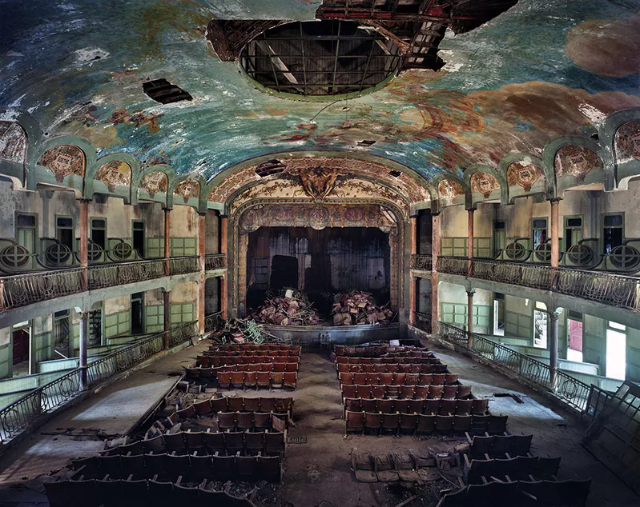


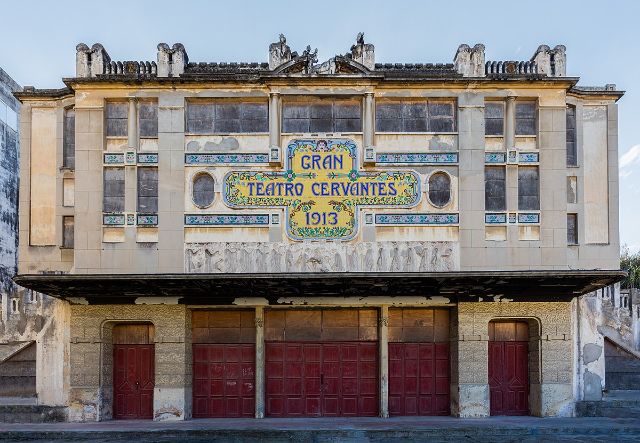
Like an old movie star, the Cervantes Grand Theater in Tangier still remains fascinating despite having fallen into a state of decay. In fact, it has not been abandoned to its fate-over the years attempts have been made to preserve the building and bring it back to life, unfortunately without success so far. Its history is detailed below, but first there is an important fact you should know: the Gran Teatro Cervantes was the largest and most successful theater in all of North Africa until the mid-20th century.If you love history, try to take a walk in front of the theater's facade as you explore Tangier-it still has a wonderful sign with the opening date: 1913. Despite its somewhat desolate appearance, it still retains a touch of glamour and has beautiful metal doors, reliefs, sculptures, and decorations on the facade.Anyone who remembers its past glamour with first nights, parties and balls cannot help but feel regret as renovations continue and the ugly duckling fails to become the swan it once was, the beauty this historic theater deserves to be.Between 1911 and 1913, a combination of personal initiative and determination led Esperanza Orellana, her husband Manuel Peña, and entrepreneur Antonio Gallego to create a grand theater in Tangier. It was to be a building that everyone could be proud of. The opening night attracted the finest members of society, including Hadj Ben Abdessadak, the pasha of Tangier. From then on, its stage was frequented by famous artists who performed the likes of Shakespeare's Othello. The theater's 1,400 seats sold out quickly, and you had to be quick if you wanted to catch a performance. Artists such as Lola Flores, María Cabellé, Enrico Caruso, Imperio Argentina and Juanito Valderrama trod the stage.The appeal of these great operas and musical performances spread throughout the city to add a touch of sparkle to private parties and New Year's Eve celebrations that no one could miss. However, its star began to decline over the decades, and its last show was performed in the 1980s. The space continued to be used until the 1990s, but in the latter period one last photo exhibition was held in 1993, and then its fate was sealed.If you visit the theater today, you will see that it is in a state of neglect both inside and outside, and that it is too dangerous to explore the interior. Yet it was not abandoned by the Spanish state: in 2019 it donated it to Morocco with the following conditions: the restoration should respect its architecture, it should keep its name, and there should be an element of Spanish culture in its program. A three-year deadline has been set to complete the restoration work, but little progress has been made so far. We currently know only that construction work resumed in October 2021 and that the Moroccan government has agreed to bear the full cost of restoration, operation, and maintenance.