



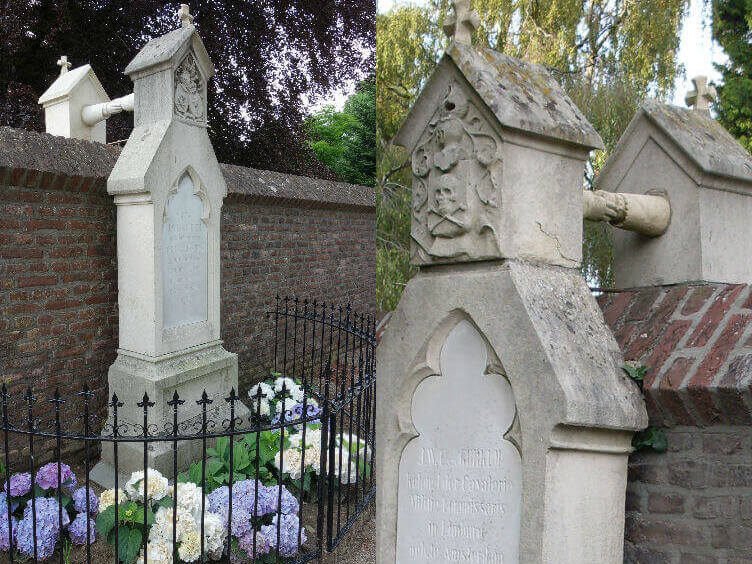
In the quaint Dutch town of Roermond, a poignant story unfolds in the local cemetery, where the graves of a Catholic woman and her Protestant husband stand in silent testimony to a love that transcended the divisions of their faith. This unique burial arrangement has intrigued visitors and locals alike, reflecting not only the personal history of the couple but also the broader social and religious dynamics of 19th-century Netherlands.

The tale begins in 1842, when Lady J.C.P.H. van Aefferden, a 22-year-old Catholic, wed Colonel J.W.C. van Gorcum, a 33-year-old Protestant and a member of the Dutch Cavalry. Their marriage was a source of controversy in a deeply divided society where religious affiliations dictated social standings and communal acceptance. The couple's union sparked discussions in Roermond, as Colonel van Gorcum, lacking noble lineage, married into a prominent family, challenging societal norms.
After 38 years of marriage, Colonel van Gorcum passed away in 1880, and was laid to rest in the Protestant section of the cemetery, notably against the wall—symbolizing the barriers that their faiths imposed even in death. His wife, Lady van Aefferden, died in 1888 and made a deeply symbolic choice to be buried not in the family tomb but on the Catholic side of the wall, as close to her husband as possible. This poignant decision is immortalized by a pair of clasped hands that connects their graves across the wall, serving as a silent reminder of their enduring love despite the ecclesiastical divide.
The cemetery itself is a reflection of the architectural styles of the era, showcasing intricate headstones and memorials that date back to the 19th century. Each grave tells its own story, with ornate carvings and inscriptions that speak to the lives and contributions of those interred. The juxtaposition of the Catholic and Protestant sections serves as a visual representation of the historical tensions between these two faiths in the region, making it a site of both historical and artistic significance.
Roermond is not just a historical site; it is a town rich in culture and traditions. One of the most notable festivals is the Roermond Carnival, typically held in February, where locals don elaborate costumes and participate in parades filled with music, dancing, and merriment. This annual event showcases the community spirit and brings together people from various backgrounds, much like the story of Lady van Aefferden and Colonel van Gorcum.
Culinary enthusiasts will find that Roermond offers a taste of traditional Limburgian cuisine. Dishes such as Limburgian vlaai, a fruit pie made from a buttery pastry filled with cherries or plums, are local favorites. The town also boasts a variety of cozy cafes and bistros where one can enjoy a glass of Limburgian beer or sample local cheeses, further enhancing the cultural experience.
For those seeking lesser-known curiosities, consider the cemetery itself, which is a historical gem. The story of Lady van Aefferden and Colonel van Gorcum is just one of many that reflect the rich tapestry of Roermond's past. Visitors may also discover hidden graves of other notable figures from the region, each with stories waiting to be uncovered.
The best time to visit Roermond is during the spring and summer months, when the weather is pleasant and the surrounding landscape is in full bloom. The cemetery is open year-round, allowing for quiet reflection and exploration. Visitors are encouraged to take their time, reading the inscriptions and contemplating the stories of those who came before.
As you wander through the cemetery, look for the clasped hands linking the two graves; it’s a powerful symbol of love that defied time, beliefs, and social norms. This intimate connection between Lady van Aefferden and Colonel van Gorcum serves as a beautiful reminder of the enduring nature of love and commitment.
To truly immerse yourself in the rich history of Roermond and its surroundings, consider using the Secret World app to create a personalized itinerary that highlights the town's remarkable stories.
