Trip.Planner
En · Travel Guide
Travel Guide · 2026 Edition

10 Best Day Trips from Bath — by train, car, and boat

Where to go, how to get there, and what to do when you arrive — from someone who has made every one of these journeys more than once

L
Words by
Lena Hofmann
Updated
18 September 2026
Read time
12 minutes
Includes
6 places · interactive map
10 Best Day Trips from Bath — by train, car, and boat
Bath is a city that makes you feel slightly guilty for leaving. The Roman Baths, the Georgian terraces, the Abbey catching afternoon light — it all conspires to keep you rooted. But after a day or two, the surrounding landscape starts to assert itself, and you realise that Bath's real gift is its position: perched at the edge of the Cotswolds, a short drive from the Severn estuary, within striking distance of Wiltshire's prehistoric heartland and the Somerset Levels. It is, in travel terms, extraordinarily well-placed.

A good day trip from Bath has to clear a few bars. First, it needs to be genuinely reachable — under ninety minutes each way by whatever means you're using, or the journey eats the day. Second, it needs to offer something Bath itself doesn't: wildness, silence, a different kind of history, a view that resets your sense of scale. Third — and this is the one most travel writing ignores — it needs to work logistically. Parking that doesn't exist, trains that stop running at four in the afternoon, sites that close on Tuesdays: these are the things that turn a good idea into a bad afternoon.

I've done all ten of the trips in this piece by multiple means of transport, in different seasons, at different times of day. What follows is not a list of the most famous places near Bath. It's a list of trips that actually work — where the journey is manageable, the payoff is real, and you can be back in time for dinner on Milsom Street. That's the standard I'm holding myself to. Let's go.

At a glance

  1. Avebury henge and stone circles: prehistoric marvels that you can actually walk through
  2. The West Kennet Long Barrow: five thousand years old, and you can walk inside
  3. Stourhead: a magical, tranquil vision of English landscape gardening at its most deliberate
  4. Chepstow Castle: Wales's oldest fortification — and the tidal river below it is half the story
  5. Low Lighthouse in Burnham-on-Sea: England's most eccentric lighthouse, at the edge of the Somerset Levels
  6. Phillipa Bowers: Scultura e Natura a Glastonbury — art, landscape, and the particular atmosphere of the Somerset hills
3 Archaeological site · 35.4 km

Avebury henge and stone circles: prehistoric marvels that you can actually walk through

Avebury henge and stone circles: prehistoric marvels that you can actually walk through
Avebury henge and stone circles are one of the greatest marvels of prehistoric Britain. Built and substantially altered during the Neolithic period — roughly between 2850 BC and 2200 BC — the henge survives as a massive earthwork enclosing a village, a pub, and several hundred standing stones, some of which weigh over forty tonnes. Unlike Stonehenge, there are no barriers. You walk among the stones. You touch them. That difference in experience is enormous and not enough people know it.

From Bath it's about thirty-five kilometres northeast on the A4 — under an hour by car, and a genuinely pleasant drive through Wiltshire farmland. The site is managed by the National Trust but the henge itself is open ground. Plan for two to three hours: walk the outer circle, explore the two inner circles, and follow the remains of the West Kennet Avenue — a processional route of paired standing stones that once connected the henge to other monuments. The village pub, the Red Lion, sits inside the henge itself, which is a sentence that still strikes me as remarkable.
Insider tip Come on a weekday morning before the coach tours arrive, typically after 10:30am. The National Trust car park fills quickly in summer. There is no entry fee for the stones themselves — only for the museum and manor house.
4 Archaeological site · 35.4 km

The West Kennet Long Barrow: five thousand years old, and you can walk inside

The West Kennet Long Barrow: five thousand years old, and you can walk inside
The West Kennet Long Barrow is a Neolithic tomb in Wiltshire dating to around 3650 BCE, making it older than Stonehenge by several centuries. Researchers believe it was used as a communal burial site for roughly a thousand years before being sealed. What makes it exceptional as a day-trip destination is not just its age — it's the access. You park on the A4, walk fifteen minutes across a field, and then you crouch and enter the burial chambers. No ticket. No guided tour required. Just you, a torch if you've brought one, and several thousand years of human history.

It pairs naturally with Avebury — the two sites are barely two kilometres apart, and a morning that takes in both gives you a coherent picture of Neolithic Wiltshire that no museum can replicate. From Bath, the drive is the same as for Avebury: A4 northeast, around forty-five minutes. The barrow sits on a slight ridge above the Vale of Pewsey and the views back toward the Marlborough Downs are worth the walk alone.
Insider tip Bring a small torch — the inner chambers are dark and your phone light will not do the carved stonework justice. The field path from the A4 layby can be muddy after rain. Wear shoes you don't mind getting dirty. Dawn visits, particularly around the solstices, draw small crowds of people who take this site very seriously indeed.
5 Gardens and Parks · 30.8 km

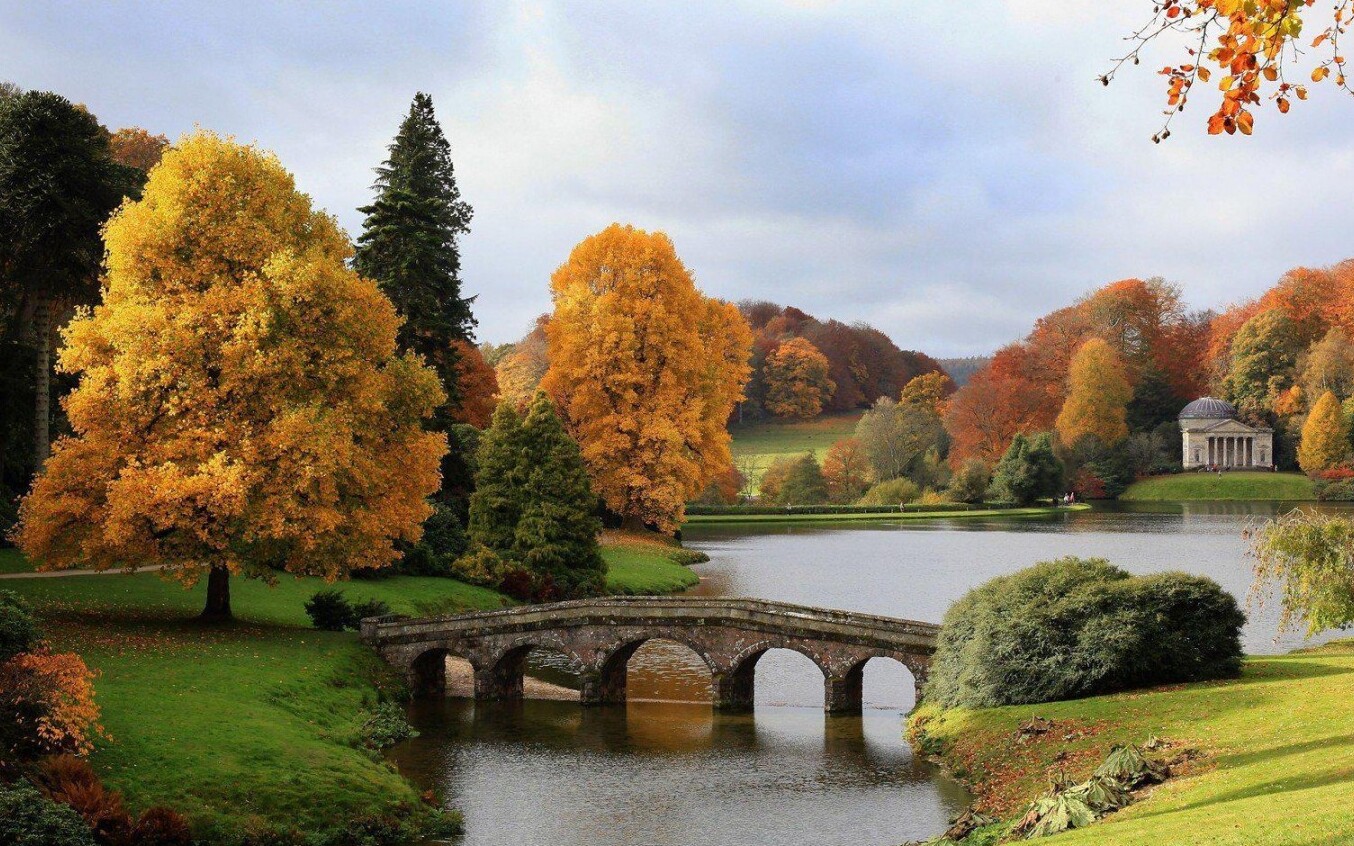
Stourhead: a magical, tranquil vision of English landscape gardening at its most deliberate

Stourhead: a magical, tranquil vision of English landscape gardening at its most deliberate
Stourhead is one of the finest examples of 18th-century English landscape gardening, and the statistics bear that out: a 1,072-hectare estate at the source of the River Stour near Mere in Wiltshire, designed in the 1740s by banker Henry Hoare II as a living painting — temples, grottos, a lake, and woodland paths arranged to create a sequence of views that reference classical antiquity. It is, in other words, a garden built by someone who had read too much Virgil and had the money to act on it. The result is extraordinary.

From Bath it's about thirty kilometres south on the A36 and A303 — around forty-five minutes. Allow at least three hours: walk the full lake circuit (roughly two kilometres), visit the Pantheon temple and the grotto, and climb to the Bristol Cross for the panoramic view back over the water. The National Trust manages the estate; entry is ticketed. The house itself is separately ticketed and worth adding if you have the time.
Insider tip Autumn — October particularly — is when the rhododendrons and beeches turn and the lake reflections are at their most dramatic. Spring brings the azaleas. Summer is the busiest period and the car park can fill before noon on weekends. Arrive by 9am or accept that you'll be walking with crowds.
7 Castle and Historic site · 36.5 km

Chepstow Castle: Wales's oldest fortification — and the tidal river below it is half the story

Chepstow Castle: Wales's oldest fortification — and the tidal river below it is half the story
Chepstow Castle is Wales's oldest fortification, begun in 1067 — just one year after the Norman Conquest — and it sits in a position that makes immediate sense of why it was built here: on a limestone cliff above the River Wye, which has one of the most extreme tidal ranges of any river in the world, dropping by almost fifteen metres between high and low tide. Standing on the castle walls and watching the Wye at different states of tide is to understand medieval strategic thinking in a way that no textbook manages.

From Bath, the train journey involves a change at Bristol Temple Meads and runs to Chepstow station — total journey around an hour to an hour and fifteen minutes. The castle is a short walk uphill from the station. Cadw (the Welsh heritage body) manages the site; entry is ticketed. Allow two hours for the castle, then walk down to the old town bridge for the view back up at the walls from river level. The Wye Valley walk begins here and even a short section of it is rewarding.
Insider tip Check the tide tables before you go — the difference between seeing the Wye at high tide (a broad, brown river) and low tide (a vast expanse of mud with the castle reflected in a thin channel) is significant. Low tide is the more dramatic view. The Cadw website lists opening hours which vary seasonally.
9 Lighthouse and Coastal site · 47.3 km

Low Lighthouse in Burnham-on-Sea: England's most eccentric lighthouse, at the edge of the Somerset Levels

Low Lighthouse in Burnham-on-Sea: England's most eccentric lighthouse, at the edge of the Somerset Levels
The Low Lighthouse is the only active lighthouse in Burnham-on-Sea, and it is one of the stranger structures you will encounter on the Somerset coast. First lit in 1832, it stands not on a cliff or a harbour wall but on nine wooden legs directly on the beach — a small wooden building elevated above the sand like a particularly anxious beach hut. It is the only lighthouse in England mounted on legs, and the reason is practical: the Severn estuary's extreme tidal range means that at low water, the lighthouse needs to be visible from a considerable distance across the exposed mud flats.

From Bath, Burnham-on-Sea is about fifty kilometres southwest — an hour by car on the A39. There is no direct train. The town itself is a traditional English seaside resort, understated and slightly faded in the way that Somerset coastal towns tend to be. Walk the beach at low tide to get close to the lighthouse legs, watch the estuary light change in the late afternoon, and allow time to walk the seafront promenade.
Insider tip Low tide is essential — at high water the lighthouse is surrounded by sea and you can't approach it. Check tide times before you go; the Severn estuary tides are extreme and the difference between accessible and inaccessible is a matter of hours. Late afternoon in autumn gives the best light for photography.
10 Art installation and Gardens · 35.9 km

Phillipa Bowers: Scultura e Natura a Glastonbury — art, landscape, and the particular atmosphere of the Somerset hills

Phillipa Bowers: Scultura e Natura a Glastonbury — art, landscape, and the particular atmosphere of the Somerset hills
This is the least conventional entry on this list, and deliberately so. Phillipa Bowers's sculptural work in the Glastonbury area occupies a space between land art and sensory experience — installations set within the Somerset landscape that engage with the particular character of this place: its mythology, its geology, its light. The work is described as a sensory experience embedded in the historic hills of Glastonbury, and that description is accurate in a way that resists easy summary.

Glastonbury itself is about thirty-five kilometres southwest of Bath — forty minutes by car on the A39. The town is well-known for its festival and its association with Arthurian legend and alternative spirituality, and it wears all of this with cheerful unapologetic energy. The Tor is the obvious landmark — a steep hill topped by a medieval tower, with views across the Somerset Levels that on a clear day extend to the Welsh hills. The Bowers sculpture work adds a contemporary artistic dimension that most visitors miss entirely, and finding it requires some research before you go.
Insider tip Glastonbury is worth visiting outside festival season — the town is quieter, the Tor walk is less crowded, and the particular quality of light over the Levels in October or March is genuinely special. Park in the main town car park and walk; the streets around the Tor are not designed for cars.
What strikes me, having made all these journeys multiple times, is how different Bath feels when you return to it. The city is beautiful in itself — nobody disputes that — but it's also a kind of base camp, a comfortable and well-provisioned place from which to understand a much larger and more varied landscape. The prehistoric monuments of Wiltshire, the tidal drama of the Severn estuary, the limestone geology of the Mendips, the Norman ambitions of the Welsh border: all of it is within a morning's reach, and all of it changes what you see when you walk back through Bath's streets in the evening.

The best day trips are the ones that make you think differently about where you started. By that measure, every destination on this list earns its place. Choose one. Go early. Come back for dinner.
🏆 Pocket guide

Take this guide with you.

Save it offline, get walking directions, and discover thousands more places like the ones you just read.

Save offline Smart routes Hidden gems
Scan to download iOS / Android
Scan for AppGallery Huawei users

All places, on a map

Map data © OpenStreetMap contributors.

Frequently asked questions

What is the best time of year to do day trips from Bath?

Late April through early June and September through October are the practical sweet spots. You get reasonable weather, manageable crowds at the major sites, and daylight hours long enough to make a full day viable. July and August are viable but the popular sites — Cheddar Gorge, Avebury, Stourhead — become significantly more crowded, and car parks at Cheddar in particular can be full before 10am on summer weekends. Winter visits to the prehistoric sites have their own appeal — fewer people, lower light, a different atmosphere — but check opening hours carefully as some facilities reduce their hours significantly between November and March.

Are rail passes worth buying for day trips from Bath?

If you're planning two or more train-based day trips in a short period, a West of England Rover or a GWR Day Ranger ticket can offer genuine savings over point-to-point fares. Check the GWR and National Rail websites for current rover options — the specific products change periodically. For single trips, booking in advance online typically gives you the cheapest fare; turn-up-and-go prices on the day can be significantly higher. The Gloucester and Chepstow routes are both served by GWR and First Great Western services out of Bath Spa.

What are the realistic parking challenges for the car-based trips?

Cheddar Gorge is the most challenging: the village car parks fill fast and the gorge road itself becomes congested. Arrive before 9:30am or after 4pm. Avebury has a National Trust car park that fills on summer weekends by mid-morning — there is limited overflow parking in the village. Stourhead's car park is large but can fill on peak autumn weekends. Glastonbury town centre parking is manageable outside festival periods. For Burnham-on-Sea, seafront parking is straightforward outside school holidays.

Can any of these trips be done without a car or train — by cycling, for example?

Avebury and West Kennet Long Barrow are both reachable by cycling from Bath — it's a substantial ride of around thirty-five kilometres each way, mostly on the A4 which has some fast sections, but experienced cyclists do it regularly. The Severn Bridge is explicitly designed for cyclists and is one of the best cycling day trips from Bath if you drive to the Aust approach and ride across. Cheddar Gorge is technically cyclable but the gorge road itself is narrow and busy in season. For the Somerset destinations — Burnham-on-Sea, Glastonbury — cycling distances are long enough that a car or public transport is more practical for most visitors.

Are these destinations suitable for visiting with children?

Cheddar Gorge and its caves are genuinely excellent for children — the cave formations, the gorge scale, and the interactive elements of the visitor centre hold attention well. Avebury works well because children can run freely among the stones without the barriers that constrain Stonehenge. Gloucester Cathedral has enough visual drama to hold most children's interest for an hour. Chepstow Castle has the ruins and battlements that children typically find compelling. Stourhead requires a longer attention span for the garden circuit, though the lake and temples provide enough variety. The Low Lighthouse at Burnham-on-Sea is a short-attention-span winner — it's visually odd, it's on a beach, and the tidal mud flats are endlessly interesting to younger visitors.

🏆 Read this offline

Save it to your phone.

Bookmark this guide, plan your trip offline, and discover thousands of places like these.

Bookmark Plan offline 60 languages
Scan to download iOS / Android
Scan for AppGallery Huawei users
Secret World Hidden places, real stories — plan your trip
Get the app
