Trip.Planner
En · Travel Guide
Travel Guide · 2026 Edition

10 Best Day Trips from Hong Kong — by train, car, and boat

Practical routes, honest advice, and the places worth leaving the city for

L
Words by
Lena Hofmann
Updated
2 October 2026
Read time
12 minutes
Includes
10 places · interactive map
10 Best Day Trips from Hong Kong — by train, car, and boat
Hong Kong has a way of making you forget the world exists beyond its own harbour. The MTR runs so smoothly, the dim sum is so good, the skyline so relentlessly compelling, that a week can pass before you realise you haven't left the island. That's a mistake. Not because Hong Kong isn't enough — it usually is — but because what surrounds it tells you something the city itself can't: where it came from, what it traded with, and what it was before the glass towers arrived.

A good day trip from Hong Kong has to clear a high bar. The city itself is too dense with options to justify a mediocre excursion. So the test I apply is simple: does this place offer something the SAR cannot? A different pace, a different language embedded in the architecture, a different relationship with the water, a different century? If yes, it earns its place in the itinerary.

The logistics here are genuinely excellent. The ferry network is old and reliable. The high-speed rail to Guangzhou is faster than many domestic flights once you factor in airport time. Lantau Island is connected by road and bus. Macau, across the Pearl River Delta, is reachable by high-speed ferry in under an hour. That means your effective day-trip radius from Hong Kong covers fishing villages, Portuguese colonial plazas, a Zaha Hadid opera house, and a lighthouse built in 1637. The variety is almost unreasonable.

What follows is not a bucket list. It's a working itinerary, organized by how you get there, with honest advice about timing, crowds, and what actually repays the journey.

At a glance

  1. Tai O Fishing Village: where the stilts hold everything up
  2. Ruins of St. Paul's Cathedral: the facade that outlasted everything
  3. Senado Square in Macao: the plaza that Portugal left behind
  4. Guia Hill Fortress: the lighthouse that still works
  5. Lou Lim Ieoc Garden: the garden with nine-turn logic
  6. Macau | The Statue of Guan Yin: the goddess facing the sea
  7. Mandarin's House: sixty rooms and a dynasty's end
  8. Macau Tower: 338 metres of perspective
  9. Macau Giant Panda Pavilion: the seashell on Coloane
  10. Guangzhou Opera House by Zaha Hadid: the building that landed from somewhere else
1 Coastal town · 32.4 km

Tai O Fishing Village: where the stilts hold everything up

Tai O Fishing Village: where the stilts hold everything up
Tai O sits at the western tip of Lantau Island, about 32 kilometres from central Hong Kong, and it operates on a completely different clock from the rest of the SAR. The village is built on stilts over a tidal river mouth — houses, drying racks, narrow walkways, all of it hovering above the water on wooden and metal poles that have been replaced, repaired, and replaced again for generations. The fisher families who settled here didn't choose the location for aesthetics; they chose it because the estuary was productive and the land was someone else's.

You can reach Tai O by taking the MTR to Tung Chung and then bus 11, which takes about 45 minutes through Lantau's interior. Alternatively, a seasonal ferry runs from Central on weekends. On arrival: walk the main stilt-house channel by hiring a small boat (the local women who run them know every corner), browse the dried seafood shops along the main lane, and climb to the Tai O Heritage Hotel — a former police station — for a view over the whole village without buying anything. The pace here is slow and the village is genuinely inhabited, not curated.
Insider tip Arrive before 10am on weekends. Tour groups from the city start arriving mid-morning and the main lane becomes difficult to move through. The boat tours also fill up fast — go straight to the dock when you arrive, before exploring on foot.
2 Archaeological site · 66.1 km

Ruins of St. Paul's Cathedral: the facade that outlasted everything

Ruins of St. Paul's Cathedral: the facade that outlasted everything
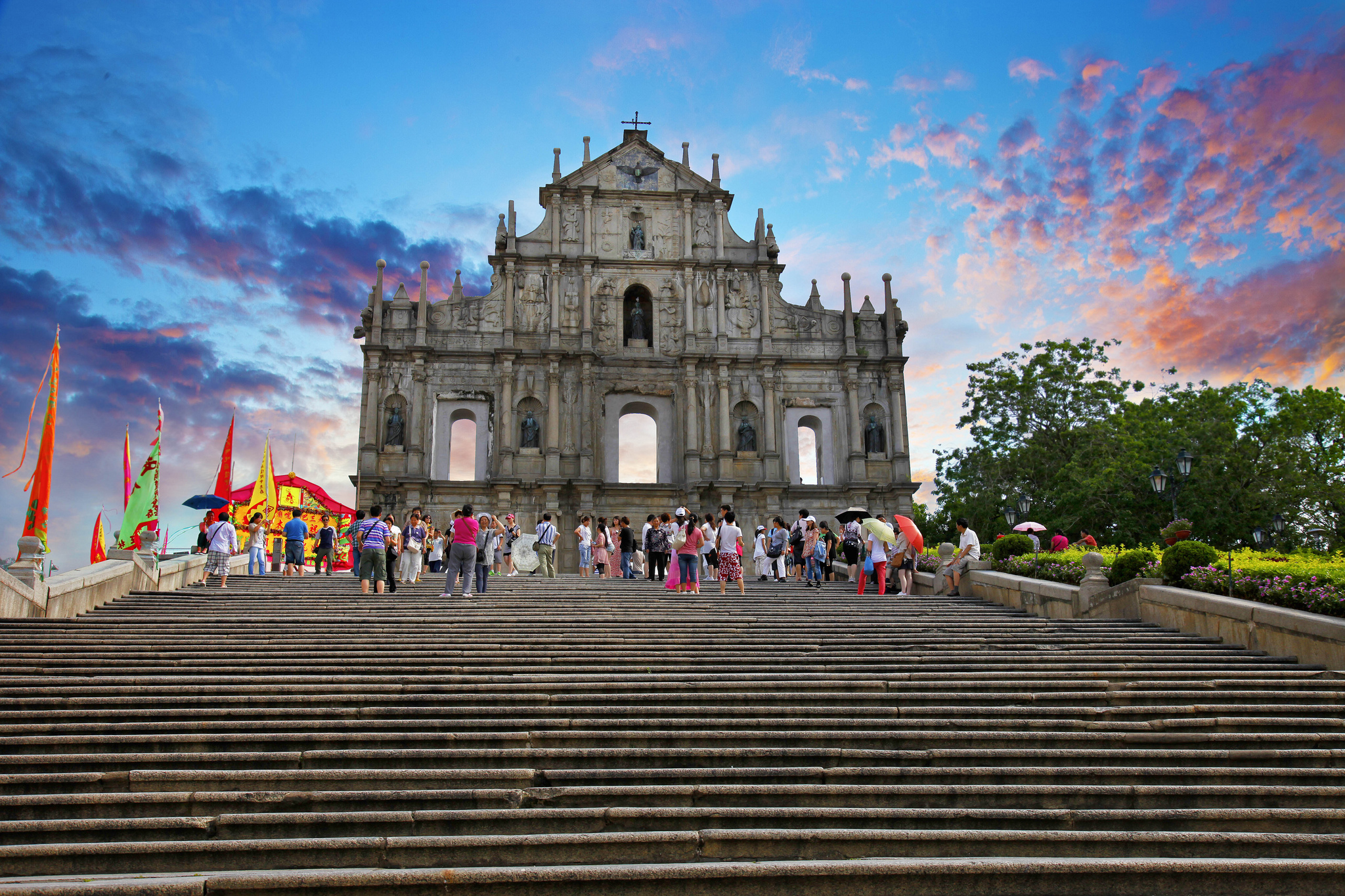
Macau's most visited monument is, technically, a wall. The facade of St. Paul's Cathedral — a 16th-century Jesuit church widely considered one of the most significant Christian structures in early modern Asia — is all that survived a fire in 1835. What remains is a carved stone frontispiece of extraordinary ambition: saints, dragons, a skeleton, a woman trampling a seven-headed hydra. The Jesuits were making a theological argument in stone, aimed at a population that read symbols rather than Latin.

The ferry from Hong Kong's Outer Harbour Terminal or the Taipa Ferry Terminal takes roughly 55 to 65 minutes. From the Macau ferry terminal, a free shuttle bus runs to the casino district and the old town is walkable from there. At St. Paul's: descend into the crypt beneath the stairs, which contains relics and a small museum; walk the full perimeter to see the back of the facade (most visitors don't); and spend time in the adjacent Nacha Temple, which sits in deliberate proximity to the cathedral as a reminder of how layered this city's religious history actually is.
Insider tip The steps in front of the facade are flooded with visitors from around 11am. If you take the first ferry out of Hong Kong (departures begin around 7am), you can reach St. Paul's by 9am and have the square largely to yourself for an hour.
3 Historic square · 66.3 km

Senado Square in Macao: the plaza that Portugal left behind

Senado Square in Macao: the plaza that Portugal left behind
Senado Square is the civic heart of old Macau — a broad, wave-patterned mosaic piazza ringed by pastel-coloured buildings in tangerine, lime, and cream, with the neoclassical post office building anchoring one end. Portugal administered Macau for over four centuries, and Senado Square is where that administration was most visibly performed: proclamations, festivals, the ordinary business of colonial government. The square itself is pedestrianised and the buildings around it are maintained with unusual care.

From the ferry terminal, the square is about 15 minutes by taxi or shuttle. It's roughly 66 kilometres from central Hong Kong by sea. Once there: go inside the Leal Senado building (the old civic chamber) and climb to the upper floor, where the council room and library are open to visitors; walk north through the square and into the warren of lanes that connect to St. Paul's; and find the small Igreja de São Domingos on the square's northern edge, which has a museum of sacred art in its upper levels that almost nobody visits. The architecture here is coherent in a way that few Asian colonial districts managed to remain.
Insider tip Senado Square is at its most photogenic and least crowded in the early morning, before the casino shuttle buses arrive. If you're combining it with St. Paul's, do the square first — it's slightly downhill from the cathedral ruins.
4 Historic fortification · 64.9 km

Guia Hill Fortress: the lighthouse that still works

Guia Hill Fortress: the lighthouse that still works
Built in 1637 on Macau's highest hill, Guia Fortress is the kind of place that rewards the visitor who doesn't consult a map and just walks uphill. The complex contains the fortress walls, a small chapel with rare surviving frescoes that blend Christian iconography with Chinese motifs, and the Guia Lighthouse — the oldest Western-style lighthouse on the Chinese coast, still operational, still used to signal typhoon warnings to the city below. The hill itself is forested and crossed by walking paths that feel genuinely removed from the casino strip.

From Senado Square, you can walk to the Guia Hill cable car (teleférico) in about 20 minutes, or take a short taxi ride. The hill is approximately 65 kilometres from Hong Kong. At the top: enter the chapel and look closely at the frescoes — the blend of European and Chinese visual language is subtle and worth time; walk the fortress ramparts for a panorama over the peninsula; and check the lighthouse exterior, since the interior is not always open to visitors.
Insider tip The cable car closes for lunch and has limited operating hours — check the schedule before you rely on it for the descent. Walking down takes about 20 minutes through pleasant shade and is often the better option.
5 Historic garden · 65.3 km

Lou Lim Ieoc Garden: the garden with nine-turn logic

Lou Lim Ieoc Garden: the garden with nine-turn logic
Lou Lim Ieoc Garden is a classical Chinese garden laid out in the 19th century by a wealthy Macanese merchant family — the kind of private retreat that was designed to be a world in miniature, with lotus ponds, bamboo groves, grottoes, and a nine-turn bridge whose zigzag path was deliberately designed to confuse evil spirits, which, the logic goes, can only travel in straight lines. The garden was later opened to the public and has been maintained with care, though it remains relatively quiet compared to Macau's more marketed attractions.

The garden is a short taxi ride from Senado Square, roughly 65 kilometres from Hong Kong. It's a good mid-morning stop after the main historic sites. Walk the full perimeter before cutting through the centre; find the pavilion that overlooks the main pond; and sit long enough to notice the light changing on the water. The bamboo section in the northwest corner is particularly dense and cool. This is not a dramatic destination — it is a restorative one, and that distinction matters after a morning of crowds.
Insider tip Entry is free. The garden is at its best on weekday mornings when local residents use it for tai chi practice. Weekends bring more visitors but the garden is large enough to absorb them without feeling overwhelmed.
6 Cultural monument · 65.2 km

Macau | The Statue of Guan Yin: the goddess facing the sea

Macau | The Statue of Guan Yin: the goddess facing the sea
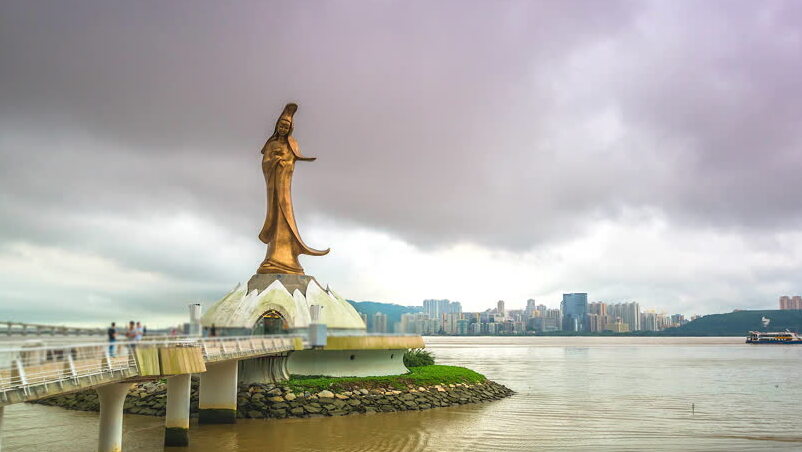
The Guan Yin statue stands near the Macau Cultural Centre on the Outer Harbour waterfront — a 20-metre bronze figure of the Taoist Goddess of Mercy, positioned so she faces the water and, beyond it, the Chinese mainland. It is not Macau's most marketed attraction, which is precisely why it deserves a mention. The statue was a gift from Buddhist communities and was inaugurated in 2000. The lotus base is hollow and contains a small shrine. The surrounding promenade is open and breezy, and the views across the harbour are unobstructed.

The statue is approximately 65 kilometres from Hong Kong and easily reached from the ferry terminal on foot or by taxi. Combine it with the nearby Cultural Centre if you have time. The walk along the waterfront promenade between the statue and the ferry terminal takes about 15 minutes and gives you a perspective on Macau's modern face — the reclaimed land, the casino towers in the distance, the water that connects everything — that the old town streets don't provide.
Insider tip This is one of the few major Macau sites that is never genuinely crowded. It's an excellent first or last stop — particularly at dusk, when the light on the water is good and the promenade is used by local joggers and families rather than tour groups.
7 Historic residence · 66.9 km

Mandarin's House: sixty rooms and a dynasty's end

Mandarin's House: sixty rooms and a dynasty's end
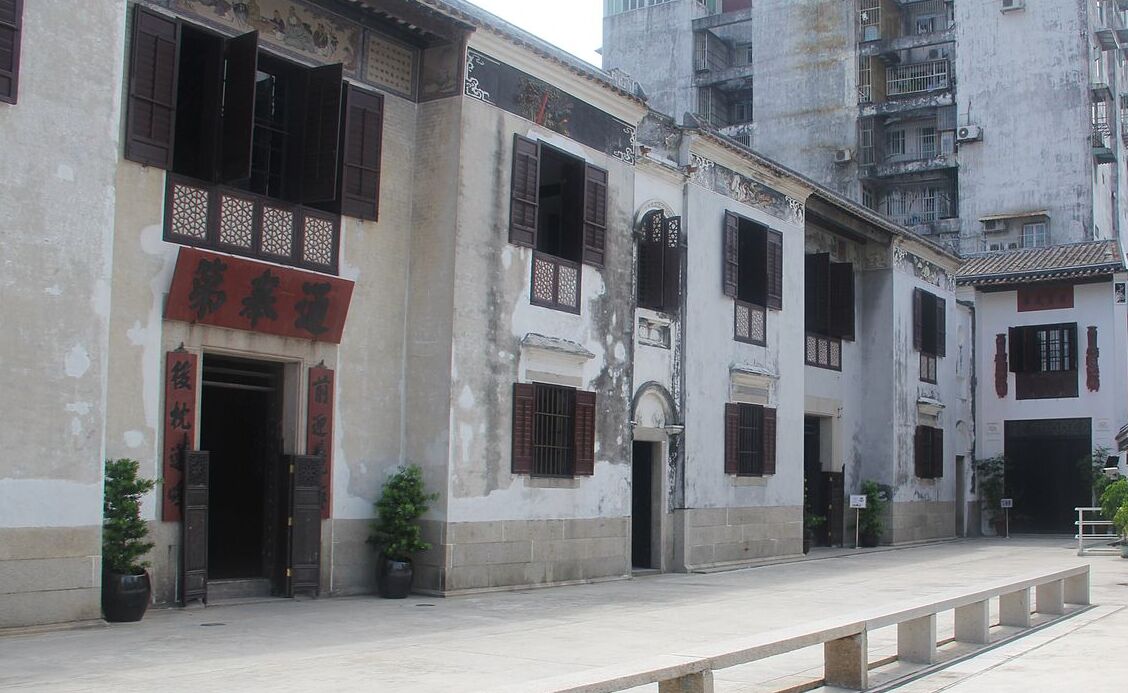
Mandarin's House is a private residence dating to 1869, built for the family of Zheng Guanying — a reformist writer and merchant whose work influenced early 20th-century Chinese political thought. The compound contains over 60 rooms arranged around a series of courtyards, and the architecture is a deliberate fusion of southern Chinese residential design with Portuguese and other Western details absorbed through Macau's position as a trading hub. The rooms are largely unfurnished but the spatial logic of the compound — how the courtyards connect, how light moves through them — is the real exhibit.

The house is in the old town, a short walk from Senado Square, at roughly 67 kilometres from Hong Kong. Entry is free. Walk every courtyard in sequence rather than cutting through; read the interpretive panels, which are unusually good; and spend time in the main reception hall, where the carved wooden screens are the finest surviving examples in the building. This is a place for slow looking rather than fast ticking.
Insider tip The house closes on Wednesdays. Check this before building your itinerary. It also closes for a midday break, so plan to arrive before 11:30am or after 2pm.
8 Panoramic landmark · 66.8 km

Macau Tower: 338 metres of perspective

Macau Tower: 338 metres of perspective
The Macau Tower is 338 metres tall and the 61st-floor observation deck gives you a clear view across the Pearl River Delta to the Chinese mainland on a good day. The tower is also known as an adrenaline venue — bungee jumping and a skywalk around the outer rim of the deck are both available — but even if you have no interest in either, the observation deck itself is worth the ticket if you want to understand Macau's geography. From up here, the reclaimed land is visible, the bridges connecting the peninsula to Taipa and Coloane are laid out clearly, and the scale of casino development on the Cotai Strip becomes legible.

The tower is on the peninsula's southern waterfront, about 67 kilometres from Hong Kong, and reachable by taxi from the ferry terminal in 10 minutes. Buy your observation deck ticket online to avoid queues at the base. The tower restaurant and café are overpriced — eat elsewhere and use the tower purely for the view.
Insider tip Visibility varies significantly with weather and season. Autumn (October to December) gives the clearest air. Avoid going up on hazy summer days — you'll spend the ticket price looking at grey. Check an air quality index for Macau the morning you plan to go.
9 Wildlife attraction · 66.4 km

Macau Giant Panda Pavilion: the seashell on Coloane

Macau Giant Panda Pavilion: the seashell on Coloane
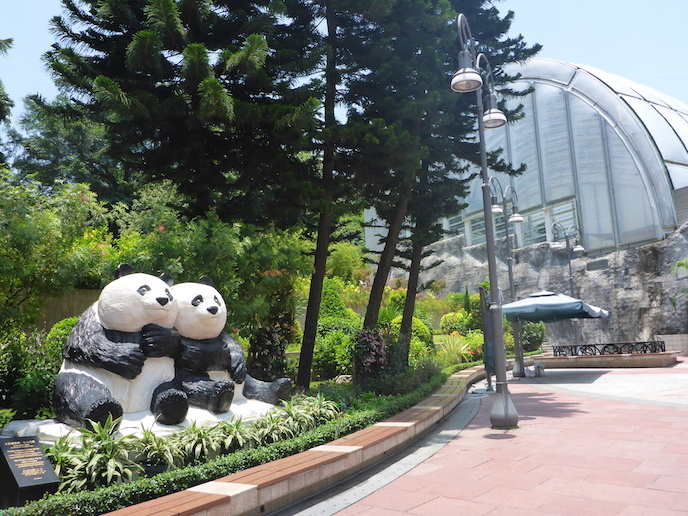
The Giant Panda Pavilion sits in Coloane — Macau's southernmost and least developed island — under a distinctive seashell-shaped glass roof that is genuinely interesting as a piece of low-key architecture. The resident giant pandas arrived as a gift from the central government and the pavilion was designed around their specific needs, with raised walkways giving visitors a vantage point above and around the enclosures rather than the usual face-to-barrier view. Coloane itself is worth the trip: quieter than the peninsula, with hiking trails and a village centre that feels closer to a Portuguese fishing town than anything else in the region.

The pavilion is about 66 kilometres from Hong Kong. Getting to Coloane requires a taxi or bus from the Taipa ferry terminal — allow 25 to 35 minutes. Combine the panda visit with a walk through Coloane Village and a stop at the small chapel of St. Francis Xavier, which contains relics and has an unusually peaceful forecourt.
Insider tip Pandas are most active in the morning. The pavilion opens at 10am — be there at opening if you want to see them moving rather than sleeping. Afternoons are quieter for visitors but the pandas are usually inactive by then.
10 Architectural landmark · 124.1 km

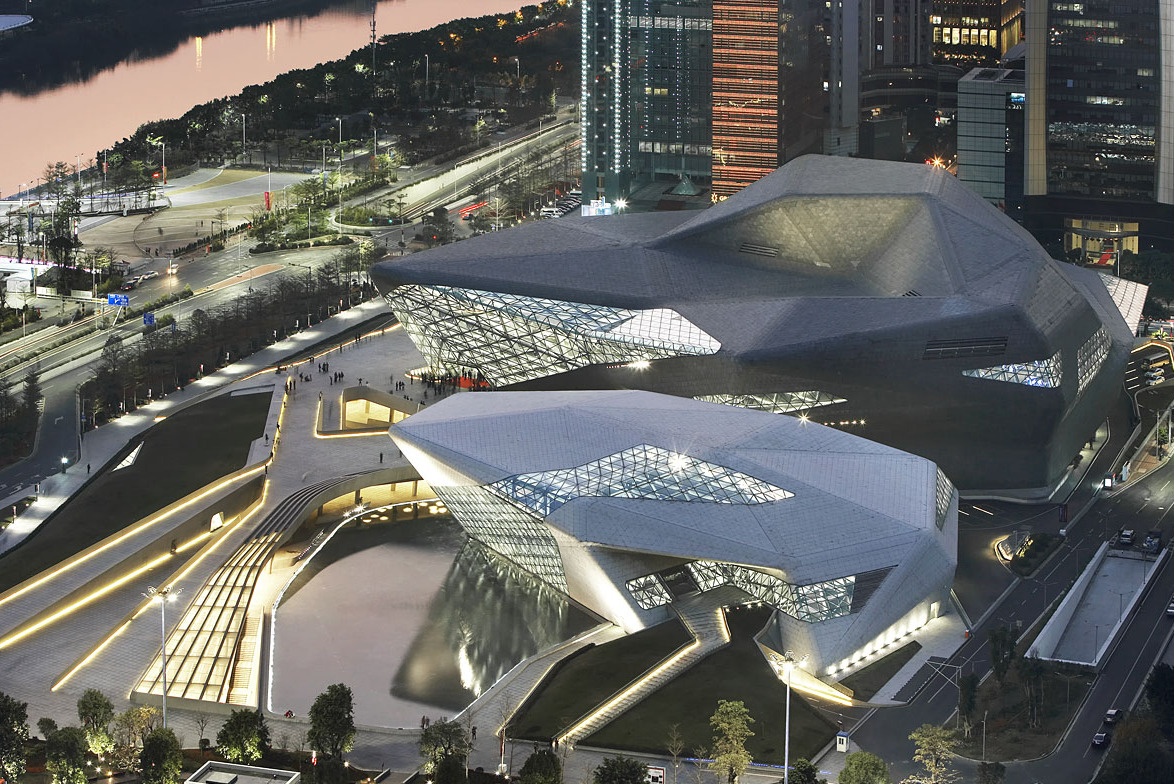
Guangzhou Opera House by Zaha Hadid: the building that landed from somewhere else

Guangzhou Opera House by Zaha Hadid: the building that landed from somewhere else
The Guangzhou Opera House opened in 2010 and remains one of Zaha Hadid's most fully realised buildings — a pair of fluid concrete and glass forms on the Pearl River bank that look, depending on the angle and the light, like river stones, like spacecraft, or like something that has no precedent at all. The larger volume contains the main auditorium; the smaller, a second performance hall. The interior is as spatially complex as the exterior suggests, with ramps and voids and a ceiling geometry that takes time to read. Whether or not a performance is scheduled, the building repays a visit purely as architecture.

From Hong Kong West Kowloon station, the high-speed rail reaches Guangzhou South in approximately 48 minutes. From Guangzhou South, take Metro Line 2 or 3 toward the city centre; the Opera House is in the Zhujiang New Town district, accessible from Zhujiang New Town station. The building is approximately 124 kilometres from Hong Kong. Walk the full exterior perimeter before entering; book a performance in advance if you want to see the main auditorium at its best; and allow time to walk along the Pearl River promenade adjacent to the building.
Insider tip High-speed rail tickets between Hong Kong and Guangzhou should be booked in advance, especially on weekends and public holidays, through the MTR's Intercity Through Train booking system or the 12306 Chinese rail app. Bring your passport — you clear immigration at Hong Kong West Kowloon before boarding.
The thing about day trips from Hong Kong is that they don't ask you to choose between the city and the world beyond it. You leave in the morning with the harbour still in your peripheral vision, and you're back in time for dinner on the Kowloon waterfront. What changes is the frame. Macau reminds you that this corner of Asia was shaped by Portugal as much as by China. Guangzhou reminds you that the Pearl River Delta is one of the most productive urban regions in human history, and that it's still building things worth looking at. Tai O reminds you that people have been living on this water for a very long time, on their own terms, in houses that float.

None of these trips require much planning. That's the point. The infrastructure is there. The only decision is which direction to point yourself in, and whether you're willing to leave.
🏆 Pocket guide

Take this guide with you.

Save it offline, get walking directions, and discover thousands more places like the ones you just read.

Save offline Smart routes Hidden gems
Scan to download iOS / Android
Scan for AppGallery Huawei users

All places, on a map

Map data © OpenStreetMap contributors.

Frequently asked questions

What is the best time of year for day trips from Hong Kong?

October through December is the most reliable window. The air is clear, humidity drops significantly, and typhoon season is over. Spring (March to April) is acceptable but hazy. Summer (June to September) brings heat, high humidity, and typhoon risk — ferries and trains can be cancelled with little notice during typhoon warnings. If you're visiting in summer, build flexibility into your schedule and always check the Hong Kong Observatory's typhoon signal status before heading to any ferry terminal.

Do I need a visa to visit Macau or Guangzhou as a day tripper?

Most Western passport holders can enter Macau visa-free for up to 30 days. Macau is a separate Special Administrative Region from Hong Kong and requires its own immigration clearance — bring your passport, not just a Hong Kong entry stamp. For Guangzhou and mainland China, most visitors require a Chinese visa obtained in advance. Some nationalities qualify for a 144-hour transit exemption under specific conditions, but this is not straightforward to rely on for a day trip. Check current visa requirements with the Chinese consulate in your home country well before travel.

How do I book the high-speed train from Hong Kong to Guangzhou?

Trains depart from Hong Kong West Kowloon station, which has full immigration and customs facilities on-site — you clear the border before boarding, which saves significant time on arrival. Tickets can be booked through the MTR's Intercity Through Train website, at the station booking office, or through the Chinese national rail app (12306). Book at least a few days ahead for weekend travel. The journey to Guangzhou South takes around 48 minutes on the fastest services. From Guangzhou South station, the metro system connects efficiently to the city centre.

How do the Macau ferries work, and which terminal should I use?

Two main terminals serve Macau from Hong Kong: the Outer Harbour Terminal (also called Macau Ferry Terminal) in Sheung Wan on Hong Kong Island, and the Taipa Ferry Terminal, which connects to Macau's Taipa island and is closer to the Cotai casino strip. TurboJET and Cotai Water Jet are the main operators. Journey time is 55 to 65 minutes. Ferries run frequently throughout the day and into the night, which means you can leave Hong Kong early, spend a full day in Macau, and return on an evening sailing. Book tickets online or at the terminal — weekend sailings fill up, particularly on Friday evenings and Sunday afternoons.

Is it practical to drive to any of these destinations from Hong Kong?

Driving within Hong Kong to reach Tai O on Lantau is possible — you'd take the Lantau Link bridge and drive across the island — but parking in Tai O village itself is extremely limited and the final approach road is narrow. The bus from Tung Chung is genuinely more practical. Driving to Macau is not possible directly; private vehicles require specific cross-border permits that most visitors won't hold. Driving to Guangzhou via the Hong Kong-Zhuhai-Macau Bridge is technically possible under a permit scheme, but the high-speed rail is faster and far less complicated for a day trip. For most visitors, the answer is: take public transport.

🏆 Read this offline

Save it to your phone.

Bookmark this guide, plan your trip offline, and discover thousands of places like these.

Bookmark Plan offline 60 languages
Scan to download iOS / Android
Scan for AppGallery Huawei users
Secret World Hidden places, real stories — plan your trip
Get the app
