10 Best Day Trips from Mexico City — by train, car, and boat
A working writer's guide to getting out of the capital without wasting half your day
L
Words by
Lena Hofmann
Updated
23 October 2026
Read time
12 minutes
Includes
7 places · interactive map
Mexico City has a gravitational pull that is hard to explain until you've lived inside it. The traffic, the altitude, the sheer density of things worth doing — it conspires to keep you rooted. But the city sits at the center of one of the most geographically varied regions on the planet, and if you spend every hour of your visit inside the Distrito Federal, you are making a mistake you will notice only in retrospect, on the plane home.
A good day trip from CDMX earns its round-trip time. That sounds obvious, but it rules out more destinations than you'd think. If you're spending four hours in a car for ninety minutes of payoff, that's not a day trip — that's a commute with a souvenir shop at the end. What works are places within roughly two to three hours of the city that offer something categorically different from what the capital provides: open sky, geological drama, colonial silence, thermal water, ancient stone.
I've done all of these routes multiple times, by different means — the suburban rail lines, rental cars on the toll roads, hired vans with drivers who know the back roads. Each mode has its logic and its failure modes. I'll tell you which is which. I'll also tell you when the crowds arrive, because in Mexico the difference between arriving at 8 a.m. and arriving at 11 a.m. is the difference between a serene experience and a queue.
None of these trips require a guide. All of them reward one. Plan accordingly, and leave early.
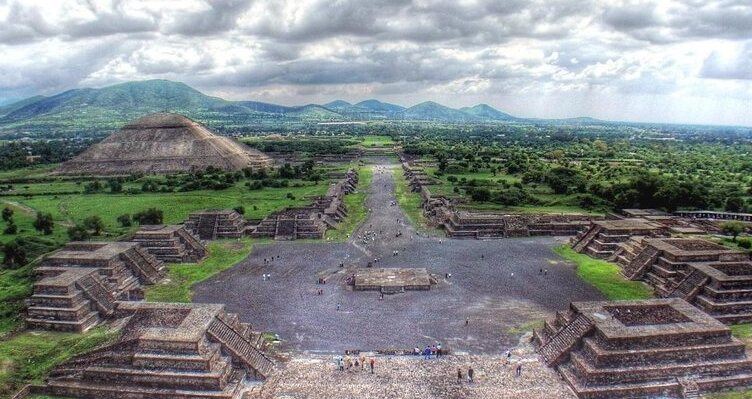
Mexico: The terraced Pyramids of the Sun and Moon — the city that built the blueprint
Teotihuacán sits 42 kilometers northeast of Mexico City, which on paper sounds like nothing. In practice, if you leave by car after 8 a.m. on a weekend, you will spend a meaningful portion of your morning on the Indios Verdes connector road, watching the pyramids exist somewhere in the theoretical future. Leave before 7 a.m. or take the bus from Terminal del Norte, which deposits you at the site entrance in about an hour and costs almost nothing. The Pyramid of the Sun — 250 yards on a side, roughly 200 feet tall — is the third-largest pyramid in the world by volume, and climbing it before the tour groups arrive is one of those experiences that recalibrates your sense of scale. Walk the full length of the Avenue of the Dead. Go inside the Palace of Quetzalpapalotl. Spend time in the site museum, which most visitors skip entirely and which contains some of the finest pre-Columbian murals you will see anywhere. Do not leave without walking the northern end of the complex, where the Pyramid of the Moon frames a view back down the avenue that the builders clearly intended.
Insider tip: The site opens at 9 a.m. but the parking lots fill by 10:30 on Sundays. Arrive by 8:45, wait at the gate, and you'll have the first hour largely to yourself. Bring water — the vendors inside charge accordingly.
Insider tip
Arrive at the gate by 8:45 a.m. The first hour before tour buses unload is categorically different from what follows. Bring your own water; vendor pricing inside the site is aggressive.
Popocatépetl is 70 kilometers southeast of Mexico City and towers to 5,426 meters, making it North America's second-highest volcano. The key thing to understand before you plan this trip: you cannot summit Popocatépetl. The volcano has been in an active eruptive phase for decades, and the exclusion zone around the crater is enforced. What you can do is get close enough to understand its scale and temperament. Drive the toll road toward Puebla and turn off toward Amecameca, a town that sits at the volcano's foot and offers some of the clearest unobstructed views of the cone. From Amecameca, the road continues up toward the Paso de Cortés — a high mountain pass between Popocatépetl and its neighboring volcano Iztaccíhuatl — where you can walk through pine forest at altitude, watch the volcano emit its characteristic plume, and feel the specific chill of standing at 3,600 meters. Check CENAPRED's daily volcanic activity report before you go. On high-alert days, the pass road closes. On calm days, it's one of the more primal landscapes accessible from the capital.
Insider tip
Check the CENAPRED website the morning of your trip. Activity phases change quickly and the Paso de Cortés access road closes with little warning. Midweek visits are quieter and the road is less congested.
Sierra Negra sits roughly 200 kilometers from Mexico City, which puts it at the outer edge of a comfortable day trip — you need to leave early and accept that you'll be driving back in the dark. The volcano hosts the Large Millimeter Telescope, one of the most powerful radio telescopes in the world, perched near the summit at around 4,600 meters. The approach road from the town of Atzitzintla is steep, unpaved in sections, and requires a vehicle with reasonable clearance. This is not a trip for a compact city rental. What you get in exchange is access to a high-altitude landscape that feels genuinely remote — cloud forest on the lower slopes, then bare volcanic rock, then the kind of thin-air silence that is hard to find within 200 kilometers of a megalopolis. The trekking routes on the upper slopes are unmarked; hire a local guide in Atzitzintla. The views across the Tehuacán valley on a clear morning are worth the early start.
Insider tip
Altitude sickness is a real risk above 4,000 meters, especially if you've just arrived in Mexico City and haven't acclimatized. Spend at least two nights at CDMX altitude before attempting this one. Drive up, don't run.
Puebla is about 106 kilometers east of Mexico City on the 150D toll road — under two hours in light traffic, closer to two and a half in real conditions. ADO runs frequent first-class buses from TAPO that are genuinely comfortable and drop you in the city center. Puebla has roughly 1.5 million people, which sounds large until you've spent a week in CDMX, after which it feels navigable. The historic center is a UNESCO World Heritage Site and compact enough to cover on foot. Walk the main zócalo and the surrounding streets of tiled Talavera facades. Visit the Capilla del Rosario inside the Templo de Santo Domingo — the baroque interior is one of the most elaborate in Mexico. Spend time in the regional museum, which houses a serious collection of pre-Columbian artifacts. The city rewards wandering: the side streets between the zócalo and the Barrio del Artista are full of craft workshops that are actually working, not performing.
Insider tip
The ADO bus from TAPO is faster than driving on weekend mornings when the 150D toll road backs up near Rio Frío. Buy your return ticket before you leave the bus station — the last comfortable bus back fills up by early evening.
This is, in essence, a deeper look at what Puebla offers for visitors whose primary interest is ecclesiastical and colonial architecture. The Cathedral of Puebla, founded in 1531 and completed over the following century, has the tallest towers of any cathedral in Mexico and an interior that requires time rather than a glance. The choir stalls alone are worth the trip for anyone interested in colonial woodwork. Puebla was founded ex nihilo by Spanish settlers — there was no pre-existing city on the site — which gives its grid a different logic from cities like Oaxaca or Cholula that were built over indigenous settlements. The result is a place where the colonial layer is the whole story, not a veneer over something older. Arrive in the morning when the light comes through the cathedral's east windows. Walk to the Templo de la Compañía de Jesús, then north toward the former convent of Santa Mónica. End the afternoon in the Barrio de los Sapos, where the antique market runs on weekends.
Insider tip
The cathedral's interior is free to enter but photography rules change depending on whether a mass is in progress. Arrive before 9 a.m. on weekdays for the best light and the fewest restrictions.
The Monumento a Tlahuicole sits approximately 95 kilometers from Mexico City and commemorates Tlahuicole, a Tlaxcalan warrior of the early sixteenth century who became legendary for his physical strength and his refusal of freedom when captured by Aztec forces — he reportedly chose ritual combat over release. The monument is an imposing statue that functions as a focal point for the surrounding area's sense of local identity, distinct from the Aztec-centric narrative that dominates much of the region's historical tourism. Getting here requires a car; there is no practical public transport connection that makes sense for a day trip. The site itself is not large, but it anchors a visit to the surrounding area well. Pair it with time in the nearby town, walk the local market if you arrive on a market day, and use the monument as an entry point into Tlaxcala's complicated and often underrepresented history in the story of the conquest.
Insider tip
This works best as part of a Tlaxcala day rather than a standalone destination. The state of Tlaxcala is small and its historic center is genuinely undervisited — you will have the streets to yourself on most weekday mornings.
Santiago de Querétaro is 184 kilometers from Mexico City — the furthest point on this list that can still be done as a day trip without feeling punishing. The toll road (57D) is good and the drive takes about two and a half hours in reasonable conditions. There is also an intercity bus connection from Terminal del Norte that takes roughly three hours. La Flautista is a sculpture in the heart of the city that has become one of the recognizable cultural markers of Querétaro — a monument to the region's artistic and musical heritage. Use it as your orientation point, then walk the UNESCO-listed historic center, which is one of the better-preserved colonial urban environments in central Mexico. The aqueduct on the eastern edge of the old city is a Roman-scale piece of engineering that most visitors photograph from one angle and then move on from — walk along it. Visit the Templo de Santa Rosa de Viterbo. Leave by 4 p.m. to avoid arriving back in CDMX during the worst of the evening traffic.
Insider tip
Leave Mexico City no later than 6:30 a.m. to reach Querétaro before the heat of midday. The return on the 57D can be slow on Sunday evenings — if you're driving, aim to leave Querétaro by 3:30 p.m.
I've been making these trips for years, and the thing I keep noticing is that the city looks different when you come back to it. Mexico City is easier to understand from the outside — from the top of a pyramid, from a high-altitude pass where you can see the basin it sits in, from a colonial street grid that shows you what the Spanish were trying to build everywhere. The capital is overwhelming in the way that all great cities are overwhelming: it gives you too much at once. These day trips give you a frame.
None of them are perfect. The roads get congested, the sites get crowded, the altitude catches you off guard. But every one of them returns something that the city, for all its virtues, cannot easily provide: the sensation of having moved through actual geography, of having covered ground, of having earned the view. Leave early. Come back before dark. Do it again.
🏆 Pocket guide
Take this guide with you.
Save it offline, get walking directions, and discover thousands more places like the ones you just read.
What is the best time of year to do day trips from Mexico City?
October through February is generally the most reliable window. The rainy season (June through September) brings afternoon thunderstorms that can make mountain roads dangerous and archaeological sites miserable by midday. November and December offer clear skies, lower humidity, and thinner crowds at most sites. March and April are dry but increasingly hot at lower elevations. Avoid Semana Santa (Holy Week) for any popular destination — Teotihuacán and Cholula in particular become extremely crowded.
Is there a working train service from Mexico City to any of these destinations?
As of the time of writing, there is no intercity passenger rail network connecting Mexico City to these destinations in any practical sense. The Suburbano commuter rail runs northwest toward Cuautitlán but does not reach Teotihuacán or any destination on this list. For most of these trips, your realistic options are: intercity ADO or ETN buses (comfortable, punctual, and often faster than driving), rental car on the toll roads, or organized day-tour vans. The bus from TAPO to Puebla and from Terminal del Norte to Querétaro are both genuinely good options.
What are the practical realities of driving out of Mexico City?
The toll roads (cuotas) are well-maintained and significantly faster than the free roads (libres). Budget for tolls — a round trip to Puebla on the 150D will cost roughly 200 to 300 pesos each way depending on vehicle class. GPS works well throughout the region. The main failure points are: leaving the city itself (the Periferico and the connectors to the toll roads are slow before 7 a.m. and after 3 p.m. on weekdays, and all day on Sundays), and the return journey on Sunday evenings when traffic backs up badly on all routes into the city. If you're driving, leave before 7 a.m. and aim to re-enter the city before 4 p.m.
Do any of these destinations require advance booking?
Grutas Tolantongo has a capacity management system on weekends and holidays — check their official site before going, as they sometimes require advance registration during peak periods. Teotihuacán does not require advance booking for general entry but the site can reach its daily capacity on major holiday weekends. For volcanic areas near Popocatépetl, no booking is required but you should check CENAPRED's daily bulletin before departure — access restrictions can be imposed on short notice. All other destinations on this list are walk-in.
How should I handle altitude on these trips, especially coming from sea level?
Mexico City itself sits at 2,240 meters, which already challenges visitors from sea level. Several destinations on this list go significantly higher: the Paso de Cortés between Popocatépetl and Iztaccíhuatl is around 3,600 meters, and Sierra Negra approaches 4,600 meters near the summit. If you've just arrived in Mexico City, spend at least two full days acclimatizing before attempting anything above 3,000 meters. Symptoms of altitude sickness — headache, nausea, fatigue — can appear quickly and are not a sign of weakness. Ascend slowly, drink water consistently, and do not plan strenuous physical activity on your first full day in the capital.
🏆 Read this offline
Save it to your phone.
Bookmark this guide, plan your trip offline, and discover thousands of places like these.
BookmarkPlan offline60 languages
iOS / Android
Huawei users
Secret WorldHidden places, real stories — plan your trip