Trip.Planner
En · Travel Guide
Travel Guide · 2026 Edition

15 Hidden Gems in Rocamadour — beyond the postcard

What the pilgrims see, what the tourists photograph, and what everyone else walks straight past

L
Words by
Lena Hofmann
Updated
10 September 2026
Read time
13 minutes
Includes
7 places · interactive map
15 Hidden Gems in Rocamadour — beyond the postcard
There is a particular kind of invisibility that belongs only to the very famous. Rocamadour suffers from it acutely. The village — if you can call a vertical arrangement of medieval sanctuaries, chapels, and pilgrim staircases a village — has been drawing visitors since the twelfth century, which means it has had eight hundred years of practice at revealing its obvious self and concealing everything else. You arrive, you look up at the cliff, you photograph the cliff, and then you follow the crowd up the Grand Escalier with the mild guilt of someone who suspects they are doing tourism incorrectly. You are not wrong to suspect this.

The problem is not that Rocamadour is overrated. It is genuinely one of the more arresting arrangements of human ambition and limestone in Western Europe. The problem is that its fame operates like a floodlight: it illuminates the centre so aggressively that the edges go dark. The canyon of the Alzou below, the agricultural plateau above, the cave systems that riddle the surrounding Quercy countryside — all of it sits in the shadow of the postcard image, waiting for the traveller who is willing to turn around, look down, or simply slow down enough to notice what is directly underfoot.

I have visited Rocamadour in four different seasons and at three different times of day, and I am still finding things that feel genuinely new. Not secret in the conspiratorial sense — most of what follows is findable if you look — but hidden in the way that anything is hidden when everyone around you has already decided what they came to see. That selective blindness is the real subject of this piece.

At a glance

  1. Rocamadour: un gioiello della cultura francese nel cuore dell'Occitania — the park no one sits in
  2. Rocamadour,one of the most spectacular villages in Europe — the Alzou Valley floor
  3. Rocamadour is a small village built on a steep rocky wall of the valley side. — the pilgrim staircase, off-peak
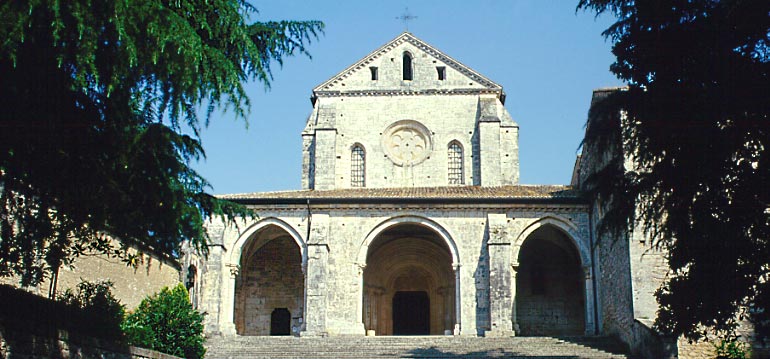
  4. Rocamadour la Città sacra - Secret World — the canyon rim at dusk
  5. Rocamadour is a beautiful village — the Quercy plateau above
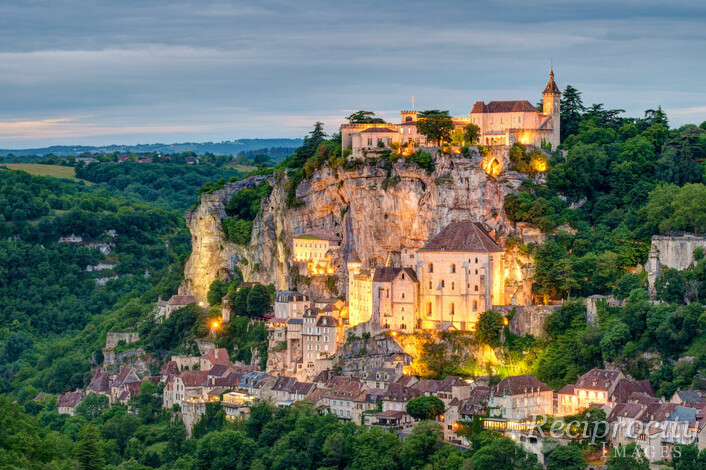
  6. Rocamadour: un gioiello della cultura francese nel cuore dell'Occitania — the lower town's residential street
  7. The Gouffre de Padirac is an incredible cave — the underground river, not the stalactites
1 Parks & Gardens · 0.0 km

Rocamadour: un gioiello della cultura francese nel cuore dell'Occitania — the park no one sits in

Rocamadour: un gioiello della cultura francese nel cuore dell'Occitania — the park no one sits in
The small green spaces that cling to the margins of Rocamadour's cliff terraces are almost universally ignored, which makes them, paradoxically, the best places to actually see the village. Positioned at the edge of the Occitanian plateau, these garden pockets — maintained with the quiet diligence of municipal workers who know no one will thank them — offer sightlines that the main esplanade never quite achieves. The cultural weight of this place, embedded in the broader Occitanian tradition of sacred landscape, is easier to feel when you are not sharing a square metre with forty other people pointing cameras in the same direction.

Sit here long enough and the architecture stops performing and starts simply existing. The layered geology of the Lot becomes legible: cream limestone below, scrub oak above, and the village wedged improbably between them like a bookmark in a very old book.
Insider tip Visit just after the morning coach parties depart — roughly 10:30 to 11:30 — when these garden margins empty completely. Bring something to read and then find you don't need it.
2 Village / Landscape · 0.1 km

Rocamadour,one of the most spectacular villages in Europe — the Alzou Valley floor

Rocamadour,one of the most spectacular villages in Europe — the Alzou Valley floor
Everyone photographs Rocamadour from above or from across the canyon. Almost no one walks down to the valley floor of the Alzou to look back up. The river — modest, often barely a trickle in summer — runs along a path accessible from the lower village, and from its banks the full geological drama of the site becomes clear in a way that no elevated viewpoint can replicate. You understand, standing here, why medieval pilgrims would have found this place theologically persuasive: the cliff simply does not look like something that should have a city on it.

The Alzou path is also ecologically interesting in its own right, threading through riparian woodland that feels entirely detached from the pilgrimage economy above. Herons work the shallows with professional indifference to the sacred city overhead.
Insider tip The path along the Alzou is largely unmarked on tourist maps handed out at the village entrance. Ask at the lower town's small information point rather than the main tourist office.
3 Village / Sacred Site · 0.1 km

Rocamadour is a small village built on a steep rocky wall of the valley side. — the pilgrim staircase, off-peak

Rocamadour is a small village built on a steep rocky wall of the valley side. — the pilgrim staircase, off-peak
The Grand Escalier — the steep staircase climbed by penitents on their knees since the Middle Ages — is not hidden in any conventional sense. It is, in fact, the spine of the entire site. What is hidden is the experience of it outside of peak hours, when the steps are empty enough to read the worn grooves left by centuries of devoted knees and tired feet. The limestone has been polished to something close to marble in places, and in low morning light the surface takes on a quality that photographs cannot convey.

The sacred town of Rocamadour was built around this vertical axis of devotion, and the staircase remains its most honest architectural document — more revealing than any of the chapels it connects, because it carries the physical record of everyone who used it.
Insider tip Arrive before 8:00 in the morning. The staircase is technically accessible from first light, and you may have it entirely to yourself — a genuinely rare condition for one of France's most visited pilgrimage routes.
4 Village / Viewpoint · 0.1 km

Rocamadour la Città sacra - Secret World — the canyon rim at dusk

Rocamadour la Città sacra - Secret World — the canyon rim at dusk
The Italian designation — città sacra, sacred city — captures something that the English-language framing of 'spectacular village' tends to miss: Rocamadour is not simply picturesque, it is organised around a theological idea made physical. The canyon rim above the sanctuaries, accessible via the château ramparts, becomes most legible as a sacred landscape at dusk, when the valley below fills with shadow while the cliff face catches the last horizontal light. The effect is less dramatic than a sunset and more interesting: the village seems to glow from within rather than from without.

This is also the hour when the day-trippers have gone and the few overnight guests have the ramparts largely to themselves — a reminder that staying in Rocamadour, rather than visiting it, is a fundamentally different experience.
Insider tip The rampart walk is free and often unlocked until well after the official closing time of the château grounds. Check the gate rather than assuming it is shut.
5 Village / Landscape · 0.1 km

Rocamadour is a beautiful village — the Quercy plateau above

Rocamadour is a beautiful village — the Quercy plateau above
The village of Rocamadour is famous for its vertical drama, which means the horizontal landscape immediately above it — the Quercy plateau, a limestone causses of lavender, truffle oaks, and dry-stone walls — receives almost none of the attention it deserves. Walk fifteen minutes from the upper village and the pilgrimage city disappears entirely, replaced by a working agricultural landscape that has changed relatively little in its broad outlines for several centuries. The Lot department's interior is one of the least densely populated corners of metropolitan France, and it shows in the best possible way.

The contrast between the intense sacred verticality of Rocamadour and the quiet horizontal emptiness of the plateau above is one of the more thought-provoking juxtapositions in this part of France — and almost no one who visits the village bothers to make the comparison.
Insider tip Several marked walking trails depart from the upper car park and loop across the plateau before returning. The shortest takes under two hours and requires no special equipment — just a willingness to leave the postcard behind.
6 Parks & Gardens · 12.2 km

Rocamadour: un gioiello della cultura francese nel cuore dell'Occitania — the lower town's residential street

Rocamadour: un gioiello della cultura francese nel cuore dell'Occitania — the lower town's residential street
The Cité — the lower, commercial level of Rocamadour — is well-documented and well-trampled. What receives almost no attention is the single residential street that runs along its northern edge, where a handful of permanent residents actually live. The contrast between the tourist infrastructure of the main thoroughfare and this quieter parallel lane is remarkable: window boxes, a cat on a step, the smell of someone's lunch. It is the kind of ordinary domestic detail that reminds you that Rocamadour, for all its UNESCO-adjacent grandeur, is also someone's home.

The Occitanian cultural context — the language, the culinary tradition, the particular relationship between landscape and community — is more legible here than in any of the sanctuaries, precisely because it is not being presented for consumption.
Insider tip This lane is not signposted as a point of interest, which is the point. Walk past the main souvenir concentration and look for the doorways with actual letterboxes.
8 Natural Site / Cave · 12.2 km

The Gouffre de Padirac is an incredible cave — the underground river, not the stalactites

The Gouffre de Padirac is an incredible cave — the underground river, not the stalactites
Most visitors to the Gouffre de Padirac — a cave system roughly twelve kilometres from Rocamadour — come for the stalactite formations, which are indeed worth seeing. What tends to get less attention in the retelling is the underground river itself: the flat-bottomed boats that carry visitors along it move slowly enough that you have time to notice the quality of the darkness on either side, the temperature drop, and the particular acoustic quality of a space where sound behaves according to rules that open-air experience has not prepared you for.

The gorge section, where the cavern opens vertically above the river, is the moment when the scale of the system becomes genuinely comprehensible. The stalactites are impressive; the river is humbling. These are different experiences, and the second one tends to be underreported.
Insider tip Book the first entry slot of the day. The underground temperature is a constant twelve degrees regardless of season, so a light layer is useful even in August.
Rocamadour will not stop being famous. It will not stop being photographed from the same three angles, visited in the same sequence, and described in the same superlatives. None of that is a reason to avoid it — famousness, in a place this old, is simply one layer among many, and it is a thinner layer than it appears from the car park.

What this village rewards, more than most, is the second look. Not the look that confirms what you expected to see, but the one that catches something at the edge of the frame — the worn step, the empty garden, the goat cheese on a market table twelve kilometres away that carries the village's name into the quotidian life of the Lot in a way that no pilgrimage ever quite managed. The postcard is accurate. It is also, as postcards always are, a carefully cropped version of a much larger and more interesting truth. The rest of that truth is available to anyone willing to put the postcard down.
🏆 Pocket guide

Take this guide with you.

Save it offline, get walking directions, and discover thousands more places like the ones you just read.

Save offline Smart routes Hidden gems
Scan to download iOS / Android
Scan for AppGallery Huawei users

All places, on a map

Map data © OpenStreetMap contributors.

Frequently asked questions

When is the best time to visit Rocamadour to avoid the largest crowds?

Late September through early November and the first three weeks of March offer the quietest conditions. The village receives heavy coach traffic from late spring through August, and the shoulder seasons not only reduce visitor numbers but also improve the quality of light in the canyon and the likelihood of morning mist in the Alzou valley. Weekday mornings are significantly quieter than weekends throughout the year.

Is it worth staying overnight in Rocamadour rather than visiting as a day trip?

Yes, and the difference is considerable. The village transforms after the day-trippers leave — typically by early evening — and the sanctuaries, staircases, and canyon views take on a character that daytime visits simply cannot replicate. The number of accommodation options within the village itself is limited, so booking well in advance is advisable, particularly for the spring and summer periods.

How far is the Gouffre de Padirac from Rocamadour, and can you visit both in a day?

The Gouffre de Padirac is approximately twelve kilometres from Rocamadour by road — a journey of around fifteen to twenty minutes by car. Visiting both in a single day is feasible, though doing justice to either site requires more time than most itineraries allow. A practical approach is to spend the morning at Padirac (arriving at opening time to avoid queues) and the late afternoon and evening at Rocamadour, staying overnight.

Is Rocamadour accessible without a car?

Access without a car is possible but requires planning. There are bus connections from Brive-la-Gaillarde and Cahors, though services are infrequent and schedules change seasonally. The nearest train station is Rocamadour-Padirac, several kilometres from the village itself, with limited onward connection. For the surrounding plateau and the Gouffre de Padirac, a car or bicycle is effectively necessary — the distances are manageable but the public transport network in rural Lot is sparse.

Where can you buy authentic Rocamadour AOC cheese near the village?

The most reliable sources are the weekly markets in the surrounding communes rather than the souvenir shops within the village itself. The market in Gramat, roughly ten kilometres away, frequently features local producers. The town of Figeac also hosts a good market. If you are visiting in the right season, some farms on the causses plateau above Rocamadour sell directly, though this requires either local knowledge or a willingness to follow hand-painted signs on rural roads.

🏆 Read this offline

Save it to your phone.

Bookmark this guide, plan your trip offline, and discover thousands of places like these.

Bookmark Plan offline 60 languages
Scan to download iOS / Android
Scan for AppGallery Huawei users
Secret World Hidden places, real stories — plan your trip
Get the app
