10 Best Things to Do in Lantau Island, Hong Kong — beyond the obvious
The largest island in Hong Kong is also its most misread. Here is a slower, more honest account of what it actually offers.
L
Words by
Lena Hofmann
Updated
11 October 2026
Read time
13 minutes
Includes
9 places · interactive map
I came to Lantau the first time the way most people do: on the Ngong Ping 360 cable car, slightly hungover from a long night in Wan Chai, half-asleep behind a smudged gondola window, watching the South China Sea tilt beneath me like a slow dream. I had a guidebook. I had a plan. I had, in other words, exactly the wrong tools for the place. Lantau — Hong Kong's largest island, bigger than Hong Kong Island itself, which surprises almost everyone — resists the kind of efficient tourism the city has otherwise perfected. It is not a place you can optimise. The MTR only reaches its eastern fringe. The roads narrow into single lanes somewhere past Tung Chung. The fishing villages smell of drying shrimp and salt and something harder to name, a kind of organic stubbornness, the refusal to become a backdrop for anyone's Instagram story.
I have been back many times since. I have walked the Lantau Trail in sections, eaten congee in Tai O before the tour groups arrived, sat in temple courtyards long enough for the incense smoke to settle into my jacket. I have also, in the spirit of full disclosure, taken the tourist cable car twice more, because it is genuinely good and I am not above convenience. What I have learned, slowly and with some embarrassment at my earlier certainties, is that Lantau rewards patience in a way that Kowloon or Central simply cannot. It is the island where Hong Kong remembers it was once mostly water, hills, and people who lived close to both. What follows is not a comprehensive guide. It is an account of what I found when I stopped rushing.
Lantau Island, l'isola più grande di Hong Kong: the ground beneath everything else
Before you plan anything specific, it is worth sitting with the fact of Lantau as a whole — its scale, its contradictions, its refusal to resolve into a single identity. The island holds a theme park and a Zen monastery within a few kilometres of each other. It has some of Hong Kong's least-visited beaches along its southern coast, where the sand is coarse and the water is clear and there is almost nobody there on a Tuesday in February. It has the Lantau Trail, a 70-kilometre circuit that takes serious walkers two to three days to complete, passing through terrain that looks nothing like the city visible from the airport on descent. Most visitors see perhaps eight percent of the island. That is not a criticism — it is an invitation. Lantau's essential character is one of incompleteness, of there always being another valley you haven't reached yet.
Insider tip
The southern beaches — Cheung Sha in particular — are accessible by bus from Tung Chung and are far less crowded than anything on Hong Kong Island or the Sai Kung peninsula. Go on a weekday.
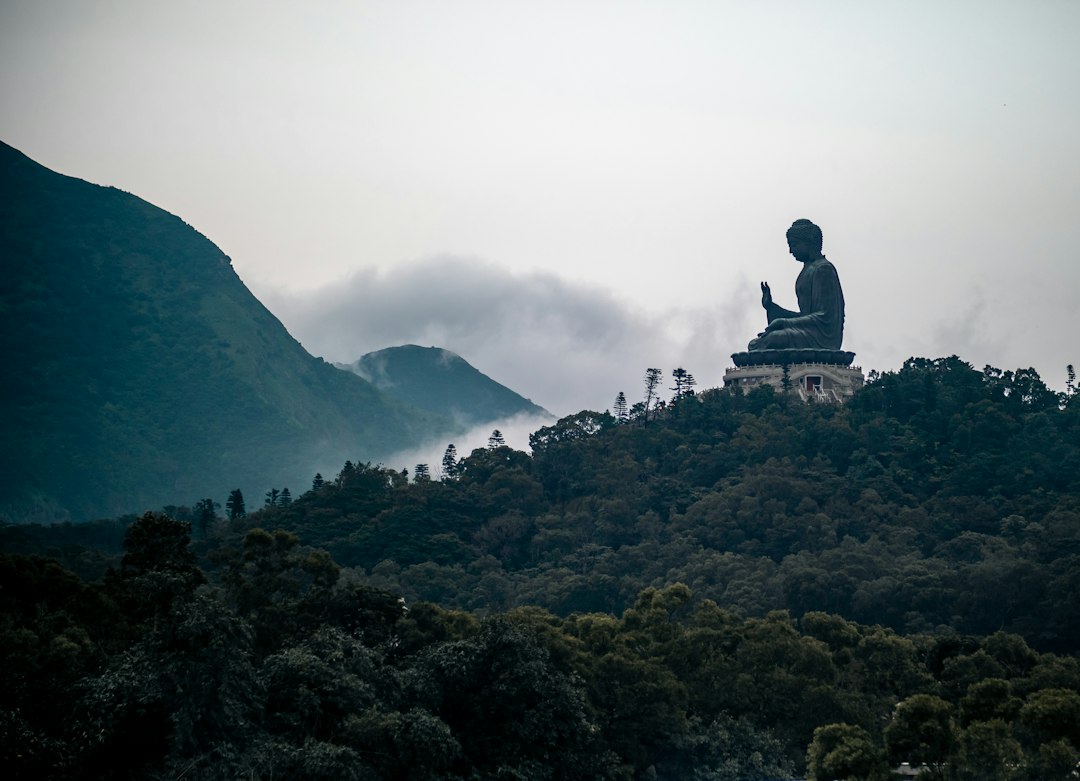
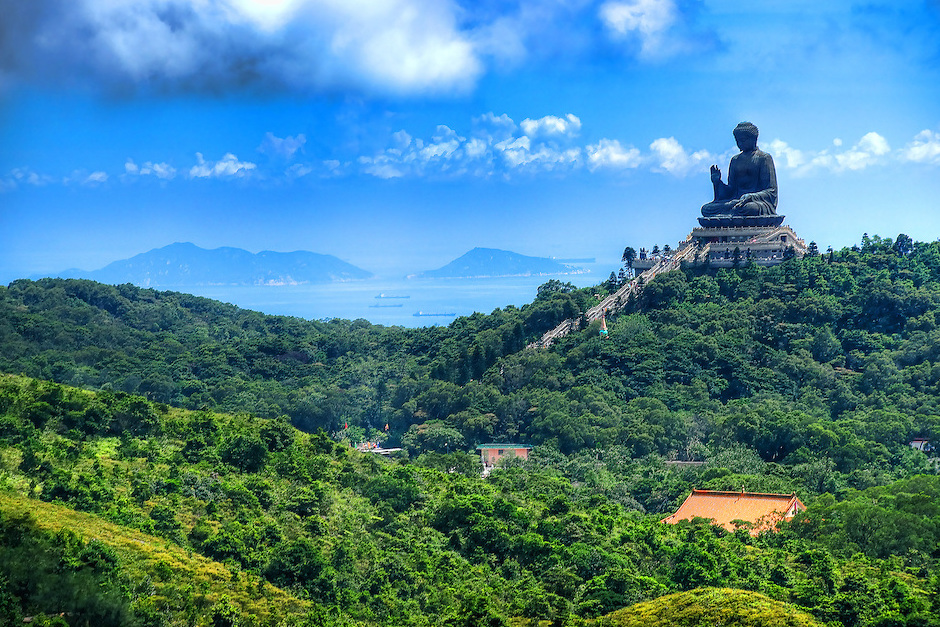
Erected in 1993 and sitting 34 metres high on a lotus throne atop Ngong Ping plateau, the Tian Tan Buddha faces north — toward mainland China, toward the Chinese people it was built to watch over. The symbolism is not subtle, and the crowds on weekends are not subtle either. Come early, before ten in the morning, and the 268 steps up to the statue's base feel like a reasonable act of devotion. Come at noon in August and they feel like a punishment. The bronze has weathered into a colour somewhere between green and grey, and the scale of the thing only becomes legible when you are close enough to see the smaller statues of offering goddesses circling the base, each one the height of a grown adult. From the top, on a clear day, you can see across the reservoir to the South China Sea. On a hazy day — which is most days — you see the haze, and the Buddha, and not much else. That is fine. The haze is also Hong Kong.
Insider tip
The cable car is the obvious approach, but the bus from Tung Chung (route 23) is cheaper, faster on busy days, and drops you at the same point. The road winds dramatically through the hills.
There is a second way to understand the Big Buddha — not as a destination but as a presence in the landscape, something you move toward rather than simply arrive at. Walking the path from the Ngong Ping village up through the tree line, the statue appears and disappears between ridgelines, growing incrementally. This approach, which takes perhaps twenty minutes on foot from the cable car terminus, changes the experience considerably. The Buddha at the end of a walk is a different object than the Buddha at the end of a queue. The surrounding terrain — scrub hills, occasional mist, the smell of incense drifting down from the monastery — provides a context that the gondola, for all its drama, strips away. The statue was designed to be seen from a distance, to anchor the landscape rather than simply occupy it.
Insider tip
Photography of the statue is best in the hour after sunrise, when the light comes from the east and the tourist crowds have not yet arrived. Bring a wide lens if you have one.
The Po Lin Monastery — known informally as the Monastery of the Precious Lotus, though its older name translates roughly as the Monastery of the Poor — predates the Big Buddha by several decades, founded in the early twentieth century by three monks from Jiangsu. Most visitors walk through it on the way to or from the statue, which means they see the main hall, take a photograph of the incense coils hanging from the ceiling, and move on. The monastery deserves more time than that. The vegetarian restaurant on the grounds serves set lunches that are filling, inexpensive, and genuinely good — bean curd preparations, braised vegetables, rice — and eating there, surrounded by monks going about their afternoon, is one of the more grounding experiences Lantau offers. The architecture is a mix of periods and styles, which gives it an organic, accumulated quality that purpose-built tourist sites rarely achieve.
Insider tip
The monastery restaurant fills up fast after midday. Arrive by 11:30 or be prepared to wait. The basic set meal costs a fraction of anything you'll find in Tung Chung.
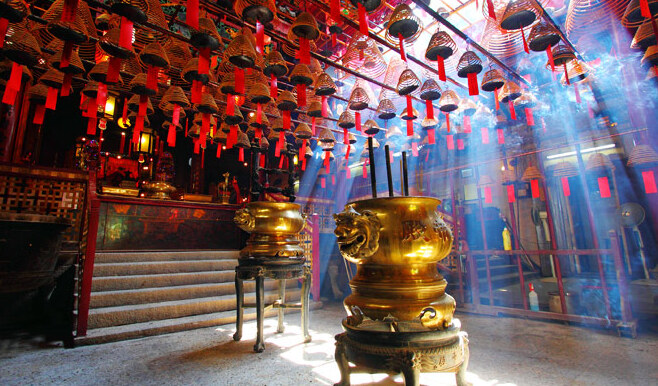
One of the oldest Taoist temples in Hong Kong, Man Mo pays tribute to two gods who make an unlikely pair: Man, the God of Literature, and Mo, the God of War. The pairing is not as contradictory as it sounds — in the Confucian-inflected moral universe of imperial China, civil and military virtue were understood as complementary rather than opposed. The temple sits roughly midway along a road that most visitors travel by bus without stopping, which means it receives a fraction of the attention given to the Big Buddha a few kilometres away. Inside, the air is thick with the smoke of coiled incense hanging from the ceiling in slow spirals, and the light is dim and amber-coloured. There is a quality of genuine use here — locals come to pray, to leave offerings, to consult the fortune sticks — that distinguishes it from temples that have become primarily photographic subjects.
Insider tip
Fortune stick readings (kau cim) are available at the temple. A practitioner can help interpret the results if you ask; the process takes about fifteen minutes and costs very little.
6Folklore· 8.3 km
Tai O Fishing Village: a town that hasn't decided whether to become a museum
Tai O sits at the western tip of Lantau on a river mouth, and it has been a fishing settlement for long enough that no one is entirely sure when it began. The houses built on stilts over the tidal channels — the famous 'stilt houses' — are the image that appears on every travel piece about the place, and the image is accurate, but it elides the complexity of what Tai O actually is. It is a working village that has also, reluctantly and unevenly, become a tourist attraction. The dried seafood shops along the main lane sell shrimp paste and salted fish and preserved eggs to both local customers and visitors who buy them as souvenirs. The population has aged and thinned — younger residents have largely left for Tung Chung or the city — but the people who remain seem to have made a kind of peace with the attention, neither performing for it nor resenting it openly. Come on a weekday morning and you will see something closer to the actual place.
Insider tip
Boat tours of the stilt house channels run from the main bridge and take about twenty minutes. They are worth doing once, but the best views of the houses are from the footbridges, which are free.
The Tai O Promenade is less a formal promenade than a loose sequence of paths and embankments that run along the water's edge through and beyond the village. Walk it in the late afternoon, when the light comes in low and flat across the Pearl River estuary, and Tai O reveals a different quality — quieter, more melancholy, more honest about what it is and what it is losing. The promenade takes you past the stilt houses from angles the boat tours don't reach, past drying racks hung with fish and squid, past elderly residents sitting in doorways watching the water. On clear days you can see across to the Pearl River Delta, to the industrial coast of Guangdong province. The border between Hong Kong and mainland China is close here, and the landscape knows it.
Insider tip
The Heritage Hotel at the old Tai O Police Station (converted in 2012) sits above the village and has a terrace bar with a view across the estuary. You don't need to be a guest to have a drink there.
8Panorama· 11.3 km
Cheung Chau - The hideaway of the pirate Cheung Po Tsai: a small island with a complicated past
Cheung Chau is not technically part of Lantau — it is its own island, about ten kilometres southwest of Hong Kong Island, reachable by ferry from Central in roughly forty-five minutes — but it belongs to the same world of outlying islands that Lantau anchors, and it shares Lantau's quality of being a place where the city's tempo does not quite apply. The island is associated with Cheung Po Tsai, an eighteenth-century pirate who operated out of these waters with a fleet that, at its peak, reportedly numbered in the hundreds of vessels. A cave on the island's western coast is said to have been his hideout, though the historical evidence for this is thin and the cave itself is small enough to disappoint anyone who imagined something more dramatic. What Cheung Chau actually offers is a car-free island of about eight square kilometres, seafood restaurants along the waterfront, and a pace of life that feels genuinely unhurried rather than performatively slow.
Insider tip
The Bun Festival (Cheung Chau Jiao), held annually in late April or May, draws large crowds and involves towers of steamed buns and a competitive bun-snatching climb. Book ferries well in advance if you plan to attend.
9Religious Site· 4.0 km
Tian Tan Buddha, referred to as the "Big Buddha": the cable car as experience in itself
The Ngong Ping 360 cable car, which carries passengers from Tung Chung up to the Ngong Ping plateau over approximately 5.7 kilometres of mountainous terrain, is the kind of infrastructure that would be a major attraction in most cities and is treated in Hong Kong as merely a means of transport. The journey takes about twenty-five minutes and crosses above forested ridges, reservoir water, and the northern coast of Lantau. The gondolas with glass floors are available at a premium and are worth the extra cost on a clear day; on a hazy day, which is most days between October and April, the standard cabin is fine. The cable car has had mechanical issues over the years — it was closed for an extended period after an incident in 2007 — and queues on weekends can stretch to ninety minutes. Factor this in. The ride down, in late afternoon light, is better than the ride up.
Insider tip
Buy tickets online in advance, especially for weekends and public holidays. The Tung Chung station is connected directly to the MTR, which makes the logistics straightforward if you're coming from Kowloon or Hong Kong Island.
There is a version of Lantau that Hong Kong's tourism infrastructure wants you to experience: cable car up, Big Buddha photograph, monastery lunch, cable car down, back in Wan Chai by seven. It is not a bad day. I have had that day and I do not regret it. But it leaves the island largely intact, unread, which is either a waste or an invitation depending on how you look at it.
What stays with me, after many visits, is not any single place but a quality of the light in the late afternoon over the Pearl River estuary from the Tai O promenade — the way the water goes silver and then pewter and then a colour that doesn't have a name in English — and the sound of the incense smoke moving in the Po Lin monastery courtyard, and the particular silence of Cheung Chau's back lanes after the day-trippers have taken the last ferry home. These are not experiences you can plan. They are what happens when you stay longer than you intended and stop looking for the next thing on the list.
Lantau is the part of Hong Kong that reminds you the city was built on water and hills by people who had no particular interest in efficiency. That reminder is worth the trip.
🏆 Pocket guide
Take this guide with you.
Save it offline, get walking directions, and discover thousands more places like the ones you just read.
How do I get to Lantau Island from central Hong Kong?
The most practical route is the MTR Tung Chung Line from Hong Kong Station or Kowloon stations to Tung Chung, which takes about 30 minutes. From Tung Chung you can take the Ngong Ping 360 cable car to the plateau, or buses to Tai O (route 11 or 1) and other parts of the island. Ferries from Central Pier also serve the outlying islands, including Mui Wo on Lantau's eastern coast, from which buses connect to the rest of the island.
Is Lantau Island worth visiting for a full day, or is half a day sufficient?
A half-day covers the Ngong Ping plateau — cable car, Big Buddha, Po Lin Monastery — reasonably well if you start early. A full day allows you to add Tai O, which is about an hour by bus from Ngong Ping and deserves at least two hours. Serious walkers or anyone wanting to explore the southern coast or the Lantau Trail should plan for multiple visits or an overnight stay. The island is large enough that trying to see everything in one day produces a rushed and unsatisfying experience.
What is the best time of year to visit Lantau?
October through December offers the most reliable combination of clear skies, lower humidity, and comfortable temperatures — typically between 18 and 25 degrees Celsius. January and February can be cool and hazy. The summer months (June through September) bring typhoon risk, high humidity, and frequent rain, though the hills are very green and the beaches are warm. The Ngong Ping cable car closes during typhoon warnings, which can disrupt plans at short notice.
Are there places to eat on Lantau beyond the monastery restaurant?
Tai O has several small restaurants serving local seafood — shrimp paste congee, steamed fish, stir-fried clams — at prices well below what you'd pay in the city. The Ngong Ping village near the cable car terminus has a cluster of restaurants that are functional but oriented toward tourist traffic. Tung Chung has a full range of options including a large shopping mall with food courts. For a more considered meal, the Heritage Hotel in Tai O has a restaurant with a reasonable menu and the best setting on the island.
Is Cheung Chau part of Lantau, and how do I get there?
Cheung Chau is a separate island, not administratively part of Lantau, but it is commonly grouped with the outlying islands that Lantau anchors. Ferries run from Central Pier 5 (Outlying Islands Ferry Terminal) roughly every hour, with the journey taking about 35 to 55 minutes depending on whether you take the fast or ordinary ferry. There are no cars on Cheung Chau — the island is navigated on foot or by bicycle — which makes it a distinctly different experience from Lantau's bus-connected villages.
🏆 Read this offline
Save it to your phone.
Bookmark this guide, plan your trip offline, and discover thousands of places like these.
BookmarkPlan offline60 languages
iOS / Android
Huawei users
Secret WorldHidden places, real stories — plan your trip