10 Best Things to Do in Sai Kung, Hong Kong — beyond the obvious
A long-term resident's unsentimental guide to one of Hong Kong's most misunderstood corners
L
Words by
Lena Hofmann
Updated
9 October 2026
Read time
13 minutes
Includes
10 places · interactive map
I first came to Sai Kung on a Sunday in October, which is precisely the wrong time to arrive if you want to think clearly about a place. The waterfront promenade was so dense with families, expat joggers, and vendors waving laminated menus at anyone who made eye contact that I spent the first forty minutes simply trying to locate a coffee that wasn't served in a styrofoam cup. I failed. I ate a fishball on a stick instead and watched a man attempt to park a Land Rover Discovery on a pavement that was never designed to accommodate one. He succeeded, which felt like a metaphor for Hong Kong in general.
Sai Kung is often described, lazily, as Hong Kong's 'back garden' — a phrase that manages to be both accurate and completely misleading. It is green, yes. It has water on three sides and country park on the fourth. But it is also a working town with a complicated layering of Hakka fishing heritage, colonial-era infrastructure, and the particular kind of expat domesticity that accumulates wherever good international schools and large supermarkets coincide. The seafood restaurants on the waterfront are real, but so is the queue for them on a Saturday afternoon.
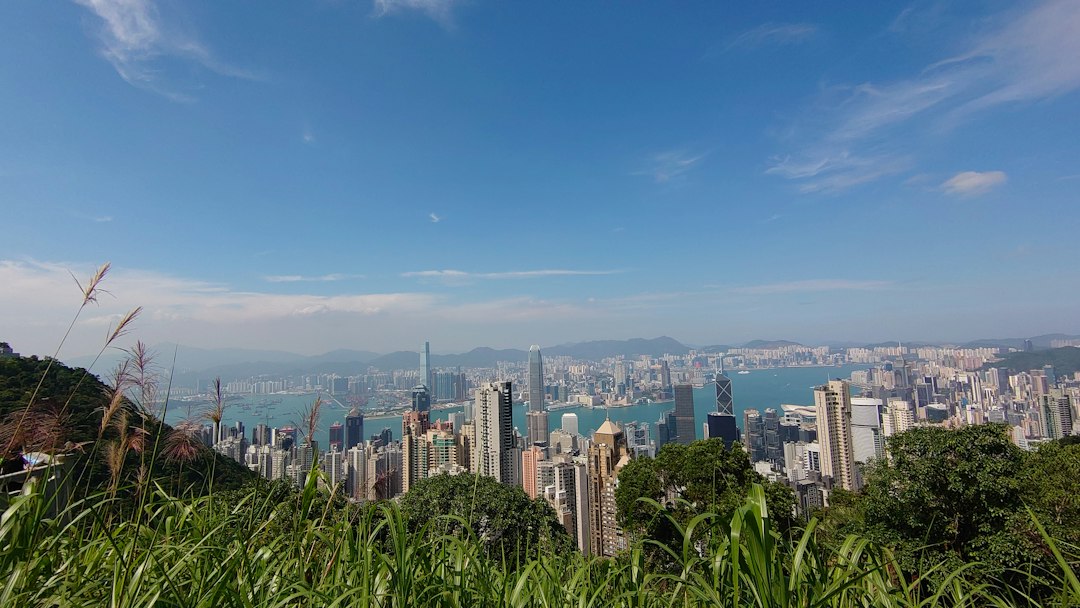
What the standard tourist itinerary misses is that Sai Kung is best understood not as a destination in itself but as a point of departure — into the New Territories, into Hong Kong's broader religious and horticultural geography, into the city's habit of placing the ancient and the contemporary in such close proximity that you stop noticing either. The entries that follow are drawn from a wider Hong Kong orbit, because Sai Kung's character only becomes legible when you understand what surrounds it.
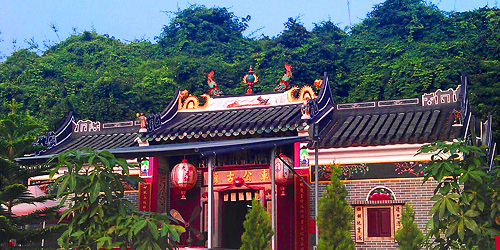
The Che Kung Temple at Ho Chung sits roughly 3.5 kilometres from Sai Kung's centre, which means most visitors drive past it without registering it exists. That is their loss and, frankly, your gain. Believed to be over 400 years old, the temple was dedicated to Che Kung, a general of the Song dynasty venerated for his power to ward off plague and misfortune — a function that has never quite gone out of fashion. What distinguishes this particular temple from the more famous Che Kung Temple in Sha Tin is precisely its scale: it is small enough that the feng shui logic of its placement remains legible. Fung shui woods rise directly behind the main hall; the Ho Chung River runs immediately in front. The orientation is deliberate, calculated, and it still works on you even if you arrived by Uber. The traditional design has been preserved with unusual care — the painted eaves, the incense coils suspended from the ceiling like slow-burning chandeliers, the worn stone of the forecourt. Go on a weekday morning, when the worshippers outnumber the photographers.
Insider tip
The river path alongside the temple is worth ten minutes of walking. The fung shui woodland behind is not open to casual visitors, but its canopy is visible from the forecourt and gives the whole site an unusual density of shade.
2Garden· 8.2 km
Hong Kong: Nan Lian Garden — a Tang dynasty grammar in a post-industrial district
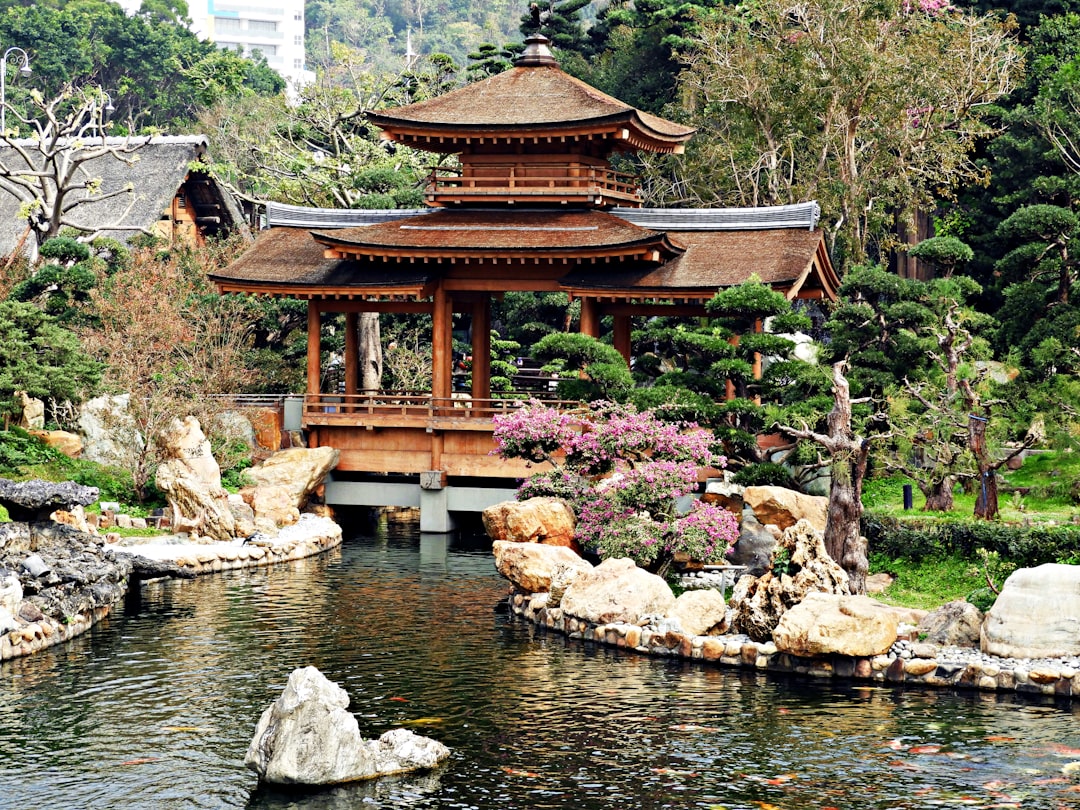
Nan Lian Garden sits in Diamond Hill, about 8 kilometres from Sai Kung's waterfront, and the contrast between its surroundings and its interior is so extreme that first-time visitors sometimes laugh involuntarily upon entering. High-rise residential towers press in on every side; inside the gates, the geometry shifts entirely. The garden was built in the style of the Tang dynasty — wooden pavilions, carefully raked gravel, lotus ponds, a rock garden that follows classical compositional rules — and it is maintained with a precision that borders on the obsessive. Every pine tree is individually shaped. Every stone placement has a precedent in classical garden design. It is a public park, free to enter, and it draws a mix of elderly residents doing tai chi before 8am, tourists who discovered it on Instagram, and the occasional architecture student with a sketchbook. The Chi Lin Nunnery immediately adjacent, built in the same Tang-influenced style, is worth folding into the same visit.
Insider tip
The garden closes at 9pm and the evening light, particularly in autumn, turns the wooden structures a colour that the daytime crowds never quite see. Arrive an hour before closing on a weekday.
It says something about Hong Kong's layered identity that the same garden — Nan Lian — appears twice in any serious account of the city, once in English and once in a register that belongs to a different set of visitors entirely. The garden between Diamond Hill's towers is not one thing to one audience. For the Cantonese retirees who arrive at dawn with thermoses of tea, it is a neighbourhood amenity. For the tourists who come from mainland China, it is a point of cultural pride. For the expats who live in the New Territories and make the MTR journey across on a Sunday, it is a corrective to the week. What the garden does, regardless of who is standing in it, is impose a slowness that Hong Kong otherwise resists. The paths are narrow enough that you cannot walk quickly. The ponds demand you stop. The classical landscaping — borrowed from Tang-era principles of mountain, water, and void — is a system for producing a particular quality of attention. It works on almost everyone, which is rarer than it sounds.
Insider tip
The garden's tea house serves decent Chinese tea in a setting that justifies the slight premium. It is not a tourist trap so much as a logical extension of the garden's logic — sit, slow down, pay for the privilege.
The MacLehose Trail is 100 kilometres long, crosses ten stages, and begins at Pak Tam Chung in the Sai Kung Country Park before terminating at Tuen Mun in the northwest New Territories. It was named after Sir Murray MacLehose, the governor who established Hong Kong's country park system in the 1970s — a decision that, in retrospect, looks like one of the most intelligent acts of urban planning in the city's history. Stage One begins near Sai Kung and is among the most walked sections: the High Island Reservoir, completed in 1978, sits below the trail's ridge and gives the walk a quality that is genuinely unlike anything else in a city of seven million people. The trail does not flatter the unprepared. Stages Four and Five, through the Maclehose's central highlands, have caught out people in trainers on warm afternoons more times than the rescue services would like to count. Go in October or November. Carry more water than you think you need. The views are not the point; the sustained physical engagement with the landscape is.
Insider tip
Stage Two, from Pak Tam Au to Kei Ling Ha, is shorter and less trafficked than Stage One and offers a more honest sense of what the trail's interior sections feel like. The minibus back to Sai Kung from Kei Ling Ha is infrequent — check the schedule before you start.
5Market· 12.2 km
Hong Kong and the Ladies' Market: Mong Kok's organised chaos, honestly described
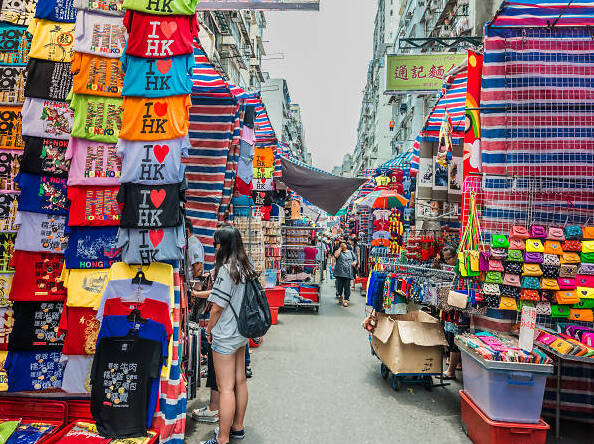
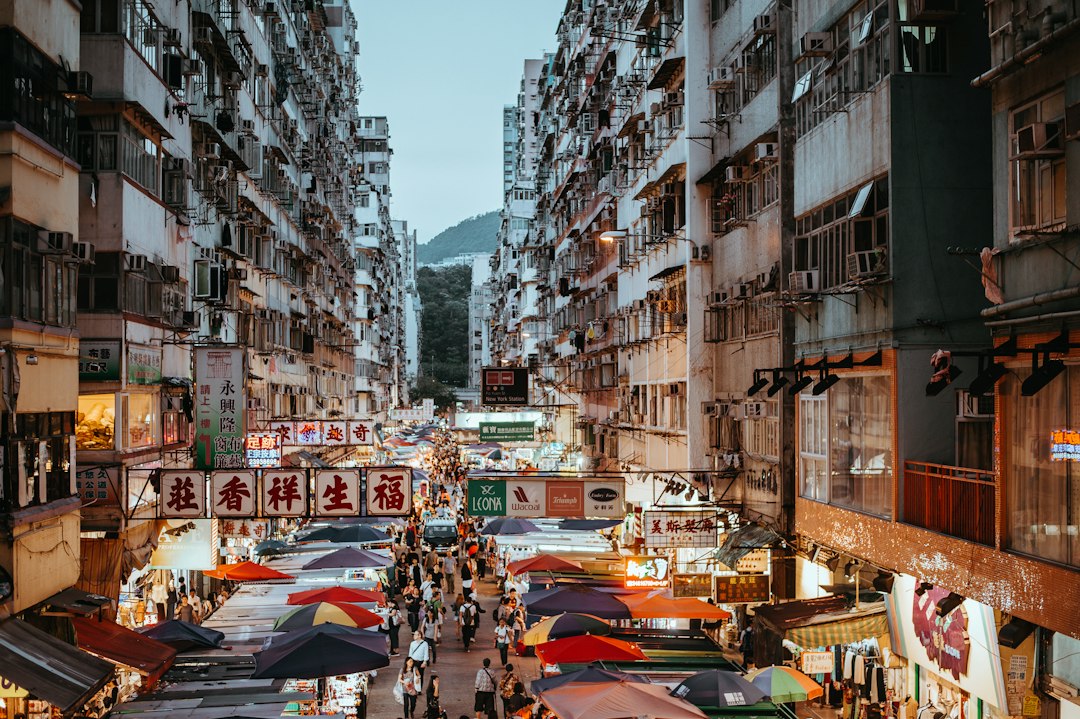
Ladies' Market runs along Tung Choi Street in Mong Kok, about 12 kilometres from Sai Kung, and it is worth visiting precisely because it makes no concessions to the idea that shopping should be comfortable. More than 100 stalls sell clothing, accessories, electronics, and goods of variable provenance in conditions of considerable noise and density. The name dates from an era when the market specialised in women's clothing; it now sells more or less everything, including items whose relationship to any known brand is aspirational at best. The experience is real in a way that many of Hong Kong's more curated retail environments are not: the haggling is genuine, the crowds are genuine, the occasional disappointment when you get home and examine your purchase in better light is genuine. Mong Kok itself — one of the most densely populated urban districts on earth — is worth half a day of walking regardless of whether you buy anything.
Insider tip
The market runs from roughly noon to midnight. Arriving after 9pm means fewer tourists and more locals, and the stall holders are sometimes more willing to negotiate when they are trying to clear stock before closing.
Mong Kok's Ladies' Market on Tung Choi Street is one of those places that Hong Kong guidebooks have been describing in essentially the same terms since the 1980s, which suggests either that nothing has changed or that the description was always slightly beside the point. The market is vivid and loud and crowded and occasionally exasperating, and it is also a genuine piece of Hong Kong's commercial fabric rather than a performance staged for visitors. The colour — the stacked fabrics, the plastic packaging, the neon of the surrounding street signage — is best understood as a visual record of the district's density rather than as decoration. Mong Kok has one of the highest population densities of any urban area on earth, and the market is partly a consequence of that compression: when space is scarce, commerce spills onto the street. The Temple Street Night Market, a few minutes' walk away, extends the same logic into the evening hours and adds fortune tellers, dai pai dong food stalls, and occasional Cantonese opera performances to the mix.
Insider tip
Pickpocketing is not rampant but it is not unknown. Keep your phone in a front pocket and treat any sudden crowd compression with the mild suspicion it probably deserves.
7Market / Folk Culture· 13.1 km
Hong Kong: The Jade Market — a greenish stone and a long history of desire
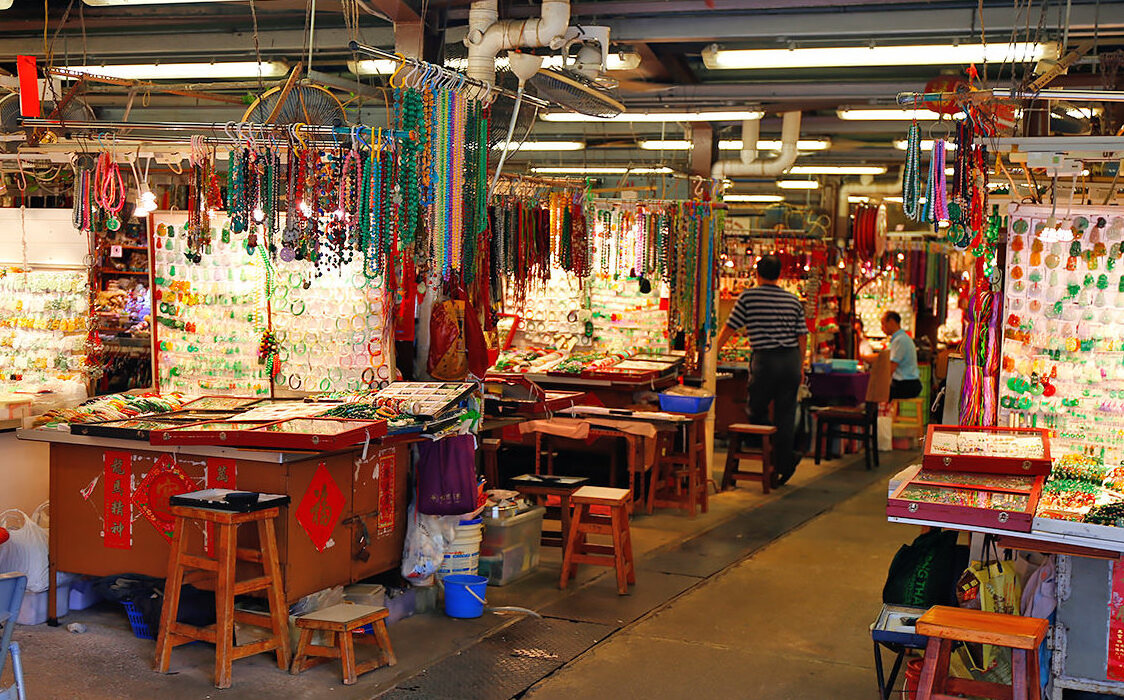
The Jade Market occupies a covered structure on Kansu Street in Yau Ma Tei, just west of Nathan Road, and it sells jade in more shades and qualities than most visitors knew existed. Jade — nephrite and jadeite are the two primary forms — has been valued in Chinese culture for millennia, associated with purity, moral virtue, and longevity in ways that have never entirely translated into Western aesthetic categories. The market has hundreds of stalls, and the range of quality is extraordinary: genuine imperial jadeite of the kind that sells at auction for sums that make no intuitive sense sits in the same general neighbourhood as dyed stone and glass that has been polished to a convincing sheen. Unless you know what you are looking at, buying expensive jade here is a gamble. Buying inexpensive jade as a souvenir is fine. The market is also worth visiting simply as an environment — the low light, the green cast of the merchandise, the particular concentration of the vendors — which has a quality that more famous Hong Kong attractions do not.
Insider tip
The market is most active in the morning. Bring cash. If a vendor's price drops by more than 60% in under two minutes, treat the original price as fictional.
8Architecture· 12.6 km
Zaha Hadid: Innovation Tower (Jockey Club Tower) — a building that refuses to stand still
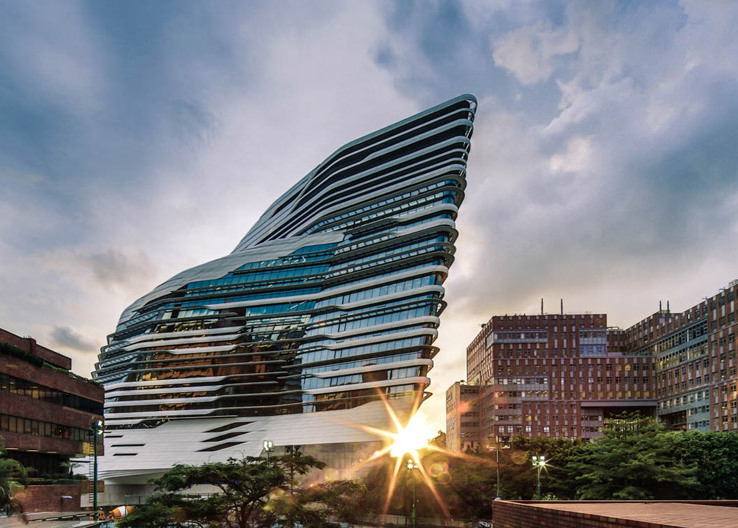
The Innovation Tower at Hong Kong Polytechnic University in Hung Hom was designed by Zaha Hadid Architects and completed in 2014. It is the kind of building that provokes strong reactions, which is probably the point. The structure — formally known as the Jockey Club Innovation Tower — houses the university's School of Design, and its exterior is a composition of warped concrete planes and angular voids that reads differently from every approach along Chatham Road South. Hadid's architecture was always in conversation with movement, with the idea that a building should not resolve into a single stable image, and the Innovation Tower is a committed example of that ambition. Whether it succeeds is a question worth sitting with. It is not universally loved by the people who work in it, which is not unusual for signature architecture. It is, however, genuinely interesting in a city where interesting buildings are rarer than the density of construction might suggest.
Insider tip
The building's interior atrium is accessible during university hours and worth seeing — the spatial logic of the exterior becomes more legible from inside. The surrounding Hung Hom neighbourhood has a low-key local restaurant scene that most visitors to the tower miss entirely.
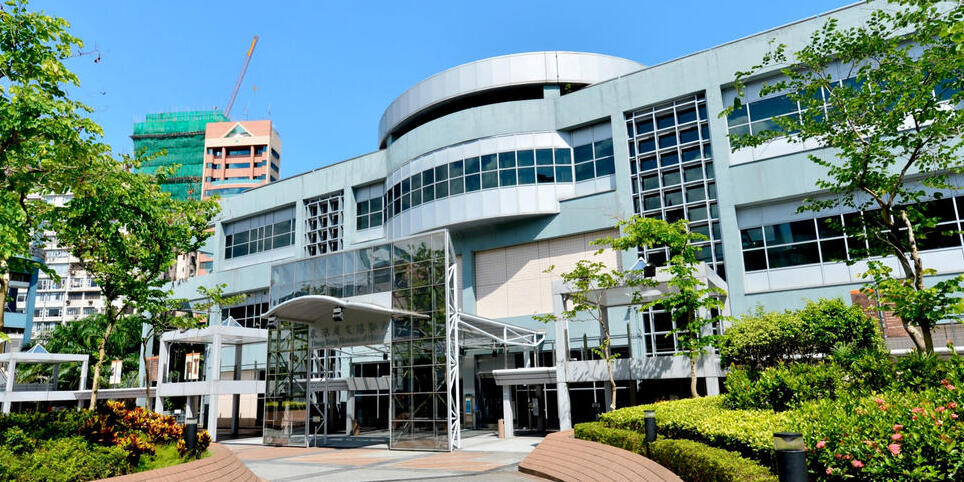
The Hong Kong Museum of History in Tsim Sha Tsui opened its permanent exhibition — 'The Hong Kong Story' — in 2001, and it covers roughly 400 million years of geological and human history in a sequence that is more coherent than that ambition makes it sound. The museum was established in 1975 following the division of the original City Museum and Art Gallery, and its collection has grown considerably since. The permanent exhibition moves from prehistoric geology through the Neolithic settlements of the region, the colonial period, the Japanese occupation of 1941–1945, and the handover of 1997 with a thoroughness that rewards patience. The Japanese occupation galleries are particularly carefully done — the oral histories and personal objects carry a weight that the more panoramic sections of the exhibition do not always achieve. The museum is free to enter for the permanent collection, which in a city with Hong Kong's cost of living feels almost subversive.
Insider tip
Allow at least three hours for the permanent exhibition if you intend to read the panels rather than glance at them. The museum shop has a better-than-average selection of books on Hong Kong history, including some that are difficult to find elsewhere.
10Food / Cultural Practice· 13.1 km
Dim Sum that means 'touch your heart': a meal that is also a social institution
Dim sum — the phrase translates as 'touch your heart' — is not a dish but a practice, a meal structure, and, in Hong Kong, a form of social infrastructure. The tradition of yum cha, drinking tea while eating small dishes served in bamboo steamers and on wheeled trolleys, is associated with the teahouses of Guangdong province and has been part of Hong Kong's daily rhythm for generations. The dishes themselves — har gow (shrimp dumplings), siu mai (pork and shrimp), char siu bao (barbecue pork buns), cheung fun (rice noodle rolls), egg tarts — are individually simple and collectively inexhaustible. In Sai Kung and the surrounding New Territories, dim sum restaurants tend toward the functional rather than the decorative: large, loud, fluorescent-lit rooms where tables are shared with strangers and the trolleys navigate the floor with the authority of vehicles that have right of way. The quality is often excellent precisely because the audience is local and unforgiving. Arrive before 10am on a weekend if you want a table without a wait.
Insider tip
Order the turnip cake (lo bak go) and the glutinous rice wrapped in lotus leaf (lo mai gai) if they appear on the trolley. Both are underordered by visitors and overappreciated by regulars, which is usually a reliable signal.
There is a particular moment that happens in Sai Kung on weekday mornings in autumn, when the typhoon season has ended and the air has lost its weight, and the waterfront is occupied mainly by older residents and fishing boats rather than weekend crowds. The town looks, briefly, like what it actually is: a place where people live, structured around tides and markets and school runs and the slow business of getting through a day. The more famous version of Sai Kung — the seafood promenade, the boat trips to outlying islands, the expat pubs with their Sunday roasts — is real, but it is the surface reading.
The deeper reading requires some willingness to move outward: to the temple at Ho Chung with its four centuries of accumulated belief, to the MacLehose Trail's ridge above the reservoir, to Kowloon's jade vendors and museum galleries and Tang-dynasty garden geometries. These are not Sai Kung in any strict geographical sense, but they are Sai Kung's context, and context is what turns a pleasant day out into something you actually understand.
Hong Kong is a city that rewards lateral movement — the willingness to take the wrong minibus and see where it goes, to eat in a restaurant with no English menu, to stand in a temple courtyard long enough that the incense smoke stops being picturesque and starts being simply present. Sai Kung is a reasonable place from which to begin that kind of travel. It is not, by itself, the destination.
🏆 Pocket guide
Take this guide with you.
Save it offline, get walking directions, and discover thousands more places like the ones you just read.
How do I get from central Hong Kong to Sai Kung town?
Take the MTR to Diamond Hill station (Kwun Tong Line), then board minibus 1A or bus 92 to Sai Kung town. The journey from Diamond Hill takes roughly 30 to 40 minutes depending on traffic. Taxis from Kowloon are an option but the cost is considerably higher and the traffic on weekends can make the journey longer than the bus. There is no direct MTR connection to Sai Kung.
When is the best time of year to visit Sai Kung and the surrounding New Territories?
October through December is the most reliably pleasant period: the typhoon season has ended, humidity drops significantly, and temperatures sit in a range that makes walking comfortable. February and March can be grey and damp but are far less crowded. July and August are hot, humid, and carry the risk of typhoon disruption — the MacLehose Trail and any outdoor activities should be planned with that in mind.
Is the MacLehose Trail suitable for casual walkers, or does it require serious preparation?
Stage One of the MacLehose Trail, from Pak Tam Chung to Long Ke, is manageable for reasonably fit walkers with proper footwear and sufficient water. The later stages, particularly Four through Six through the central highlands, are more demanding and have caught out underprepared hikers. Sun exposure is significant on the exposed ridges. The Hong Kong Observatory app provides reliable weather data and should be checked before any multi-hour walk in the country parks.
Is bargaining expected at the Ladies' Market and the Jade Market?
At both markets, the initial asking price is understood by all parties to be a starting point rather than a fixed figure. Polite negotiation is normal and expected. The degree of discount available varies considerably by stall and by item. At the Jade Market, the quality differential between items at similar price points is significant enough that buying anything expensive without some knowledge of jade grading carries real risk. For inexpensive souvenirs, the stakes are lower.
Are the Nan Lian Garden and Chi Lin Nunnery free to visit?
Nan Lian Garden is free to enter and open daily except Tuesdays. The Chi Lin Nunnery adjacent to it is also free. The garden's tea house and restaurant charge for food and drink at rates that are moderate by Hong Kong standards. The garden closes at 9pm, which makes it one of the few green spaces in the city accessible in the evening hours.
🏆 Read this offline
Save it to your phone.
Bookmark this guide, plan your trip offline, and discover thousands of places like these.
BookmarkPlan offline60 languages
iOS / Android
Huawei users
Secret WorldHidden places, real stories — plan your trip