
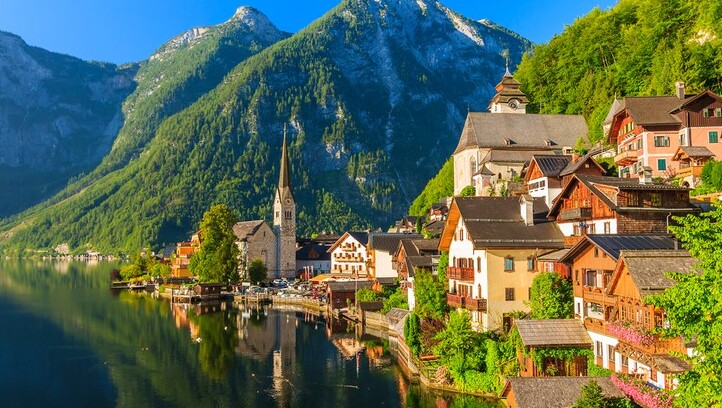

Hallstatt is known for its production of salt, dating back to prehistoric times, and gave its name to the Hallstatt culture, the archaeological culture linked to Proto-Celtic and early Celtic people of the Early Iron Age in Europe. In 1846, Johann Georg Ramsauer discovered a large prehistoric cemetery at the Salzberg mines near Hallstatt, which he excavated during the second half of the 19th century. Eventually the excavation would yield 1,045 burials, although no settlement has yet been found. This may be covered by the later village, which has long occupied the entire narrow strip between the steep hillsides and the lake. Some 1,300 burials have been found, including around 2,000 individuals, with women and children but few infants. Nor is there a "princely" burial, as often found near large settlements. Instead, there are a large number of burials varying considerably in the number and richness of the grave goods, but with a high proportion containing goods suggesting a life well above subsistence levelHallstatt are part of the Bronze Age Urnfield culture. Phase A saw Villanovan influence. In this period, people were cremated and buried in simple graves. In phase B, tumulus (barrow or kurgan) burial becomes common, and cremation predominates. Little is known about this period in which the typical Celtic elements have not yet distinguished themselves from the earlier Villanova-culture. The "Hallstatt period" proper is restricted to HaC and HaD (8th to 5th centuries BC), corresponding to the early European Iron Age. Hallstatt lies in the area where the western and eastern zones of the Hallstatt culture meet, which is reflected in the finds from there.[6 Hallstatt D is succeeded by the La Tène culture. Hallstatt C is characterized by the first appearance of iron swords mixed amongst the bronze ones. Inhumation and cremation co-occur. For the final phase, Hallstatt D, daggers, almost to the exclusion of swords.


