


The wind comes from the Baltic without warning, bending the heather bushes that cover the gray granite cliffs. Here, at the northernmost corner of the Danish island of Bornholm, the Hammeren Lighthouse stands as a steadfast point in a landscape that seems to resist any taming. It is not a postcard monument, polished and reassuring: it is a structure that makes sense only in this precise context, among ancient rocks and a sea that changes color three times a day.

The lighthouse is located near Allinge-Sandvig, the municipality that occupies the northern tip of the island, and it remains an active lighthouse today, part of the navigation system that guides vessels through the waters of the northern Baltic Sea. This operational continuity is one of the details that distinguishes it from many other European lighthouses turned into static museums: the light still rotates, giving it a functional dignity that the tourist immediately perceives.
The structure and the surrounding landscape

The Hammeren lighthouse is built of white plastered bricks, a cylindrical shape that contrasts with the ruggedness of the granite on which it stands. The height of the tower allows for a view that on clear days extends towards the Swedish coast to the northeast and towards the open waters to the west. Around the lighthouse, the landscape is dominated by heather — Calluna vulgaris — which in summer paints the rocky hills purple, while in winter it gives way to an equally fascinating palette of ochre and burnt brown.
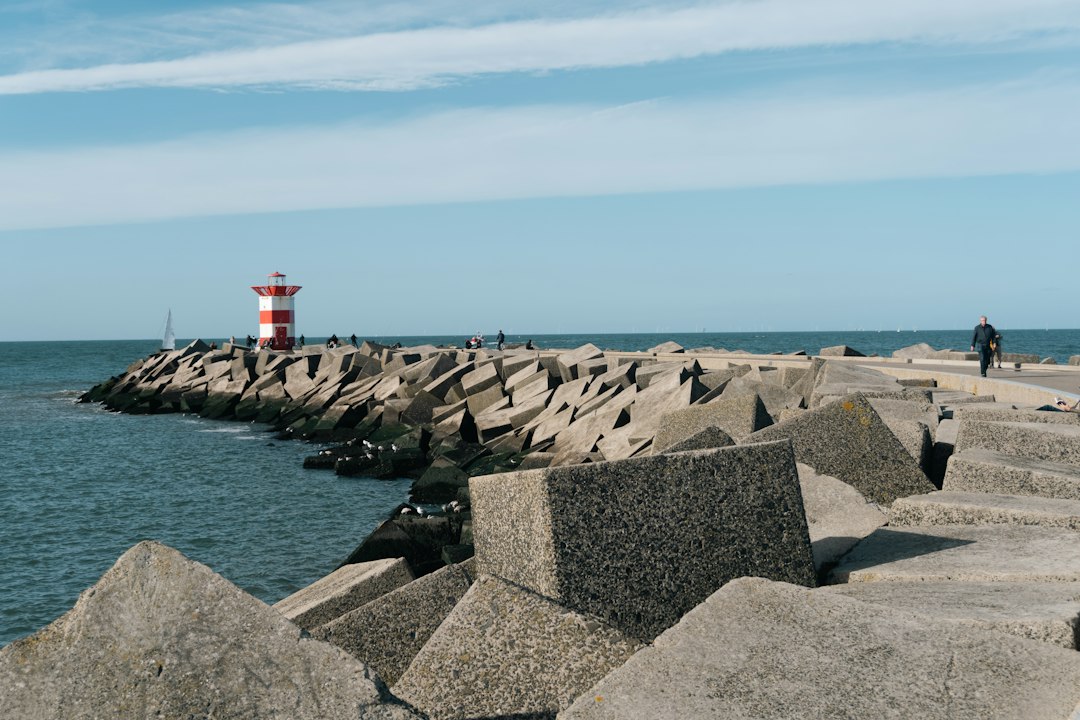
The granite cliffs that descend towards the sea belong geologically to one of the oldest rock formations in Scandinavia, and even without knowing the geology, it is impossible not to notice the particular texture of those rocks: gray, split into square blocks, with veins of white quartz that shine when the sun is low. Walking among these formations requires caution, but offers photographic perspectives that are hard to replicate elsewhere.
The guided tours and the internal experience
In the summer months, the lighthouse opens to the public with guided tours that allow visitors to climb inside the tower. It is during these tours that one truly understands the logic of a lighthouse: the narrow and steep steps, the optical mechanism in the lantern, the silence found on the intermediate floors while outside the wind never stops. Local guides explain the functioning of the signaling system and the history of navigation in this area of the Baltic, historically busy with trade routes between the Nordic countries.

The number of steps and the internal architectural details are elements that vary from lighthouse to lighthouse, and Hammeren is no exception: the iron spiral staircase is narrow enough to remind us that these buildings were designed for the keepers, not for tourists. At the top, the view justifies every effort: the sea opens up in all directions, and on clear days, the silhouettes of the smaller islands scattered in the Baltic are clearly distinguishable.
How to get there and when to visit

Allinge-Sandvig can be reached by ferry from Copenhagen or from Ystad, Sweden — the crossing from Ystad takes about an hour and twenty minutes and is often the most convenient for those coming from the European continent. Once on the island, the Hammeren lighthouse can be reached by car or bicycle by following the roads along the northern coast. Bornholm is a cyclist's paradise, with marked routes connecting the main points of interest, and cycling to Hammeren is an experience in itself, with continuous views of the sea.
The most useful practical advice is to arrive in the early morning hours, preferably before ten: the morning light enhances the colors of the granite and heather, and the wind is generally calmer compared to the afternoon. In July and August, the site can become crowded during the central hours of the day, while in spring and early autumn, ideal conditions can be found with much less tourist traffic. Bringing a waterproof layer is always a good idea, regardless of the forecast: the weather on Bornholm changes quickly, and gusts of wind at the northern tip of the island can surprise even on seemingly calm days.
Why the trip is worth it
Hammeren is not the type of destination you visit to check a box on a list. It is a place that requires a certain willingness to stand still, to look at the sea without expecting something particular to happen. The combination of an active lighthouse, exceptional geological landscape, and relative isolation creates an atmosphere that few other corners of Denmark can offer.
Those who visit Bornholm are often surprised by the variety of the island: the sandy beaches to the south, the medieval villages inland, the unique round churches. But Hammeren, with its lighthouse that continues to do its job every night, represents something different — a promontory where function and beauty effortlessly coincide, and where the Baltic ceases to be a backdrop to become the true protagonist.


