
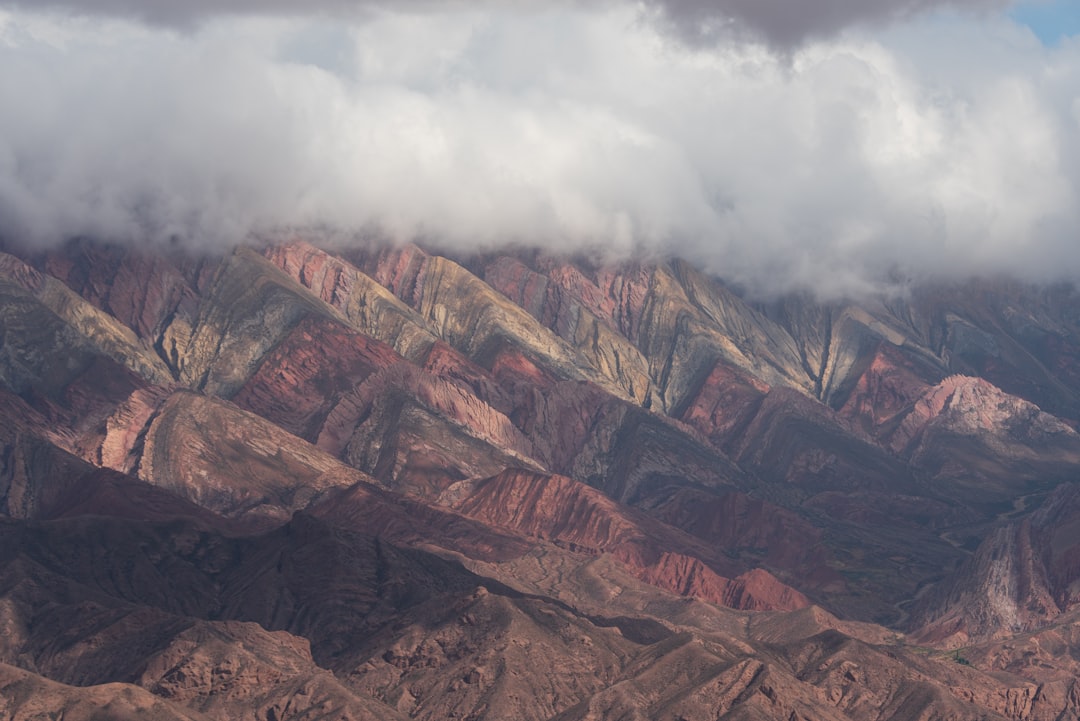

In the early hours of the morning, when the slanting light of the sun touches the rocky walls of the Cerro de los Siete Colores, the landscape seems almost unreal. The mineral stripes of oxide red, copper green, sulfur yellow, and manganese purple progressively light up, transforming the mountain into a living palette that changes shades every hour. This visual phenomenon, entirely natural and observable with the naked eye, is the beating heart of the Quebrada de Humahuaca, a mountain gorge that extends for about 155 kilometers in the province of Jujuy, in the northwest of Argentina.
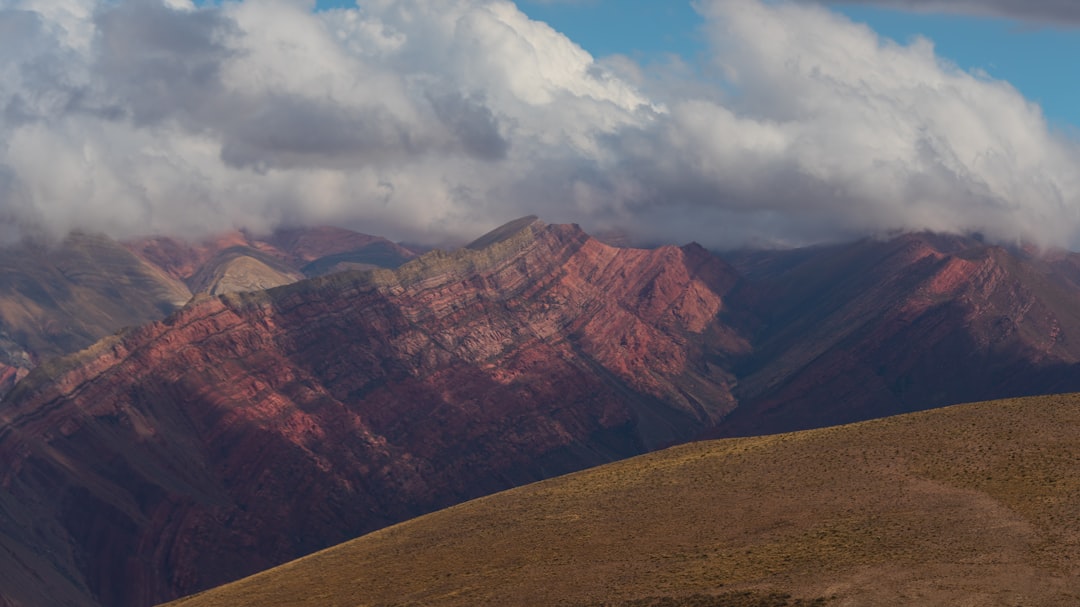
The quebrada develops along the course of the Rio Grande, at an altitude that ranges between 2,000 and 3,500 meters above sea level. In 2003, UNESCO listed it as a World Heritage Site, recognizing it as a cultural and natural landscape of exceptional value. But beyond the official recognitions, what strikes the visitor is the visual density of the territory: every curve of the road reveals a chromatic variation, a different geological formation, an ecosystem that changes with altitude.
A vertical ecosystem between deserts and puna
The Quebrada de Humahuaca is not a uniform environment. Proceeding north from Tilcara to Humahuaca and beyond, one crosses distinct microclimates that host radically different plant communities. At the lower altitudes, where humidity is slightly higher, columnar cacti of the species Trichocereus pasacana grow, which can reach ten meters in height and represent one of the most characteristic elements of the visual landscape of the gorge. Higher up, the vegetation becomes sparse and opens up to the puna, the arid Andean plateau where tufted grasses called ichu dominate.
This altitudinal variation creates distinct habitats that support a surprisingly rich fauna for such an apparently arid environment. In the higher areas, one can spot the suri, the large Andean ostrich also known as puna ñandú, a species that walks among the ichu bushes with slow and solemn movements. In rocky areas, the vizcacha — rodent-like animals similar to chinchillas with long tails — perch on sunlit walls in the early morning hours. On the thermal currents rising along the walls of the gorge glide the Andean condors, recognizable by their wingspan that can exceed three meters.
The geology that paints the mountains
The seven colors of the Cerro de los Siete Colores, visible near Purmamarca, are the result of marine and continental sediments accumulated in different geological eras and subsequently uplifted by Andean tectonic activity. Each color stripe corresponds to a specific mineral composition: red comes from iron oxides, green from the presence of copper and chlorite, yellow from hydrated iron, and purple from manganese minerals. These layers, tilted and folded by movements of the Earth's crust, are now exposed vertically and readable like the pages of a geological book.
Walking along the Paseo de los Colorados, the approximately three-kilometer trail that circumnavigates the Cerro de los Siete Colores starting from the center of Purmamarca, it is possible to closely observe the variations in color and texture of the rock. The route takes about an hour and a half at a leisurely pace and presents no technical difficulties, but the altitude — Purmamarca is located at about 2,200 meters — requires walking slowly to avoid soroche, altitude sickness.
The fauna of the altitudes: where to find it
For those who want to maximize wildlife sightings, the first hours after dawn are crucial. The vizcacha come out to warm themselves in the sun on the rocks between 7 and 9 in the morning, while the condors take advantage of the thermals that form when the rock walls heat up, generally between 9 and 11. The llamas and vicuñas — the latter protected by national regulations — graze freely in the open areas of the puna and can be spotted relatively easily along provincial road 52 that climbs towards the Puna de Atacama.
In the waters of the Rio Grande and its tributaries live some species of aquatic birds adapted to the Andean environment, including the torrent duck, a duck that swims upstream in the faster sections of the river. Observing it requires patience and silence, but the visual reward — a bird that challenges the white water of a mountain stream with apparent nonchalance — is worth the wait.
Practical tips for visiting the quebrada
The best time to visit the Cerro de los Siete Colores is in the early morning hours, when the low light enhances the chromatic stripes and the temperatures are still cool. In summer (from November to March), afternoon rain is frequent and can make the trails slippery, as well as cover the sky with clouds that dull the colors. The dry season, between May and September, offers more stable conditions and optimal brightness.
To reach Purmamarca from Jujuy capital, there are regular buses that travel along national road 9, with a journey of about an hour and a half. Those arriving by car have greater flexibility to stop along the gorge. It is advisable to bring plenty of water, high-factor sunscreen, and layered clothing: the temperature difference between the valley floor and higher altitudes can exceed ten degrees even within the same day.


