
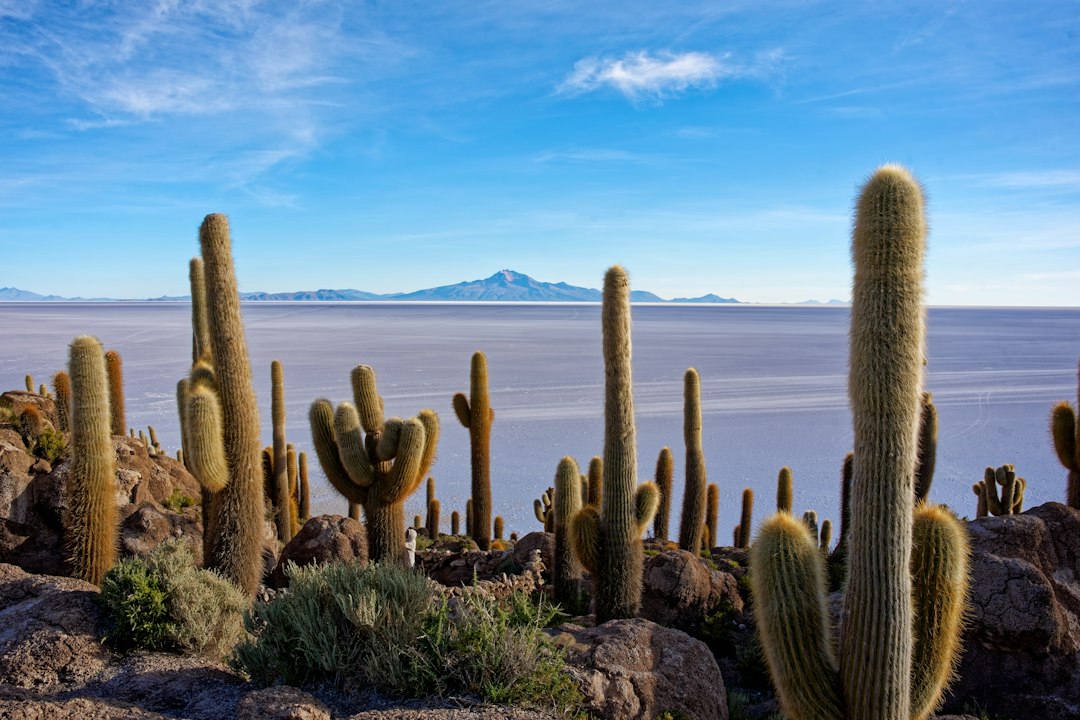

At three thousand six hundred meters above sea level, in the middle of the largest salt mirror on the planet, there is an island that resembles nothing that has been seen before. Isla Incahuasi — whose name in Quechua means approximately "house of the Incas" — is an ancient coral reef that emerged millennia ago when the prehistoric lake Lake Minchin dried up, leaving behind a white expanse of over ten thousand square kilometers. Today that expanse is the Salar de Uyuni, and the island floats at its center like a green and spiny mirage in an ocean of crystals.

What strikes you even before landing is the silence. Not the relative silence of a forest or an empty cathedral, but a physical silence, almost pressing, that the salt amplifies by absorbing every reverberation. The horizon is so flat and so white that it becomes difficult to distinguish where the ground ends and where the sky begins, especially during the central hours of the day when the light becomes blinding and the heat creates thin halos of steam on the surface.
A coral island in the middle of salt
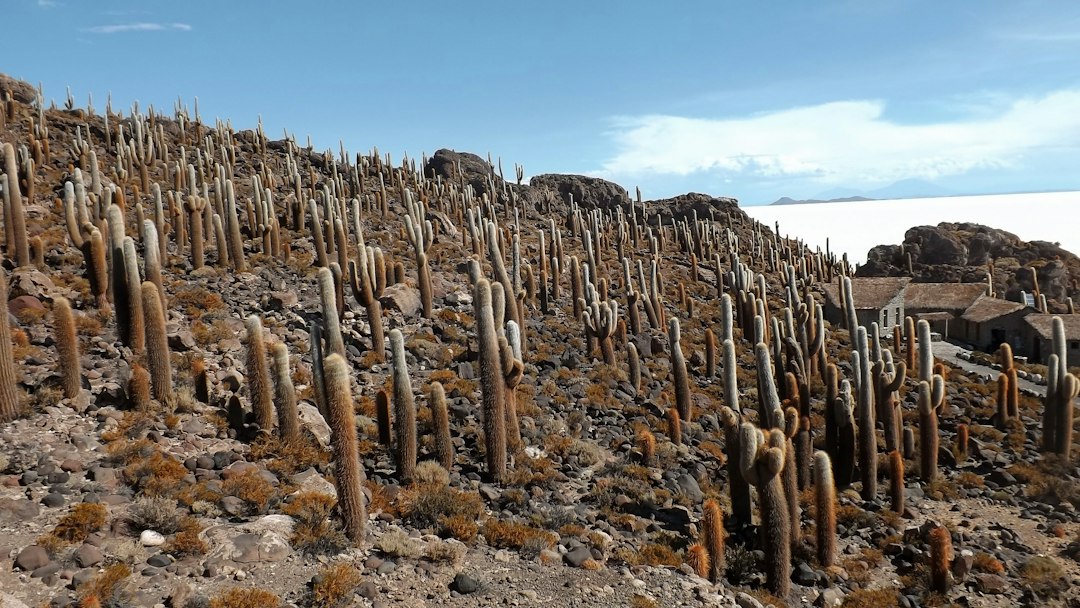
The geology of Incahuasi is the first thing that amazes the attentive visitor. Walking along the marked paths, one can directly observe the rocks of the island: they are fossil corals, calcified marine organisms that testify to the existence of an ancient inland sea. Touching them with your hands — rough, white, perforated like petrified sponges — is one of the most disorienting tactile experiences that a journey can offer. You are in the middle of a high-altitude salt desert, yet you hold in your fingers the proof that fish swam here in ancient times.
The island is about a kilometer long and can be walked in less than an hour by following the main path that climbs to the highest viewpoint. From up there, the view of the Salar is total: no trees, no hills, no buildings interrupt the white line that extends to the distant volcanoes. On clear days, the snow-capped peaks that mark the border between Bolivia and Chile can be distinguished in the distance.

The columnar cacti and the slow time
The most iconic feature of the island is its vegetation. Echinopsis atacamensis, the typical columnar cactus of the Andes, grows here in extraordinary density, reaching heights that exceed ten meters. Some specimens are estimated to be between six hundred and nine hundred years old: they were already adults when the Spanish conquerors arrived in South America. They grow very slowly — about one centimeter a year — and their presence on the island creates a landscape that oscillates between prehistoric and surreal.

Walking among these silent giants at sunset, when the slanting light of the sun transforms the salt into gold and the shadows of the cacti stretch for dozens of meters across the flat surface, is one of those moments when the journey stops being tourism and becomes something harder to name. The night that follows is equally powerful: at that altitude, far from any light pollution, the sky of the Salar de Uyuni is considered one of the best in the world for astronomical observation, with the Milky Way visible to the naked eye for much of the year.
How to get there and when to go

The starting point for visiting Isla Incahuasi is the city of Uyuni, reachable by train or bus from Potosí or Oruro, or by plane with Bolivian domestic flights. From Uyuni, dozens of organized 4x4 jeep tours depart every morning that cross the salt flat and reach the island in about an hour and a half of driving. The entrance ticket to the island costs around thirty bolivianos, a price subject to change, to be paid directly at the entrance.
The most important practical advice concerns the season. From November to April, during the rainy season, the Salar is covered by a thin layer of water that creates the famous mirror effect, transforming the surface into a perfect reflection of the sky. It is the most photographed spectacle in Bolivia, but the island's paths can be slippery and some routes may be closed. From May to October, the salt is completely dry, the light is clearer, and the walking conditions are ideal. In both cases, high-protection sunscreen is essential: the reflection of the white acts like a parabolic mirror and sunburns occur quickly even on cloudy days.
What to bring and how to prepare
Altitude is the factor that many underestimate. Uyuni is located at about 3,670 meters above sea level and the island is at the same altitude. Those arriving directly from coastal areas should allow themselves at least one day to acclimatize before tackling excursions. Sunglasses with high UV protection are essential, not optional: the white surface reflects over ninety percent of sunlight. Bringing enough water is equally essential, as there are no natural sources on the island and the available services are minimal. The wind can be intense and sudden even on seemingly calm days, so an extra layer of clothing never weighs too much in the backpack.


