

At six in the morning, from the road that climbs towards Kuelap, the valleys below you have disappeared. In their place, a solid white sea of clouds fills every depression, and the treetops emerge like islands in a still ocean. This is the morning thermal inversion that transforms the ascent to the Chachapoya fortress into something difficult to describe without falling into hyperbole — and yet it is an ordinary meteorological phenomenon in this portion of high Amazonia, where the humidity of the rainforest meets the cold air of the Andes at over 3,000 meters in altitude.

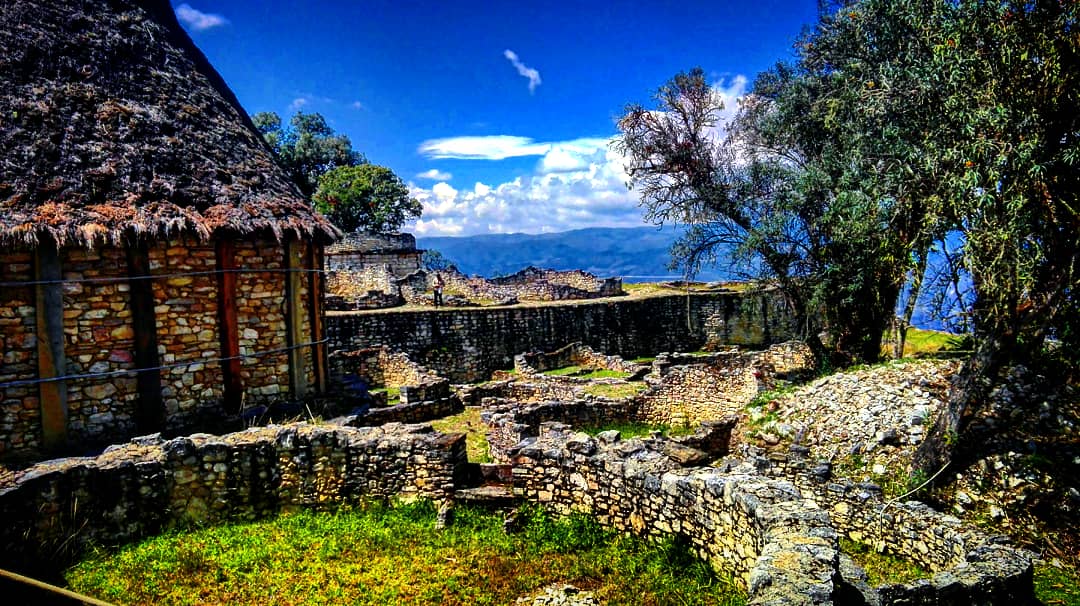
Kuelap is located in the Amazonas department, in northern Peru, above the city of Tingo. The fortress was built by the Chachapoya culture, probably between the 6th and 10th centuries AD, although the structures continued to be inhabited until the Inca period and beyond. The perimeter walls reach heights of up to 19 meters in some places, making the complex one of the most imposing stone constructions on the American continent. Inside, there are about 400 circular structures, many of which are still partially standing, with the characteristic diamond-shaped geometric friezes decorating the outer facades.
The light at dawn: the moment when colors change everything

Those who arrive at the top before the sun is high are faced with a palette that has nothing to do with the colors of full day. The stones of the walls, a gray almost silver in the shadow, become ochre and honey as soon as the first rays hit them sideways. The orchids and mosses that grow on the rocky surfaces — because here the vegetation does not stop in front of any stone — take on an almost fluorescent green against the beige of the limestone.
Looking northeast from inside the fortress, one can see the canyon of the Utcubamba River plunging steeply into the low forest. Backlit at dawn, the outline of the ridges is black against a sky that changes in a few minutes from orange to pale yellow to white. It is not a sight that can be captured in a photo: it takes time, and above all, it requires being there at the right moment.
The central hours: the green of the cloud forest
Around noon the light is less dramatic but clearer, allowing for better visibility of architectural details. The three original entrances of the fortress — narrow trapezoidal corridors that narrow towards the top, a typical feature of Chachapoya architecture — are easier to photograph with the diffused light of the afternoon. The main corridor, the central one, is so narrow that two people struggle to pass side by side: it was a deliberate defensive choice.
The vegetation at this time shows all its layers: bromeliads cling to the branches of podocarpus trees, tree ferns grow among the crumbling structures, and in some places the roots of the trees have literally embraced the stone walls over the centuries. The green is not uniform: there are at least ten different shades, from the yellow-green of new leaves to the almost black dark green of ferns in the shade.
The sunset and the long shadows on the walls
In the late afternoon, when the organized groups have already descended, the fortress changes character. The shadows lengthen and the geometric friezes on the walls of the circular structures become much more readable: the diamond and zigzag reliefs that decorate some houses emerge clearly from the contrast between light and slanting shadow. It is probably the best moment to understand how much precision work that stonework required, made without the use of mortar.
The clouds, in the afternoon, tend to rise from the canyons and partially envelop the site. It is not uncommon for visibility to shift from total clarity to a thick fog that reduces the view to a few meters, only to dissolve just as quickly. This continuous movement of the clouds gives the light a diffuse and soft quality that eliminates harsh contrasts and makes the colors of the stone and vegetation particularly saturated.
Practical information for the visit
The most convenient access is via the cable car inaugurated in 2017, which departs from Nuevo Tingo and covers about 4 kilometers in less than twenty minutes, with spectacular views of the underlying canyons. The entrance ticket to the site, including the cable car, is around 20-30 Peruvian soles, but it is advisable to check the updated price directly at the local offices. The site generally opens at 8 in the morning: arriving with the first available cable car ensures seeing the cloud inversion and having the facilities almost to oneself.
Bringing a waterproof layer is essential: even on seemingly serene days, clouds can arrive suddenly and the temperature drops quickly with humidity. From Chachapoyas, the nearest city with full services, it takes about an hour and a half to reach Nuevo Tingo by road. Avoid weekends if possible: large groups arriving from Chachapoyas tend to crowd the site during the central hours of the morning, reducing the chance to observe the site in silence.


