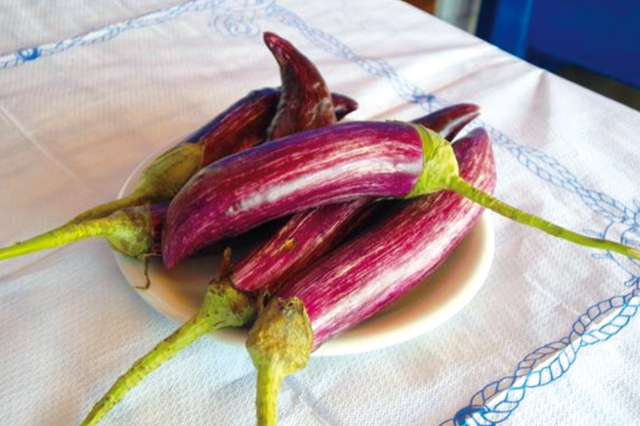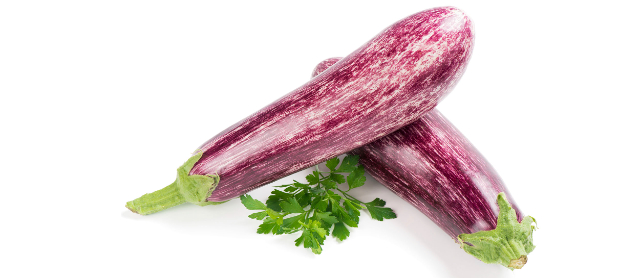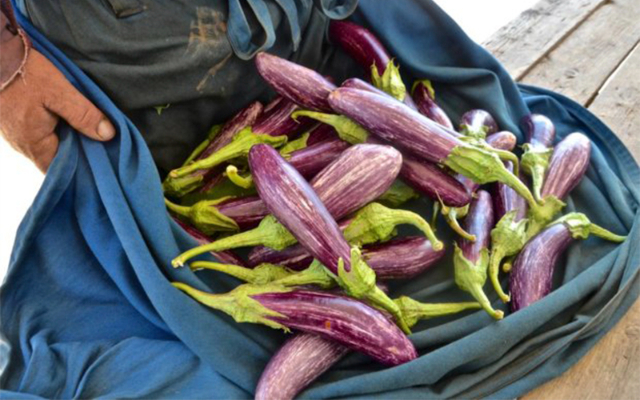

Slender and shiny with white stripes, the Tsakoniki eggplant (melitzana) grows only in the valley of Leonidio, a beautiful Peloponnesian town overlooking the Aegean Sea.Leonidio was once the capital of the Tsakonia region (from which the eggplant takes its name), which includes several villages where one of the world's oldest languages, an ancient Greek dialect dating back to the time of King Leonidas of Sparta, is still spoken.Unlike the dark purple eggplant with which most people are familiar, the Tsakoniki eggplant is thin; it grows to about 20-25 centimeters in length and 4-6 centimeters in diameter. In addition to its characteristic white stripes and horn-like end, it is also much sweeter and is used in a variety of summer dishes and desserts in Greece.According to Maria Lysikatou, president of the Tsakoniki Women's Cooperative in Leonidio, several eggplant varieties have appeared in recent years that resemble Tsakoniki but are not. The hallmarks of the Tsakoniki are the pointed end, the white stripes that blend into purple, and the glossy sheen, she says.According to Lysikatou, the famous Greek eggplant is known for its milder, sweeter flavor, "nourished" by Leonidio's microclimate and soil, as the village is situated between the sea and towering red limestone cliffs.In 1996, the European Union granted the Greek eggplant variety PDO (protected designation of origin) certification. Therefore, it is one of the main products of the Tsakonia area, generating income for hundreds of farmers in and around Leonidio."For us and for the region, the Tsakoniki eggplant is our pride and joy," Lysikatou says. "It promotes our homeland and is part of our heritage, with secrets and recipes passed down from generation to generation."This perennial plant is harvested in June and July, Lysikatou says, and again from September to November. The one-month break between the two harvests, he adds, is because the eggplant does not develop well in conditions of excessive heat, cold or humidity. Harvesting it in August, the hottest month of the year, could cause brown spots on the skin.Also, unlike the darker eggplant Solanum melongena, which requires soaking in water to remove bitterness before cooking, the Tsakoniki eggplant does not. This lack of bitterness makes it ideal for use in desserts. The most celebrated dessert in the Tsakonia region is melitzanaki, which literally means "small eggplant." The traditional dessert is prepared as "spoon sweet," which is a fruit or vegetable preserved in syrup served on a teaspoon.It may look simple to the eye, but preparing spoon sweet melitzanaki requires skill and perfect timing. To make the ultimate sweet, Lysikatou says, the eggplant must be harvested prematurely while still small and green, then peeled and prepared.Another great way to prepare Greek eggplant is to fry it, Lysikatou says. It is also cooked as part of a vegan stew or with meat (grilled or barbecued), as a dipping sauce, in sandwiches, on pizza, and as part of the famous papoutsaki, stuffed with ground meat and topped with bechamel sauce.