
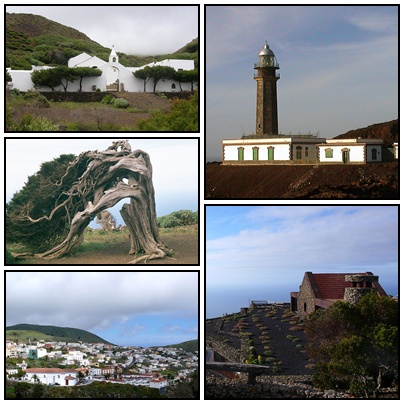

At almost a thousand meters above sea level, the edge of the cliff seems to dissolve into the void. Below, the Atlantic Ocean sparkles like a sheet of molten metal, unreachable and silent. The Mirador de La Peña, on the island of El Hierro in the Spanish Canary Islands, is one of those places where the perception of depth stops functioning normally: the drop between the observation point and the underlying coast exceeds 1,000 meters, and the eye struggles to believe what it sees.
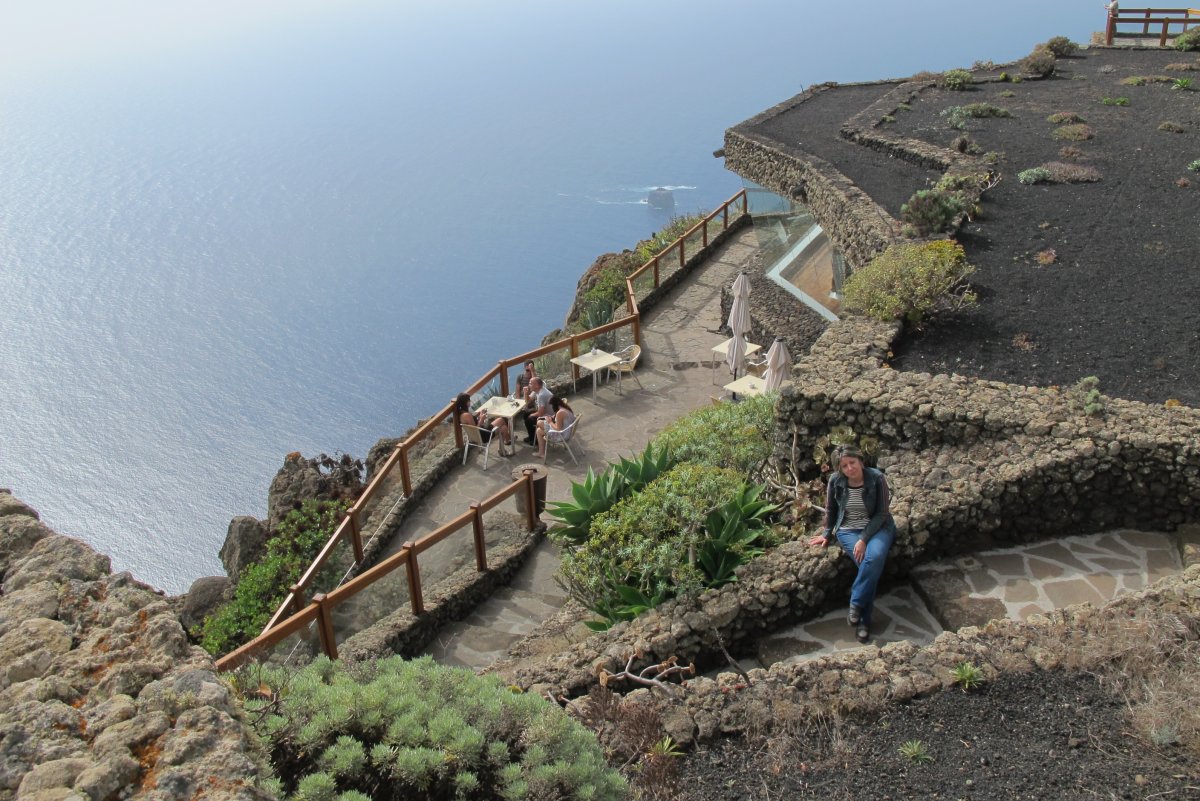
The viewpoint is not just a panoramic overlook: it is a work designed by the Canarian artist and architect César Manrique, a central figure in the history of architecture and landscape design in the Canary Islands. Manrique, born in Lanzarote in 1919 and passed away in 1992, is known for developing a style capable of integrating human structures into the volcanic landscape of the islands, without overpowering it. At La Peña, he left one of his most successful interventions: a restaurant-viewpoint that seems to grow from the rock itself, with open terraces, colorful ceramics, and organic shapes that engage with the black basalt of the caldera.
The landscape: colors and depth at every hour of the day
In the early morning, when the light is still oblique and golden, the Gulf of El Golfo — the large marine caldera that opens to the northwest of the island — appears like a natural theater. The rocky walls drop steeply towards a strip of green land and white houses, then further down to the sea. The dominant tones are the ochre of the rocks, the intense green of the terraced crops, and the deep blue of the ocean, which at certain moments almost shifts to purple towards the horizon.
In the afternoon, when the sun begins to descend towards the west, the colors change completely. The cliffs take on shades of orange and brick red, and the shadows cast by the edges of the caldera create sharp contrasts that make the landscape almost three-dimensional. The hour of sunset is probably the moment of maximum chromatic intensity: the sky above the Atlantic can change in a few minutes from yellow to bright pink, to dark purple, while the lights of the small village of La Frontera begin to turn on almost a thousand meters below.
Manrique's Architecture: Integration and Details to Observe
When visiting the Mirador de La Peña, it is worth pausing to observe the architectural details that Manrique has scattered throughout the structure. The hand-painted ceramics that decorate some of the internal surfaces of the restaurant are a typical element of his visual language, already visible in other of his interventions in Lanzarote such as the Jameos del Agua. The outdoor terraces are built to follow the natural profile of the rock, avoiding any element that interrupts the visual line downward.
The internal restaurant offers large windows that frame the landscape as if they were paintings. Even those who do not dine inside can access the external panoramic terraces, which remain the most frequented spot by visitors. From there, the circular structure of the caldera of El Golfo can be clearly seen, an ancient volcanic crater partially submerged by the ocean: a geological detail that makes the panorama even more unusual.
How to get there and when to visit
El Hierro can be reached by plane from Tenerife or Gran Canaria, with flights operated by regional companies such as Binter Canarias. The island's airport is located in the southern part, and from there the Mirador de La Peña can be reached by car in about 30-40 minutes, traveling along mountain roads with tight but well-paved curves. There is no regular public transport service to the viewpoint, so renting a car is practically essential.
The most useful practical advice is to arrive within the early hours of the morning or late afternoon, avoiding the central part of the day when tourist buses coming from inter-island ferries tend to concentrate in the parking lot. El Hierro is the least touristy island in the Canary archipelago, but the Mirador de La Peña remains its most visited attraction, and on weekends it can become crowded. The restaurant observes typical Spanish hours, closing in the early afternoon, so it is advisable to check the updated hours before planning a lunch stop.
El Hierro and the context of the island
Reaching the Mirador de La Peña means crossing a good part of the interior of El Hierro, an island declared Biosphere Reserve by UNESCO in 2000. The landscape traversed before reaching the viewpoint — laurisilva forests, fields of black lava, small almost deserted villages — prepares the gaze for something unusual. La Peña is not an isolated endpoint: it is the visual culmination of an island that has chosen to preserve its nature with a rare consistency in the Canary archipelago.
Standing on the edge of that terrace, with the wind rising from the caldera and the silence interrupted only by the occasional bird, is an experience difficult to categorize in a precise tourist category. It is not just a panorama, it is not just architecture. It is the concrete feeling of being on an island that ends abruptly, and beneath it, there is only ocean.


