
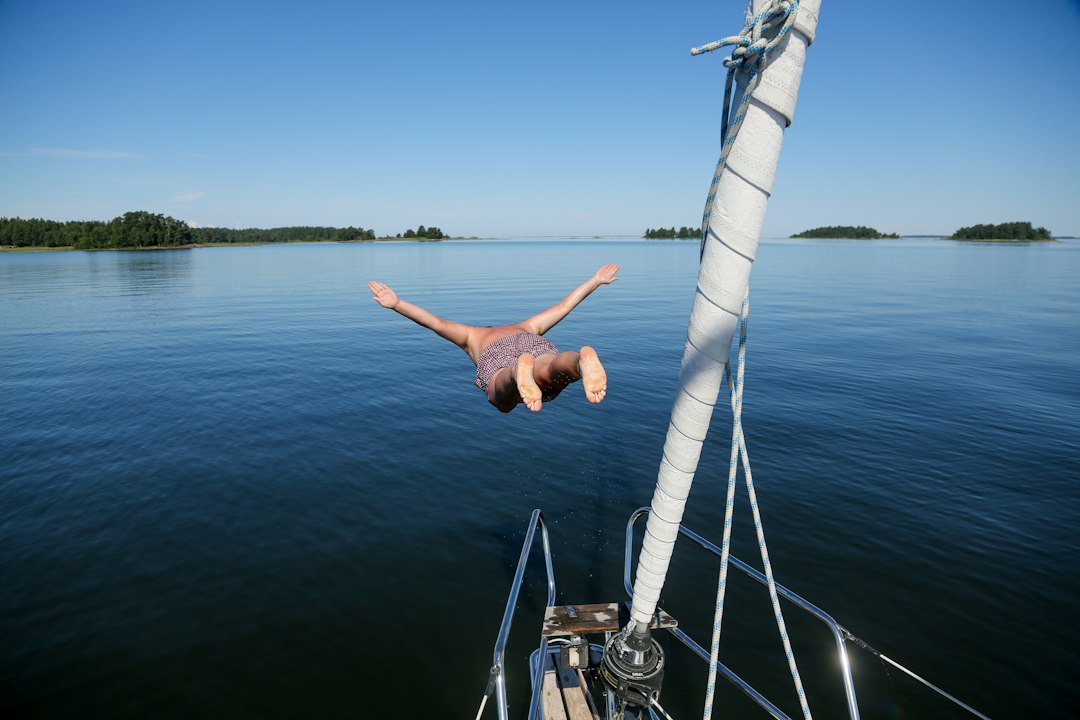

The water stretches to the horizon like an inland sea, gray and shining under the Scandinavian sky. Lake Vänern, with its 5,655 square kilometers of surface area, is the largest lake in Scandinavia and the third largest in Europe by area. Those who arrive on its shores for the first time find it hard to believe they are facing a lake: the opposite shore is not visible, waves form like in the open sea, and the wind carries with it a scent of fresh water and pine that is unlike anything else.

The city of Lidköping, on the southern shore of Vänern, is the ideal starting point to explore this extraordinary body of water. The historic center of the city features a square divided in two by a stream, the result of a curious urban planning story from the 17th century, when two distinct villages were united under a single administration. From here, the lake is reachable on foot in just a few minutes, and the piers already offer a first glimpse of what awaits those who venture onto the water.
The islands and the archipelago of Vänern

Vänern hosts over 22,000 islands and islets, many of which are covered by coniferous forests and inhabited only by waterfowl and a few families of fishermen. Kayaking among these islands is one of the most authentic experiences that the lake offers: the silence is almost absolute, broken only by the splashing of the paddles and the calls of the gray herons that watch over the low shores. Some larger islands, such as Kållandsö, are also accessible by car via bridges and local roads, and offer campsites, nature trails, and viewpoints over the open lake.
For those who prefer fishing, Vänern is renowned throughout Sweden for its populations of lake salmon, trout, and pike. The cold and deep waters — the lake reaches a maximum depth of about 106 meters — maintain ideal conditions for these species. Local guides organize fishing trips from spring to autumn, and even less experienced fishermen often manage to bring home a good catch.

The Läckö Castle and Viking Traces
On the peninsula of Kållandsö stands the Läckö Castle, one of the best-preserved medieval fortresses in Sweden. The current structure mainly dates back to the 17th century when Count Magnus Gabriel De la Gardie transformed it into a baroque residence of great magnificence, expanding it with towers, courtyards, and decorated interiors. The castle is open to visitors during the summer, with guided tours that allow entry into the frescoed halls and the opportunity to discover the history of the powerful lords who ruled this region. The entrance ticket costs around 130-150 Swedish crowns for adults, with reductions for children and families.

Near the lake, and particularly in the area of Husaby, there are ancient Viking graves and runes that testify to how central these lands were in Scandinavian medieval history. In Husaby, there is also the church where, according to tradition, King Olof Skötkonung was baptized around the year 1008, marking Sweden's conversion to Christianity. The original baptismal font is still visible inside the church.
When to go and how to organize the visit
The best time to visit Vänern is between June and August, when the days are long — the sun sets late, after 10:00 PM — and the water temperatures allow for some swimming in the more sheltered bays. During these months, tourist services are fully operational: kayak rentals, boat tours, fresh fish restaurants along the docks of Lidköping. Those who want to avoid the largest crowds can choose the weeks of June before midsummer, the summer solstice festival that takes place at the end of June and attracts many Swedish tourists.
To reach Lidköping, the most convenient solution is to rent a car from Gothenburg Landvetter Airport, which is about 90 kilometers away. There is also a train connection with a change at Herrljunga, but the travel time increases significantly. Once on site, it is advisable to dedicate at least three days to the area: one for Läckö Castle and the surroundings of Kållandsö, one for a kayak excursion among the islands, and one to explore Lidköping and its ceramics — the city is known for the Rörstrand manufacture, founded in 1726, which has produced some of the most famous porcelain in Sweden.
A lake to experience slowly
The Vänern is not a place to consume quickly. Its grandeur invites slowness, pauses, and observation. Sitting on a flat rock at dusk, watching the sun lower over the water while the cormorants return to the islands, is an experience that requires neither tickets nor reservations. It is simply there, available to anyone who arrives with the patience to wait.
Those seeking authentic Nordic landscapes, far from the more beaten paths, will find in Vänern and its region a Sweden still capable of surprising: silent, vast, and extraordinarily beautiful in its finest hours.


